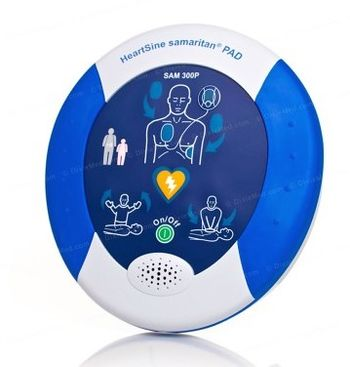
HeartSine Samaritan PAD AED
 HeartSine · Model Samaritan PAD AED
Durable - The Samaritan PAD is lighter (2.4 lbs.) and smaller than other defibrillators Portable and Lightweight- The Samaritan PAD 300P resists shock and vibration and carries an IP56 Rating, the industry’s highest rating against dust and water.
Key tips
- ·Never skip the daily/shift ready-check - a defibrillator found dead during a code is a real, repeated root-cause finding.
- ·Pads and batteries have real expiration dates - check them on every PM, not just at annual service.
- ·Verify energy-delivery accuracy with a real defibrillator analyzer, not just a self-test pass.
Typical Failure Modes
Compiled for this model from its own documentation and established engineering knowledge for this equipment class - not from a verified service record. Confirm against the manufacturer's service manual.
Fails the delivered-energy / discharge test
HighSymptoms: Delivered energy outside tolerance on the analyser, will not charge, or charges slowly.
Root cause: HV capacitor / charging-circuit ageing, or an output-relay fault.
Battery will not hold charge / fails readiness
HighSymptoms: Short standby, readiness indicator shows service, unit fails the self-test on battery.
Root cause: Aged battery pack or a charging fault.
Therapy cable / pads or paddles fault
MediumSymptoms: "Check pads", "connect electrodes", no ECG through pads, poor paceing capture.
Root cause: Worn therapy cable, expired pads, or a paddle / connector fault.
ECG / SpO2 / NIBP / CO2 parameter fault (defib-monitors)
MediumSymptoms: A monitoring parameter drops or is implausible.
Root cause: Patient cable / sensor or the parameter module.
Recorder / data fault
LowSymptoms: No printout, event data will not transfer.
Root cause: Thermal recorder or the data / Wi-Fi interface.
Serviceable Parts & Consumables
Serviceable items for this model, compiled from its documentation and engineering knowledge for this equipment class. Service class and relative cost are estimates, not manufacturer figures; no part numbers are given. Confirm intervals and pricing against the manufacturer.
Battery pack
Class Periodic replacementRel. cost $$R&R Easy
Therapy / defib cable
Class Periodic replacementRel. cost $$R&R Fairly easy
Multifunction pads
Class Frequent wear itemRel. cost $R&R Easy
HV / charging board
Class Major service partRel. cost $$$$R&R Difficult
Thermal recorder / print head
Class Periodic replacementRel. cost $$R&R Fairly easy
| Part | Service class | Relative cost | R&R difficulty |
|---|---|---|---|
| Battery pack | Periodic replacement | $$ | Easy |
| Therapy / defib cable | Periodic replacement | $$ | Fairly easy |
| Multifunction pads | Frequent wear item | $ | Easy |
| HV / charging board | Major service part | $$$$ | Difficult |
| Thermal recorder / print head | Periodic replacement | $$ | Fairly easy |
Relative cost: $ lowest · $$$$ highest service-part cost for this equipment class. Not a price.
PM Checklist
Preventive-maintenance tasks typical of this equipment class. Perform to the manufacturer's procedure and your facility's policy - this is general reference, not a schedule for this specific unit.
- ·Daily/shift visual and self-test check (AAMI EQ56 daily-ready standard)
- ·Battery and pad expiration-date tracking
- ·Energy-delivery accuracy test against a defibrillator analyzer
- ·Paddle/cable continuity check
- ·Annual full PM
Troubleshooting Approach
A starting sequence for this model, compiled from its documentation and engineering knowledge for this equipment class. Follow the manufacturer's service documentation for the actual procedure.
Symptom: Fails the discharge / energy test
- Run the full delivered-energy test at several settings with a defib analyser.
- Test synchronised cardioversion and, if fitted, pacing.
- Check the therapy cable and paddles.
- If energy is out of tolerance or charge time is long, remove from service.
- Refer the HV / charging board to the OEM.
Symptom: Fails readiness or dies on battery
- Fit a fully charged battery and repeat the self-test.
- Run a battery capacity test / calibration.
- Confirm the charger and charging contacts.
- Replace the battery pack when capacity is low.
- Log the readiness self-test result before returning to service.
Technical Specs
- Weight
- 2.4 lbs
- Defibrillator Type
- External, Automated (AED)
Typical Location
Where this class of equipment is typically deployed - general reference, not this unit's own placement record.
- Crash carts (every unit)
- Emergency Department
- ICU
- OR
- Code-blue response areas
Documents & Manuals
No documents available for this device yet.
Safety & Recalls
Synced live from the FDA openFDA API.
- RECALL
Due to a damaged (over stretched) membrane tail that causes an intermittent fault.
- RECALL
Due to customer complaints, defibrillator pads may contain damage pins that disrupt the mechanical fit and electrical contact.
- RECALL
Due to a component manufacturing issue, Automated External Defibrillator may not function properly (deliver shocks)
- RECALL
Automated external defibrillators have a manufacturing issue that could prevent the device from delivering instructional voice prompts to the user during use of the device. Visual instructional icons will still be present, but this issue could potentially lead to no therapy or a delay in therapy.
- RECALL
Automated external defibrillators were shipped in their test configuration so there is a potential to have incorrect language, and CPR duration resulting in the device prompting users to perform CPR for 5-seconds, and it could analyze heart rhythm and instruct users to deliver a shock every 5-seconds if a shockable heart rhythm is detected, potentially leading to no therapy or delayed therapy.
- RECALL
Single use battery and electrode cartridge may be rendered inoperable due to depleted battery cells which could prevent the defibrillator from analyzing patient condition or delivering therapy correctly.
- RECALL
Automated external defibrillators were potentially distributed with the incorrect language configuration, which can lead to a delay in therapy or no therapy.
- RECALL
A small number of sealed foil pouches containing the electrodes were found to be difficult to open, resulting in potential delay in therapy.
- RECALL
Certain Samaritan 300/300P PAD devices may experience one or both of the following conditions that could affect the ability to deliver therapy to a patient in an SCA event if needed: Issue 1 (On/Off Issue): the device may turn itself on and off without input from the user. When this occures, the normal sequence of audible instruction prompts that occurs when the device is turned on will be emit
- RECALL
Immediately after battery installation the devices announce a low battery fault warning and shut themselves off, or the service indicator icon starts blinking indicating a fault condition.
- RECALL
The affected Automatic External Defibrillators (AED) annouce a fault warning and shut themselves off before a shock can be delivered to the patient. This is reportedly due to slow capacitor charging rates which are interpreted by the AED software as a fault condition.
Troubleshoot this device with Bio
Describe a symptom or error code. Bio answers from this device's own documented error codes, failure modes, parts, and guides.
Ask Bio