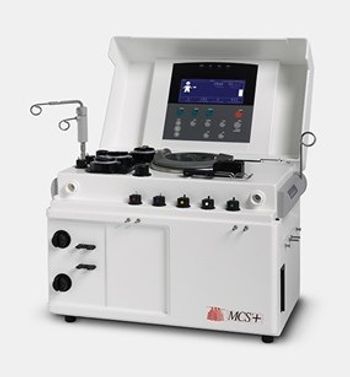
Haemonetics MCS+ LN 8150
 Haemonetics · Model MCS+ LN 8150
Enables the donor to give twice as much blood during one visit. Saves the collection agency the expense of performing two donor histories and two sets of tests. Allows the agency to improve its monitoring of existing inventory. Facilitates better planning for the future by matching donor potential with anticipated needs. Type O donors to request that they come to the center to help meet the need. Filters both units of red cells with one filter. Requires no sterile weld process. Is lightweight and easily transportable to collection sites at places of work, worship, or other community locations.
Key tips
- ·A no-signal/flatline alarm gets checked on the patient first, not the monitor - rule out a real clinical event before troubleshooting.
- ·Recalibrate NIBP against a reference manometer, not just a self-test pass.
- ·Reused patient cables (SpO2, ECG leads) are a common source of intermittent-fault complaints - swap the cable before the module.
Typical Failure Modes
Compiled for this model from its own documentation and established engineering knowledge for this equipment class - not from a verified service record. Confirm against the manufacturer's service manual.
Will not power on or unexpected shutdown
HighSymptoms: The patient monitoring is dead, reboots, or shuts down mid-use.
Root cause: Mains lead / fuse, an aged battery, or a power-supply board fault.
Battery will not hold charge
MediumSymptoms: Short run time on battery; low-battery alarm soon after a full charge.
Root cause: Aged rechargeable battery pack or a charger fault.
Display / control-panel fault
MediumSymptoms: Blank, dim or distorted display; unresponsive keys or touchscreen.
Root cause: Display, backlight, or control-board fault.
Fails self-test or calibration
MediumSymptoms: Power-on self-test or the scheduled performance check fails or is out of tolerance.
Root cause: Sensor drift or an internal board fault; recalibration or repair needed.
Serviceable Parts & Consumables
Serviceable items for this model, compiled from its documentation and engineering knowledge for this equipment class. Service class and relative cost are estimates, not manufacturer figures; no part numbers are given. Confirm intervals and pricing against the manufacturer.
Rechargeable battery pack
Class Periodic replacementRel. cost $$R&R Fairly easy
Power supply / mains board
Class Major service partRel. cost $$$R&R Difficult
Display / control-panel assembly
Class Major service partRel. cost $$$R&R Moderate
Cooling fan
Class Major service partRel. cost $R&R Moderate
| Part | Service class | Relative cost | R&R difficulty |
|---|---|---|---|
| Rechargeable battery pack | Periodic replacement | $$ | Fairly easy |
| Power supply / mains board | Major service part | $$$ | Difficult |
| Display / control-panel assembly | Major service part | $$$ | Moderate |
| Cooling fan | Major service part | $ | Moderate |
Relative cost: $ lowest · $$$$ highest service-part cost for this equipment class. Not a price.
PM Checklist
Preventive-maintenance tasks typical of this equipment class. Perform to the manufacturer's procedure and your facility's policy - this is general reference, not a schedule for this specific unit.
- ·Routine cable and lead-wire inspection for fraying/wear
- ·Battery conditioning cycle
- ·NIBP calibration check against a reference manometer
- ·ECG / SpO2 accuracy verification against a patient simulator
- ·Annual electrical safety test
Troubleshooting Approach
A starting sequence for this model, compiled from its documentation and engineering knowledge for this equipment class. Follow the manufacturer's service documentation for the actual procedure.
Symptom: Conductivity / temperature / dialysate-prep alarm / treatment will not start
- Confirm the concentrate is connected, correct and not empty.
- Verify dialysate conductivity and temperature with independent calibrated meters.
- Check / calibrate the conductivity cell and temperature sensor.
- Inspect the proportioning pumps / valves and de-air the hydraulics.
- Do not treat until conductivity and temperature are verified in range.
Symptom: Blood or dialysate pump fault / occlusion or flow alarm
- Inspect the pump rotor and rollers for wear and correct the occlusion setting.
- Reseat the tubing segment in the raceway.
- Check the pressure transducers and their protectors for wetting.
- Calibrate the pressure channels.
- Replace the rotor / rollers or a faulty sensor as isolated.
Symptom: Pressure / air-detector / blood-leak alarm implausible or not triggering
- Verify each pressure channel against a reference.
- Test the air detector and the blood-leak detector per the service procedure.
- Clean the blood-leak detector optics.
- Calibrate the channels.
- Replace a sensor that fails its functional test - these are safety systems.
Symptom: UF / balancing-chamber fault / disinfection will not complete
- Check the balancing-chamber diaphragm / valves and the flow sensors.
- Run the UF calibration.
- For disinfection, check the heater, the dosing / rinse valves and the residual test.
- Replace the balancing-chamber kit as isolated.
- Verify fluid balance and a clean residual test before clinical use.
Typical Location
Where this class of equipment is typically deployed - general reference, not this unit's own placement record.
- ICU / CCU
- Emergency Department
- OR / PACU
- General med-surg floors
- Step-down units
- Telemetry units
Documents & Manuals
Troubleshoot this device with Bio
Describe a symptom or error code. Bio answers from this device's own documented error codes, failure modes, parts, and guides.
Ask Bio