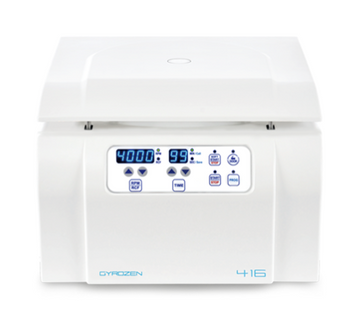
Gyrozen 416
 Gyrozen · Model 416
A separate button for "Soft" start/stop function to achieve very gentle acceleration and deceleration Furnished with unique air flow design and anti-vibration structure to minimize heat and noise generation Lid drop protection design allows easiness and safety when loading or unloading samples Automatic lid release and vivid end alarm for easy retrieval of sample A large assortment of rotors, buckets and adaptors for microtubes and all sizes of tubes up to 100 ml CE MDD-certified version also available (inquire)
Key tips
- ·Run QC controls before trusting any repair - an analyzer that passes self-test can still report clinically wrong results.
- ·Rule out a reagent lot change before opening the instrument - it can look exactly like a hardware fault.
- ·Centrifuge rotors have a hard retirement age/cycle limit regardless of visible condition - don't eyeball it.
Typical Failure Modes
Compiled for this model from its own documentation and established engineering knowledge for this equipment class - not from a verified service record. Confirm against the manufacturer's service manual.
Will not start / error at start
HighSymptoms: Error code, run will not begin, or aborts.
Root cause: Set speed exceeds the rotor maximum, an imbalanced load, the lid / door not locked, an unapproved rotor, or a drive / control fault.
Will not reach speed / excessive noise or vibration
MediumSymptoms: Slow spin-up, rumble, or vibration.
Root cause: Load imbalance, worn drive / motor bearings, a worn drive coupling, or (older units) worn motor brushes.
Refrigeration not cooling
MediumSymptoms: Chamber will not reach set temperature.
Root cause: Compressor, condenser, or a sealed-system fault.
Lid / door will not open / lock
MediumSymptoms: Lid-lock error, will not open after a run, or will not lock to start.
Root cause: Lid-lock solenoid / switch fault, or a run still in progress.
Speed / temperature inaccurate
MediumSymptoms: RCF / RPM or chamber temperature does not match the setting.
Root cause: Tacho / speed-sensor or temperature-sensor drift.
Serviceable Parts & Consumables
Serviceable items for this model, compiled from its documentation and engineering knowledge for this equipment class. Service class and relative cost are estimates, not manufacturer figures; no part numbers are given. Confirm intervals and pricing against the manufacturer.
Drive / motor bearings & coupling
Class Major service partRel. cost $$$R&R Difficult
Lid-lock solenoid / switch
Class Major service partRel. cost $$R&R Moderate
Speed / temperature sensor
Class Major service partRel. cost $$R&R Moderate
Refrigeration components
Class Major service partRel. cost $$$$R&R Expert-level
Rotor / rotor O-rings
Log rotor use; retire per the manufacturer's rotor-life programme.
Class Major service partRel. cost $$$R&R Easy
| Part | Service class | Relative cost | R&R difficulty |
|---|---|---|---|
| Drive / motor bearings & coupling | Major service part | $$$ | Difficult |
| Lid-lock solenoid / switch | Major service part | $$ | Moderate |
| Speed / temperature sensor | Major service part | $$ | Moderate |
| Refrigeration components | Major service part | $$$$ | Expert-level |
| Rotor / rotor O-rings Log rotor use; retire per the manufacturer's rotor-life programme. | Major service part | $$$ | Easy |
Relative cost: $ lowest · $$$$ highest service-part cost for this equipment class. Not a price.
PM Checklist
Preventive-maintenance tasks typical of this equipment class. Perform to the manufacturer's procedure and your facility's policy - this is general reference, not a schedule for this specific unit.
- ·Daily QC controls run and reviewed
- ·Calibration verification per assay
- ·Routine cleaning and decontamination
- ·Scheduled reagent-path and pump-tubing maintenance
Error Codes
Extracted directly from this unit's own service manual.
E1RPM Sensor Error: Failure to reach to 200 rpm within 2 sec.
• Turn the power switch off.• Check RPM sensor and cable.• Test again to see if the problem is repaired. If the problem is not be fixed;• Replace the RPM sensor assy
E2Door Open Error: Door opens during operation
• Turn the power switch off.• Detach the front panel.• Test by Door button to see if the solenoid works.• Adjust the Door lock position. If the problem is not fixed;• Replace the Door Lock assy or,• Replace the solenoid assy and sensor
E3Motor Overheated: Detected internal temperature is higher than 110 ℃
• Clean the ventilation inlet opening or remove any objects blocking inside.• Turn the power switch off and wait about 1 hour with the door opened for cooling down the motor.• Test again to see if the problem remains. If the problem is not fixed;• Replace the motor
E4Under voltage: Supply voltage to Motor is lower than required.
• Confirm the voltage under the Test mode.• Replace the motor.
E5Over voltage: Supply voltage to Motor is lower than allowed.
• Confirm the voltage under test mode.• Replace the motor.
E6Over speed: Actual rpm speed value is higher 1,000 rpm than set speed value
• Confirm the speed under test mode or by tachometer.• Upgrade the firmware If the problem is not fixed;• Replace the motor
E7Control system failure: Device does not work at all
• After power on, check if the beep sound issued.• Check if the Power LED on the main board is on. If some trouble of firmware is confirmed;• Update the firmware
E8Rotor Imbalance: Rotor is not balanced around its center of rotation (E8 is issued always during the operation)
• Relocate instrument to a flat, level, and vibration free surface.• Make sure that samples are evenly weighted and distributed symmetrically around the center of rotation.• Make sure the rotor and/or rotor lid is securely attached to the shaft.• Test 1st time with imbalance distance between 170 and 200 and with imbalance range of 10.• Test 2nd time with imbalance range more than 10. If E8 error is issued on 1st and not on 2nd test;• Imbalance sensor works normally.• Set the distance and range with the original value at the time of production.
E9RPM sensor error: Rotor is not recognized and RPM data is lost.
• Install the rotor as instructed in the manual• Make sure that rotor is aligned correctly.• Replace the rotor with correct one.• Check if RPM value on the display If RPM value does not vary;• Replace RPM sensor with normal one.
E15Motor Temperature error: Temperature of Motor goes too high
• Measure the resistance value of temperature sensor.• Check if the value falls on 10,000Ω(10kΩ) at 25℃. If Temperature sensor is not normal;• Replace the sensor with normal one.
Troubleshooting Approach
A starting sequence for this model, compiled from its documentation and engineering knowledge for this equipment class. Follow the manufacturer's service documentation for the actual procedure.
Symptom: Will not start / error at start
- Confirm the set speed does not exceed the fitted rotor's maximum and the rotor is approved and correctly seated.
- Rebalance the load - opposing positions evenly loaded.
- Confirm the lid / door latches and locks.
- Look the fault code up in the manual and follow the remedy.
- Functional-check after any repair.
Symptom: Will not reach speed / noisy
- Rebalance the load.
- Spin the rotor by hand and feel for bearing roughness.
- Inspect the drive coupling and, on older units, the motor brushes.
- Replace the worn component.
- Verify speed with a tachometer and confirm smooth running.
Typical Location
Where this class of equipment is typically deployed - general reference, not this unit's own placement record.
- Central / core laboratory
- Point-of-care testing stations
- Blood bank
- Microbiology lab
Documents & Manuals
Related calculators
From BioLab, for work done with this kind of equipment.
Troubleshoot this device with Bio
Describe a symptom or error code. Bio answers from this device's own documented error codes, failure modes, parts, and guides.
Ask Bio