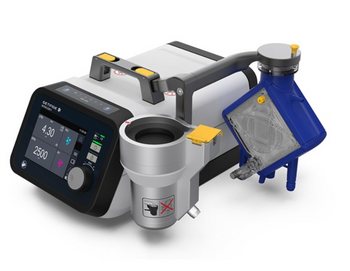
Getinge Rotaflow II
 Getinge · Model Rotaflow II
The user interface, with familiar elements, is easy-to-use and intuitive to operate. A simplified user interface is more user-friendly and can shorten the learning curve, for a safe use of the system. Supporting features such as a step by step priming wizard guides and assists during the setup of the device, the connection and priming of the PLS Set as well as a functional test, if required The advanced alarm management with supplementary information and guided assistance supports you in better troubleshooting and patient management. The hot-plug capability of the new Rotaflow Drive ensures immediate exchange during operation Color-coded parts help the user to immediately recognize where to operate the device. As well as a new plug connection, it also helps to avoid confusion with old drive versions Use of external flow bubble and bubble sensors Electrical interface for transmission of alarms to an external system e. g. nurse call Ethernet network connection and serial interface RS232 for transmission of application and device data to external systems.
Typical Failure Modes
Compiled for this model from its own documentation and established engineering knowledge for this equipment class - not from a verified service record. Confirm against the manufacturer's service manual.
Pump head will not spin / speed error
HighSymptoms: Centrifugal pump does not turn or does not reach set RPM, drive alarm.
Root cause: PLS pump set not fully engaged in the drive, a magnetic-coupling / bearing fault, or a drive-motor fault.
Flow reading inaccurate or absent
HighSymptoms: Displayed flow implausible or dashed, flow-probe alarm.
Root cause: Ultrasonic flow probe not clipped correctly, air/coupling gel issue, or a probe fault.
Battery will not hold charge
MediumSymptoms: Short run time on battery, battery alarm, will not calibrate.
Root cause: Aged user-replaceable battery - the system supports end-user battery calibration and replacement.
Emergency-mode / hand-crank fault
HighSymptoms: Emergency drive or hand crank does not maintain pump speed on power loss.
Root cause: Emergency drive coupling or the hand-crank mechanism.
Holder / release-mechanism fault
LowSymptoms: Compact holder will not lock the drive or release it for transport.
Root cause: Worn holder latch / release.
Serviceable Parts & Consumables
Serviceable items for this model, compiled from its documentation and engineering knowledge for this equipment class. Service class and relative cost are estimates, not manufacturer figures; no part numbers are given. Confirm intervals and pricing against the manufacturer.
User-replaceable battery
Calibrate after replacement per the manual.
Class Periodic replacementRel. cost $$R&R Easy
Ultrasonic flow probe
Class Periodic replacementRel. cost $$$R&R Fairly easy
Disposable PLS centrifugal pump set
Class ConsumableRel. cost $$R&R Easy
Drive unit (motor / coupling)
Class Major service partRel. cost $$$$R&R Difficult
Compact holder latch / release
Class Major service partRel. cost $$R&R Moderate
| Part | Service class | Relative cost | R&R difficulty |
|---|---|---|---|
| User-replaceable battery Calibrate after replacement per the manual. | Periodic replacement | $$ | Easy |
| Ultrasonic flow probe | Periodic replacement | $$$ | Fairly easy |
| Disposable PLS centrifugal pump set | Consumable | $$ | Easy |
| Drive unit (motor / coupling) | Major service part | $$$$ | Difficult |
| Compact holder latch / release | Major service part | $$ | Moderate |
Relative cost: $ lowest · $$$$ highest service-part cost for this equipment class. Not a price.
Troubleshooting Approach
A starting sequence for this model, compiled from its documentation and engineering knowledge for this equipment class. Follow the manufacturer's service documentation for the actual procedure.
Symptom: Pump will not spin / speed error
- Confirm the PLS pump set is fully seated and locked in the drive.
- Follow the priming wizard and check for a mechanical bind in the set.
- Check the emergency-mode buttons and hand crank operate.
- Move the set to a spare drive if available to isolate drive vs set.
- Escalate a confirmed drive-motor / coupling fault to Getinge.
Symptom: Flow value wrong or missing
- Re-clip the ultrasonic flow probe on the correct tubing segment with coupling as specified.
- Check for air at the probe site.
- Compare against expected flow for the RPM and circuit.
- Swap in a known-good flow probe.
- Recalibrate or replace the probe per the manual.