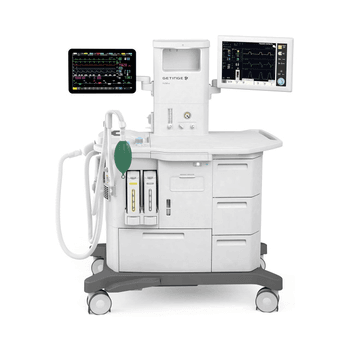
Getinge Flow-e
 Getinge · Model Flow-e
Well-designed drawers take care of your space and storage needs. There are also for spare vaporizers and an optional lockable compartment An unmatched length of stepless rails enables you to add all the monitors and accessories you need. O‚Guard Active hypoxia prevention O2Guard is the world’s only system for active hypoxia prevention. Should the inspired oxygen level drop below 21%, the O2Guard automatically overrules the settings and increases the flow of oxygen. Gentle steps against atelectasis Lung recruitment maneuvers have become the tool of choice to counter atelectasis, to improve oxygenation and help prevent postoperative complications.
Key tips
- ·A failed daily leak test takes the machine out of service immediately - there is no acceptable workaround.
- ·Never run an agent-specific vaporizer with the wrong agent, even briefly, during testing.
- ·CO2-absorbent exhaustion mimics several unrelated fault symptoms - rule it out early.
Typical Failure Modes
Compiled for this model from its own documentation and established engineering knowledge for this equipment class - not from a verified service record. Confirm against the manufacturer's service manual.
Fails the pre-use leak / machine check
HighSymptoms: Low-pressure or circle-system leak test fails, machine not ready for use.
Root cause: Breathing-circuit / absorber leak, a worn APL valve or bag arm, a CO2-absorber canister seal, or a vaporiser back-bar leak.
Ventilator / bellows or piston fault
HighSymptoms: Set tidal volume not delivered, bellows will not fill or hangs up, piston fault, PEEP not held.
Root cause: Bellows leak, a drive-gas valve fault, a flow-sensor fault, or a piston-seal fault.
O2 flowmeter / hypoxic-guard fault
MediumSymptoms: O2 flow not matching the setting, flowmeter float sticking, hypoxic-guard / ratio fault, no O2 flush.
Root cause: Worn flowmeter (rotameter), a hypoxic-guard link fault, or a flush-valve fault.
Vaporiser fault
MediumSymptoms: Agent output does not match the dial, back-bar leak, dial stiff.
Root cause: Vaporiser seating / O-ring, or an internal vaporiser fault (calibrate at an authorised centre).
Gas-supply / pipeline / O2-failure alarm
MediumSymptoms: O2-failure whistle / alarm, anti-hypoxia device cuts N2O, pipeline-pressure fault.
Root cause: Loss of pipeline / cylinder pressure, or a pressure-sensor fault.
Scavenging (AGSS) fault
LowSymptoms: Waste-gas scavenging alarm or not evacuating, theatre pollution.
Root cause: Scavenging flow / connection or a receiver-valve fault.
Serviceable Parts & Consumables
Serviceable items for this model, compiled from its documentation and engineering knowledge for this equipment class. Service class and relative cost are estimates, not manufacturer figures; no part numbers are given. Confirm intervals and pricing against the manufacturer.
APL valve / breathing-system gaskets & seals
Class Periodic replacementRel. cost $$R&R Fairly easy
CO2 absorbent / canister seals
Class ConsumableRel. cost $R&R Easy
Ventilator bellows / piston seal
Class Major service partRel. cost $$$R&R Difficult
Flow sensor(s)
Class Frequent wear itemRel. cost $$R&R Fairly easy
O2 flowmeter (rotameter)
Class Major service partRel. cost $$R&R Moderate
Vaporiser O-ring / back-bar seal
Class Periodic replacementRel. cost $R&R Fairly easy
| Part | Service class | Relative cost | R&R difficulty |
|---|---|---|---|
| APL valve / breathing-system gaskets & seals | Periodic replacement | $$ | Fairly easy |
| CO2 absorbent / canister seals | Consumable | $ | Easy |
| Ventilator bellows / piston seal | Major service part | $$$ | Difficult |
| Flow sensor(s) | Frequent wear item | $$ | Fairly easy |
| O2 flowmeter (rotameter) | Major service part | $$ | Moderate |
| Vaporiser O-ring / back-bar seal | Periodic replacement | $ | Fairly easy |
Relative cost: $ lowest · $$$$ highest service-part cost for this equipment class. Not a price.
PM Checklist
Preventive-maintenance tasks typical of this equipment class. Perform to the manufacturer's procedure and your facility's policy - this is general reference, not a schedule for this specific unit.
- ·Daily pre-anesthesia machine check: leak test, O2 sensor calibration, per facility protocol
- ·Scheduled vaporizer calibration and agent-specific service
- ·Absorber / CO2 canister replacement
- ·Breathing circuit and hose inspection
- ·Annual full PM and electrical safety test
Troubleshooting Approach
A starting sequence for this model, compiled from its documentation and engineering knowledge for this equipment class. Follow the manufacturer's service documentation for the actual procedure.
Symptom: Leak / machine check fails
- Run the check with the exact circuit and absorber.
- Reseat the CO2-absorber canister and check its seal; replace exhausted absorbent.
- Inspect the breathing-system gaskets, bag arm and APL valve.
- Check each vaporiser is seated with an intact O-ring.
- Re-run the check; escalate an internal leak that cannot be localised.
Symptom: Ventilator not delivering set volume
- Verify tidal volume with a calibrated gas-flow analyser.
- Inspect the bellows / piston and its seal for leaks.
- Calibrate the flow sensors.
- Check the drive-gas valve and circuit compliance compensation.
- Replace the bellows / flow sensors as isolated and re-verify.
Typical Location
Where this class of equipment is typically deployed - general reference, not this unit's own placement record.
- Operating rooms
- Procedure / endoscopy suites requiring sedation
- Obstetric delivery rooms
Documents & Manuals
No documents available for this device yet.
Troubleshoot this device with Bio
Describe a symptom or error code. Bio answers from this device's own documented error codes, failure modes, parts, and guides.
Ask Bio