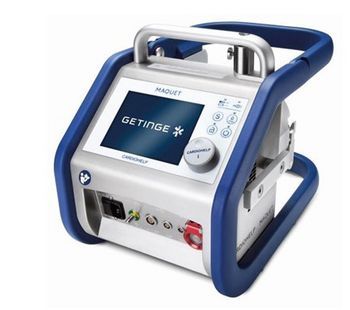
Getinge Cardiohelp System
 Getinge · Model Cardiohelp System
Secure installation in any ambulance and various helicopter types Integrated lithium-ion batteries provide at least 90 minutes of operating time when fully charged.
Key tips
- ·Never defeat or bypass a return-electrode monitoring (REM) alarm to finish a case - it's a direct burn risk.
- ·Verify OR table battery backup - a table that loses power mid-procedure is a real, documented incident type.
- ·Track surgical light lamp-hours rather than waiting for failure - a sudden failure mid-case is avoidable.
Typical Failure Modes
Compiled for this model from its own documentation and established engineering knowledge for this equipment class - not from a verified service record. Confirm against the manufacturer's service manual.
Roller / centrifugal pump fault
HighSymptoms: A pump will not run at set flow, speed unstable, occlusion out of adjustment, flow-probe error.
Root cause: Worn roller-pump raceway / rollers, a centrifugal drive-motor / coupling fault, or a flow-probe fault.
Console / control-module fault
HighSymptoms: A pump module unresponsive, display errors, module not recognised by the console.
Root cause: Module electronics or the console-to-module link.
Battery / UPS fault
HighSymptoms: Short back-up run time, will not transfer cleanly on a power interruption.
Root cause: Aged battery / UPS pack.
Pressure / level / bubble-monitoring fault
MediumSymptoms: Pressure, reservoir-level or bubble-detector alarms implausible or not triggering.
Root cause: Transducer, level-sensor, or bubble-detector fault.
Heater-cooler / temperature fault
MediumSymptoms: Blood / cardioplegia temperature not tracking, heater-cooler alarm, flow fault.
Root cause: Heater-cooler pump / refrigeration or a temperature-probe fault.
Serviceable Parts & Consumables
Serviceable items for this model, compiled from its documentation and engineering knowledge for this equipment class. Service class and relative cost are estimates, not manufacturer figures; no part numbers are given. Confirm intervals and pricing against the manufacturer.
Roller-pump raceway / roller kit
Class Periodic replacementRel. cost $$$R&R Difficult
Centrifugal drive motor / coupling
Class Major service partRel. cost $$$R&R Difficult
Battery / UPS pack
Class Periodic replacementRel. cost $$$R&R Moderate
Pressure / level / bubble sensors
Class Periodic replacementRel. cost $$R&R Moderate
Flow probe
Class Periodic replacementRel. cost $$R&R Fairly easy
| Part | Service class | Relative cost | R&R difficulty |
|---|---|---|---|
| Roller-pump raceway / roller kit | Periodic replacement | $$$ | Difficult |
| Centrifugal drive motor / coupling | Major service part | $$$ | Difficult |
| Battery / UPS pack | Periodic replacement | $$$ | Moderate |
| Pressure / level / bubble sensors | Periodic replacement | $$ | Moderate |
| Flow probe | Periodic replacement | $$ | Fairly easy |
Relative cost: $ lowest · $$$$ highest service-part cost for this equipment class. Not a price.
PM Checklist
Preventive-maintenance tasks typical of this equipment class. Perform to the manufacturer's procedure and your facility's policy - this is general reference, not a schedule for this specific unit.
- ·Pre-case functional check
- ·Electrosurgical return-electrode cable inspection
- ·Table hydraulic / mechanical inspection
- ·Annual electrical safety test and full PM
Troubleshooting Approach
A starting sequence for this model, compiled from its documentation and engineering knowledge for this equipment class. Follow the manufacturer's service documentation for the actual procedure.
Symptom: Pump will not run at set flow / speed unstable / flow-probe error
- Move the function to a spare pump module / mast position to isolate module from console.
- Check the roller occlusion setting and inspect the raceway / rollers (roller pumps).
- Check the centrifugal drive coupling and the flow probe.
- Verify flow against an independent flow probe.
- Replace the roller kit / drive components as isolated; a full functional check is required before clinical use.
Symptom: Console / control-module fault / module not recognised
- Reseat the module and try another console position.
- Restart the console per the OEM procedure.
- Check the console-to-module link.
- Swap a spare module in.
- Escalate a console fault to the OEM.
Symptom: Pressure / level / bubble-monitoring implausible or not triggering
- Verify each pressure channel against a reference.
- Test the level and bubble detectors per the service procedure.
- Reseat the sensor connectors and clean any optics.
- Calibrate the pressure channels.
- Replace a sensor that fails its functional test - these are safety systems.
Symptom: Battery / UPS short back-up time
- Run a battery / UPS test.
- Check the charger and connections.
- Replace the battery / UPS pack.
- Confirm a clean transfer on a simulated power interruption.
- Log the back-up run time.
Typical Location
Where this class of equipment is typically deployed - general reference, not this unit's own placement record.
- Operating rooms
- Procedure rooms
- Interventional suites
Documents & Manuals
Troubleshoot this device with Bio
Describe a symptom or error code. Bio answers from this device's own documented error codes, failure modes, parts, and guides.
Ask Bio