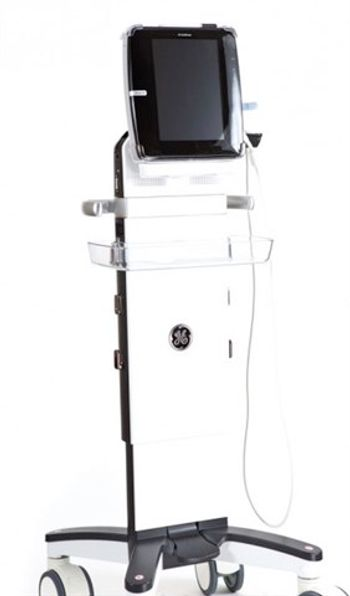
GE HealthCare Venue 40
 GE HealthCare · Model Venue 40
[u]High-resolution images for a high level of confidence[/u] Needle recognition supports vision in three key areas - needle, anatomy and motion - to help accurately reveal the structure of a needle within anatomy, without distortion. Precisely visualize your target and surrounding anatomy – all with defined edges and detail. Power Doppler Imaging (PDI) highlights vascular sensitivity for fine vascularity and low flow. PDI quantification for diagnosis and monitoring. PDI sensitivity helps verify the presence of blood flow to help detect small vessels, inflammation and disease states in adult and pediatric patients. Color and PDI quantification helps measure blood flow within a specific area to assist with diagnosis and monitoring. [u]Remarkably easy to use – regardless of the application[/u] Choose from three probes - always connected - for quick access to multiple exams. Work quickly with intuitive, pre-configured application settings. Perform exams easily with an intuitive touch interface. Respond fast with quick boot-up when time is critical. Enhance comfort and efficiency with adjustable height and screen. [u]Designed for easy cleaning[/u] Single-surface, splash-resistant screen has no seams, buttons, keyboard or a monitor frame to trap contaminants. Flush transducer connection helps to reduce the places germs can hide. Screen withstands medical disinfectants and everyday wear and tear. [u]Portability for better mobility - on the go[/u] Sleek, compact system wheels into tight spaces such as bedside or trauma bay. Universal docking system enables mounting to a cart or a table dock without tools for easy transfer while on battery. Quick-boot-up readies the system by the time gloves are put on Fast battery recharge minimizes downtime. Optional storage tray keeps supplies within reach for convenience. [u]Straightforward and flexible data management[/u] Easily record, archive, recall and transfer files, or print. Flexible archiving so users never have to leave images in the machine. Send images to the destination – PACS or EMR – even on battery and unplugged. Use the DVI port to display user screens on an external monitor. Get easy archiving with multiple file formats: JPEG and MP4 (one-minute loop capability). Save images to SD Card or USB drive for easy archiving. Transfer images on the spot with wired or wireless (optional) network connection. Store images and cine loops to a shared folder across the network for attachment to EMR. Store images to PACS and worklist with optional DICOM. Print on the go with optional black-and-white printer.
Intended use: [u]High-resolution images for a high level of confidence[/u] Needle recognition supports vision in three key areas—needle, anatomy and motion - to help accurately reveal the structure of a needle within anatomy, without distortion. Precisely visualize your target and surrounding anatomy – all with defined edges and detail. Power Doppler Imaging (PDI) highlights vascular sensitivity for fine vascularity and low flow. PDI quantification for diagnosis and monitoring. PDI sensitivity helps verify the presence of blood flow to help detect small vessels, inflammation and disease states in adult and pediatric patients. Color and PDI quantification helps measure blood flow within a specific area to assist with diagnosis and monitoring. [u]Remarkably easy to use – regardless of the application[/u] Choose from three probes - always connected - for quick access to multiple exams. Work quickly with intuitive, pre-configured application settings. Perform exams easily with an intuitive touch interface. Respond fast with quick boot-up when time is critical. Enhance comfort and efficiency with adjustable height and screen. [u]Designed for easy cleaning[/u] Single-surface, splash-resistant screen has no seams, buttons, keyboard or a monitor frame to trap contaminants. Flush transducer connection helps to reduce the places germs can hide. Screen withstands medical disinfectants and everyday wear and tear. [u]Portability for better mobility - on the go[/u] Sleek, compact system wheels into tight spaces such as bedside or trauma bay. Universal docking system enables mounting to a cart or a table dock without tools for easy transfer while on battery. Quick-boot-up readies the system by the time gloves are put on Fast battery recharge minimizes downtime. Optional storage tray keeps supplies within reach for convenience. [u]Straightforward and flexible data management[/u] Easily record, archive, recall and transfer files, or print. Flexible archiving so users never have to leave images in the machine. Send images to the destination – PACS or EMR – even on battery and unplugged. Use the DVI port to display user screens on an external monitor. Get easy archiving with multiple file formats: JPEG and MP4 (one-minute loop capability). Save images to SD Card or USB drive for easy archiving. Transfer images on the spot with wired or wireless (optional) network connection. Store images and cine loops to a shared folder across the network for attachment to EMR. Store images to PACS and worklist with optional DICOM. Print on the go with optional black-and-white printer.
Key tips
- ·Never bypass a radiation interlock to "just get the image" - this is one of the few true zero-tolerance rules in BMET work.
- ·Trend image-quality phantom results over time - drift shows up before an outright failure does.
- ·Portable/mobile units take real physical abuse from transport - check wheel locks and cable strain reliefs more often than fixed units.
Typical Failure Modes
Compiled for this model from its own documentation and established engineering knowledge for this equipment class - not from a verified service record. Confirm against the manufacturer's service manual.
Poor 2D image quality across multiple probes
HighSymptoms: Noisy, low-contrast or non-uniform image, missing sector, drop-out that follows the system not the probe.
Root cause: Front-end / beamformer board fault, a probe-port (connector) board fault, or a system-board fault.
Transducer not recognised / probe-port fault
MediumSymptoms: A probe works on one port but not another, or is not detected at all.
Root cause: Worn probe-port connector or a scan-connector board fault.
Will not boot / intermittent shutdown
HighSymptoms: Dead system, hangs at boot, or powers off under load.
Root cause: Power supply / DC converter, the system battery, or a system-board fault.
Control panel / touchscreen or monitor fault
MediumSymptoms: Unresponsive TGC sliders or keys, distorted or blank display.
Root cause: Control-panel board, touchscreen, or the monitor.
Overheating / loud cooling fan
LowSymptoms: Thermal-shutdown warning, fan roar, hot exhaust.
Root cause: Failed or dust-clogged cooling fan or blocked air path.
DICOM / network / storage fault
LowSymptoms: Studies will not send to PACS, images will not archive, worklist empty.
Root cause: Network configuration or a storage-drive fault.
Serviceable Parts & Consumables
Serviceable items for this model, compiled from its documentation and engineering knowledge for this equipment class. Service class and relative cost are estimates, not manufacturer figures; no part numbers are given. Confirm intervals and pricing against the manufacturer.
Front-end / beamformer board
Class Major service partRel. cost $$$$R&R Difficult
Probe-port / scan-connector board
Class Major service partRel. cost $$$R&R Difficult
Power supply / DC converter
Class Major service partRel. cost $$$R&R Difficult
Control-panel / touchscreen assembly
Class Major service partRel. cost $$$R&R Moderate
Cooling fan
Class Major service partRel. cost $R&R Moderate
System hard drive
Class Major service partRel. cost $$R&R Moderate
| Part | Service class | Relative cost | R&R difficulty |
|---|---|---|---|
| Front-end / beamformer board | Major service part | $$$$ | Difficult |
| Probe-port / scan-connector board | Major service part | $$$ | Difficult |
| Power supply / DC converter | Major service part | $$$ | Difficult |
| Control-panel / touchscreen assembly | Major service part | $$$ | Moderate |
| Cooling fan | Major service part | $ | Moderate |
| System hard drive | Major service part | $$ | Moderate |
Relative cost: $ lowest · $$$$ highest service-part cost for this equipment class. Not a price.
PM Checklist
Preventive-maintenance tasks typical of this equipment class. Perform to the manufacturer's procedure and your facility's policy - this is general reference, not a schedule for this specific unit.
- ·Daily QC per modality: image-quality phantom test
- ·Tube and detector inspection
- ·Annual state-required radiation safety survey
- ·Vendor-scheduled preventive maintenance
Troubleshooting Approach
A starting sequence for this model, compiled from its documentation and engineering knowledge for this equipment class. Follow the manufacturer's service documentation for the actual procedure.
Symptom: Poor image quality or a probe not recognised
- Try the probe on a second port and a known-good probe on the suspect port.
- Wipe off all gel, inspect the lens, and scan a phantom or your own forearm.
- Inspect the probe-port connectors for bent pins or debris.
- Run any built-in front-end / channel diagnostics.
- Replace the probe-port board or front-end board as isolated.
Symptom: Will not boot or shuts down
- Confirm mains and the on/off sequence per the manual.
- Check the power-supply / DC-converter outputs.
- Note any boot / POST beep or code.
- Reseat the system boards.
- Refer the power supply or system board as isolated.
Typical Location
Where this class of equipment is typically deployed - general reference, not this unit's own placement record.
- Radiology / Imaging department
- Emergency Department (portable units)
- Operating Room (C-arms)
- Cath lab
- Bedside ICU (portable X-ray)
Documents & Manuals
Troubleshoot this device with Bio
Describe a symptom or error code. Bio answers from this device's own documented error codes, failure modes, parts, and guides.
Ask Bio