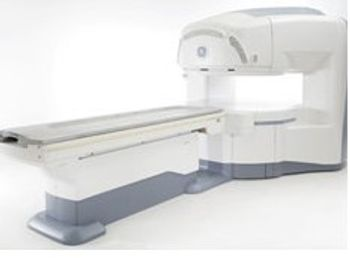
GE HealthCare Signa Ovation 0.35T
 GE HealthCare · Model Signa Ovation 0.35T
Real-time interactive imaging at 3.5 frames per sec Robust gradient system (19mT/m, maximum SR46T/m/sec) 2D slice thickness of 1.4mm - 20mm 3D slice thickness of 0.2mm - 20mm Open, patient-friendly design Maximum patient weight of 225 kg (500 lbs) 4 (8 quad channels) independent high bandwidth receivers Fastest pulse sequences in Open MRI Fastest reconstruction, up to 850 images/sec at 2562-FFs 65% faster post-processing powered by Linux OS.
Key tips
- ·Never bypass a radiation interlock to "just get the image" - this is one of the few true zero-tolerance rules in BMET work.
- ·Trend image-quality phantom results over time - drift shows up before an outright failure does.
- ·Portable/mobile units take real physical abuse from transport - check wheel locks and cable strain reliefs more often than fixed units.
Typical Failure Modes
Compiled for this model from its own documentation and established engineering knowledge for this equipment class - not from a verified service record. Confirm against the manufacturer's service manual.
RF coil fault / poor SNR
HighSymptoms: Low signal-to-noise, shading, or a dead region in images; coil not detected or fails the coil check.
Root cause: Damaged RF coil element, a coil-cable / connector fault, or a preamp fault.
Gradient fault / image distortion
HighSymptoms: Geometric distortion, gradient-amplifier faults, acoustic change, over-temperature trips.
Root cause: Gradient-amplifier fault, gradient-coil cooling problem, or a gradient-coil fault.
Cryogen / cold-head / compressor fault
HighSymptoms: Rising helium boil-off, cold-head noise or stall, He level dropping, compressor alarms.
Root cause: Cold-head at end of life, a helium-compressor fault, or a chilled-water problem.
Chilled water / cooling fault
MediumSymptoms: System-cooling alarms, gradient or RF over-temperature, scans aborting.
Root cause: Facility chilled-water supply, the heat exchanger, or internal pumps.
Patient table / positioning fault
MediumSymptoms: Table will not dock, drive or index; landmarking errors.
Root cause: Table drive, docking sensor, or encoder fault.
Reconstruction / host / network fault
MediumSymptoms: Recon errors, host hangs, images will not reach PACS.
Root cause: Recon or host computer fault, or the network / storage.
Serviceable Parts & Consumables
Serviceable items for this model, compiled from its documentation and engineering knowledge for this equipment class. Service class and relative cost are estimates, not manufacturer figures; no part numbers are given. Confirm intervals and pricing against the manufacturer.
RF receive coil (exchange)
Class Major service partRel. cost $$$$R&R Moderate
Cold head
Planned replacement; He boil-off rises as it wears.
Class Periodic replacementRel. cost $$$$R&R Difficult
Helium compressor / adsorber
Class Major service partRel. cost $$$$R&R Difficult
Gradient amplifier module
Class Major service partRel. cost $$$$R&R Expert-level
Chilled-water pump / heat exchanger
Class Major service partRel. cost $$$R&R Difficult
Patient table drive / encoder
Class Major service partRel. cost $$$R&R Difficult
| Part | Service class | Relative cost | R&R difficulty |
|---|---|---|---|
| RF receive coil (exchange) | Major service part | $$$$ | Moderate |
| Cold head Planned replacement; He boil-off rises as it wears. | Periodic replacement | $$$$ | Difficult |
| Helium compressor / adsorber | Major service part | $$$$ | Difficult |
| Gradient amplifier module | Major service part | $$$$ | Expert-level |
| Chilled-water pump / heat exchanger | Major service part | $$$ | Difficult |
| Patient table drive / encoder | Major service part | $$$ | Difficult |
Relative cost: $ lowest · $$$$ highest service-part cost for this equipment class. Not a price.
PM Checklist
Preventive-maintenance tasks typical of this equipment class. Perform to the manufacturer's procedure and your facility's policy - this is general reference, not a schedule for this specific unit.
- ·Daily QC per modality: image-quality phantom test
- ·Tube and detector inspection
- ·Annual state-required radiation safety survey
- ·Vendor-scheduled preventive maintenance
Troubleshooting Approach
A starting sequence for this model, compiled from its documentation and engineering knowledge for this equipment class. Follow the manufacturer's service documentation for the actual procedure.
Symptom: Poor SNR or a dead region with one coil
- Swap in a known-good coil of the same type and repeat the scan.
- Run the coil-check / coil-QA tool.
- Inspect the coil housing and cable for damage; reseat the connector.
- Scan the ACR / QA phantom and compare SNR to baseline.
- Quarantine and exchange the faulty coil.
Symptom: Rising helium boil-off or cold-head noise
- Log the helium level and boil-off trend daily.
- Check the cold-head sound and the compressor pressures against spec.
- Confirm the chilled-water supply temperature and flow.
- Schedule a cold-head / compressor service before the level reaches the OEM action point.
- Never let the magnet approach a quench threshold - escalate urgently.
Technical Specs
- Magnet Type
- Permanent
- Weight
- 19200 kg
- Clinical Use
- Whole Body
- Magnetic Field Strength
- 0.35 T
- Patient Weight Capacity
- 500 lbs
Typical Location
Where this class of equipment is typically deployed - general reference, not this unit's own placement record.
- Radiology / Imaging department
- Emergency Department (portable units)
- Operating Room (C-arms)
- Cath lab
- Bedside ICU (portable X-ray)
Documents & Manuals
No documents available for this device yet.
Safety & Recalls
Synced live from the FDA openFDA API.
- RECALL
GE Healthcare has become aware of a potential safety issue involving MRI systems due to software versions not being maintained properly at some sites.
Troubleshoot this device with Bio
Describe a symptom or error code. Bio answers from this device's own documented error codes, failure modes, parts, and guides.
Ask Bio