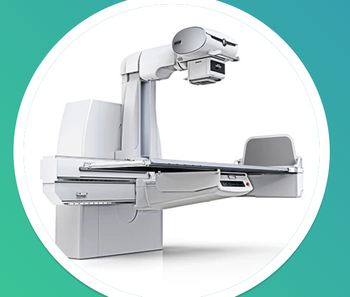
GE HealthCare Precision 180
 GE HealthCare · Model Precision 180
All about performance The Precision 180 can perform tomo, stitching, DSA, bariatric exams and conduct chest exams without extra equipment. All about Easy. Intuitive touchscreen user interface and AutoRF simplify exam set-up with fewer clicks and less need to physically move equipment. All about confidence. With the latest premium FPD low-dose technology, pediatric protocols, virtual radiation-free collimation and positioning and advanced apps, the Precision 180 is designed to deliver fast, high quality images that support quality care. Easy that excels. Combines ease of use, diagnostic confidence and multi use performance supported by inbuilt remote services.
Key tips
- ·Never bypass a radiation interlock to "just get the image" - this is one of the few true zero-tolerance rules in BMET work.
- ·Trend image-quality phantom results over time - drift shows up before an outright failure does.
- ·Portable/mobile units take real physical abuse from transport - check wheel locks and cable strain reliefs more often than fixed units.
Typical Failure Modes
Compiled for this model from its own documentation and established engineering knowledge for this equipment class - not from a verified service record. Confirm against the manufacturer's service manual.
Detector not connecting / dropped images
HighSymptoms: Panel not detected, images not received, wireless / tethered link drops mid-exam.
Root cause: Detector battery (wireless), Wi-Fi / tether cable, a docking / connector fault, or detector electronics.
Image quality / calibration fault
MediumSymptoms: Fixed-pattern artefacts, non-uniformity, dead pixels / lines, calibration overdue or failing.
Root cause: Detector gain / offset calibration, a bad pixel map, or physical detector (drop) damage.
Generator / exposure fault
HighSymptoms: Exposure inhibited, kV / mAs error, no exposure captured, AEC over/under.
Root cause: HV generator, tube, filament supply, or an AEC / interface fault.
Positioner / tube-stand / bucky fault
MediumSymptoms: Tube column, wall stand or table bucky will not track, detent, or auto-position.
Root cause: Drive motor, brake, encoder, or the auto-positioning interface.
Acquisition workstation / PACS fault
MediumSymptoms: Images will not display, process or send; worklist missing; slow processing.
Root cause: Workstation PC, software, or the DICOM / network configuration.
Serviceable Parts & Consumables
Serviceable items for this model, compiled from its documentation and engineering knowledge for this equipment class. Service class and relative cost are estimates, not manufacturer figures; no part numbers are given. Confirm intervals and pricing against the manufacturer.
Flat-panel detector (exchange)
Class Major service partRel. cost $$$$R&R Moderate
Detector battery (wireless)
Class Periodic replacementRel. cost $$R&R Easy
Tether cable / access point
Class Periodic replacementRel. cost $$R&R Fairly easy
Positioner drive / brake / encoder
Class Major service partRel. cost $$$R&R Difficult
Acquisition workstation PC
Class Major service partRel. cost $$$R&R Moderate
AEC ion chamber
Class Major service partRel. cost $$$R&R Difficult
| Part | Service class | Relative cost | R&R difficulty |
|---|---|---|---|
| Flat-panel detector (exchange) | Major service part | $$$$ | Moderate |
| Detector battery (wireless) | Periodic replacement | $$ | Easy |
| Tether cable / access point | Periodic replacement | $$ | Fairly easy |
| Positioner drive / brake / encoder | Major service part | $$$ | Difficult |
| Acquisition workstation PC | Major service part | $$$ | Moderate |
| AEC ion chamber | Major service part | $$$ | Difficult |
Relative cost: $ lowest · $$$$ highest service-part cost for this equipment class. Not a price.
PM Checklist
Preventive-maintenance tasks typical of this equipment class. Perform to the manufacturer's procedure and your facility's policy - this is general reference, not a schedule for this specific unit.
- ·Daily QC per modality: image-quality phantom test
- ·Tube and detector inspection
- ·Annual state-required radiation safety survey
- ·Vendor-scheduled preventive maintenance
Troubleshooting Approach
A starting sequence for this model, compiled from its documentation and engineering knowledge for this equipment class. Follow the manufacturer's service documentation for the actual procedure.
Symptom: Detector not connecting or images not arriving
- Check the detector battery (wireless) or reseat the tether.
- Confirm the Wi-Fi access point, channel and range.
- Reboot the detector and the acquisition workstation.
- Try a known-good detector if the site has one.
- Escalate a confirmed detector-electronics fault to the OEM.
Symptom: Fixed-pattern artefacts or failed calibration
- Run the detector gain / offset calibration and the dead-pixel map.
- Inspect the detector for drop / crush damage.
- Expose a uniform phantom and check uniformity.
- Confirm the generator and AEC are within spec with an analyser.
- Exchange the detector if calibration will not hold.
Typical Location
Where this class of equipment is typically deployed - general reference, not this unit's own placement record.
- Radiology / Imaging department
- Emergency Department (portable units)
- Operating Room (C-arms)
- Cath lab
- Bedside ICU (portable X-ray)
Documents & Manuals
No documents available for this device yet.
Safety & Recalls
Synced live from the FDA openFDA API.
- RECALL
The SFD/IDD safety mechanism may not engage properly at the lower range of SFD/IDD travel. This mechanism is installed to hold and prevent the SFD/IDD from falling due to a counterweight cable failure. The lower range of travel is 1.1 in (28mm) from the lowest point of normal SFD/IDD vertical compression. A fall of the SFD/IDD could result in an injury to a patient or operator.
- RECALL
A reported incident of a monitor that fell from the suspension. A fall of a monitor could result in an injury to a patient or operator. Recall affects the single and dual LCD monitor suspensions used on Precision 500D Classical R & F system, Precision RXi 23A/32A Analog System, Precision RXi Digital system and Precision MPi fluoroscopic imaging systems.
- RECALL
The Precision MPi collimator did not contain a label identifying the device as being certified to comply with applicable requirements of the x-ray performance standard.
- RECALL
The Precision RXi collimator did not contain a label identifying the device as being certified to comply with applicable requirements of the x-ray performance standard.
- RECALL
GE Healthcare was notified that 2 recently installed Precision 500D systems were not in compliance with portions of the Performance Standard for Diagnostic X-ray Equipment. X-ray production was possible from the fluoroscopic X-ray tube when the Primary Protective Barrier was not in position to intercept the X-ray beam. Users are recommended to follow good clinical standards to ensure the Image I
- RECALL
It was reported that when the GE Precision 500D foot pedal is repeatedly activated, a defect in the fluoro-timer will cause the dose measurement to report a higher value than was actually received by the patient. Patient will receive a lower dosage irradiation time which will result in indication of cumulative air kerma higher than that to which the patient was actually exposed.
- RECALL
Inaccurate cassette size display reading/ Inaccurate mAs reading: 1. When the device is in PBL mode and a larger film cassette is inserted into the table Bucky (replacing a smaller cassette) after a protocol is selected on the console, the collimator will not adjust to the larger cassette size. The collimator stays at the original smaller cassette size and allows the operator to take an exposure.
Troubleshoot this device with Bio
Describe a symptom or error code. Bio answers from this device's own documented error codes, failure modes, parts, and guides.
Ask Bio