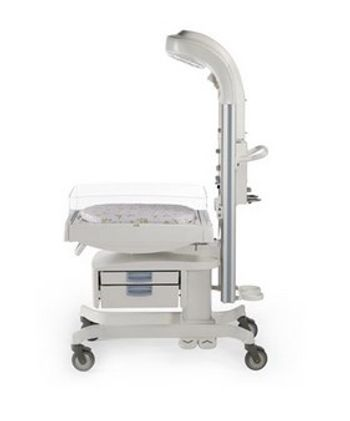
GE HealthCare Giraffe Warmer
 GE HealthCare · Model Giraffe Warmer
Keeps the baby warm and you cool & comfortable. Gives you easy access to your patients. An innovative recessed heater design provides access during procedures. Lets you warm up the bed without dealing with nuisance alarms. Turn Giraffe Warmer on well in advance so you know the bed will be warm when your patient arrives. Provides everything you need for resuscitation therapy. Integrated SPO2 and T-Piece Resuscitation Systems allow you to access everything you need to deliver resuscitation therapy to high-risk newborns. Lets you do your job without disturbing your patients. The patented Baby Susan* rotating mattress minimizes unnecessary baby stimulation. Gives you peace of mind with the support you need. The Giraffe Warmer is fully supported with optional multi-year service coverage, technical support, and additional education and training programs. Silence alarms without touching anything: The hands-free alarm silencing feature lets you easily control alarms by simply moving your hand in front of the sensor. Weigh your patients quick and easy: Weighing ill newborns can be a difficult procedure, but with our integrated in-bed scale option, you can weigh your patients at the bedside and easily chart daily weight trends. Adjust the lighting: With dimmable observation lights and an integrated procedure light, you always have the right lights for your patient no matter what situation arises. Monitor your patients with integrated, full-color display: A brilliant full-color display provides information about your patient in an easy-to-read format. In addition, full-color trends track your patients temperature, weight, SpO2, and pulse rate.
Key tips
- ·Never skip temperature-accuracy verification to save time - it's the one check that directly prevents burns.
- ·Hose/blanket connector wear is the most common real fault and the easiest to miss on a quick visual check.
Typical Failure Modes
Compiled for this model from its own documentation and established engineering knowledge for this equipment class - not from a verified service record. Confirm against the manufacturer's service manual.
Air- or radiant-heater control fault
HighSymptoms: Chamber / patient will not reach or hold the set temperature, temperature alarm, self-test / "Check" fault.
Root cause: Heater element / infrared rod, the air- or skin-temperature sensor, the fan (incubator), or a control-board fault.
Skin-temperature (servo) control fault
HighSymptoms: Servo mode does not regulate to the skin probe, deviation alarm, probe-fault alarm.
Root cause: Damaged skin temperature probe or its connector, or the servo-control circuit.
Alarm / audible / power-fail-alarm fault
MediumSymptoms: No or quiet audible alarm, alarm lamp does not light on the self-test.
Root cause: Buzzer / speaker or the alarm board - a safety-critical failure.
Humidity / airflow fault (incubator)
MediumSymptoms: Set humidity not reached, uneven chamber temperature, airflow alarm.
Root cause: Humidifier reservoir / heater, or a worn circulation fan / blocked air filter.
Mattress / weigh-scale / tilt / access-port fault
LowSymptoms: In-bed scale inaccurate, tilt mechanism stiff, port latches or iris sleeves worn.
Root cause: Load cell, tilt actuator, or worn access-port hardware.
Serviceable Parts & Consumables
Serviceable items for this model, compiled from its documentation and engineering knowledge for this equipment class. Service class and relative cost are estimates, not manufacturer figures; no part numbers are given. Confirm intervals and pricing against the manufacturer.
Air / skin temperature sensors
Class Frequent wear itemRel. cost $$R&R Fairly easy
Heater element / infrared rod
Class Major service partRel. cost $$R&R Difficult
Circulation fan (incubator)
Class Major service partRel. cost $$R&R Moderate
Humidifier heater / reservoir (incubator)
Class Periodic replacementRel. cost $$R&R Moderate
Buzzer / alarm board
Class Major service partRel. cost $R&R Moderate
| Part | Service class | Relative cost | R&R difficulty |
|---|---|---|---|
| Air / skin temperature sensors | Frequent wear item | $$ | Fairly easy |
| Heater element / infrared rod | Major service part | $$ | Difficult |
| Circulation fan (incubator) | Major service part | $$ | Moderate |
| Humidifier heater / reservoir (incubator) | Periodic replacement | $$ | Moderate |
| Buzzer / alarm board | Major service part | $ | Moderate |
Relative cost: $ lowest · $$$$ highest service-part cost for this equipment class. Not a price.
PM Checklist
Preventive-maintenance tasks typical of this equipment class. Perform to the manufacturer's procedure and your facility's policy - this is general reference, not a schedule for this specific unit.
- ·Hose / blanket connector inspection
- ·Temperature-accuracy verification
- ·Annual electrical safety test
Troubleshooting Approach
A starting sequence for this model, compiled from its documentation and engineering knowledge for this equipment class. Follow the manufacturer's service documentation for the actual procedure.
Symptom: Heater / temperature control fault
- Run the readiness / self-test and confirm the alarm lamp and buzzer.
- Set a target temperature and confirm the unit reaches it.
- Compare the chamber / skin temperature to an independent calibrated reference.
- Check the fan runs and the air filter is clean (incubator).
- Replace the temperature sensor, heater element or infrared rod as isolated.
Symptom: Servo / skin-probe fault
- Fit a known-good skin temperature probe with good skin contact.
- Check the probe connector and cable.
- Verify the servo regulates to the probe with a warm reference.
- Replace the probe.
- Refer the servo-control circuit for service if it still will not regulate.
Technical Specs
- Height
- 193 cm to 218 cm
- Weight
- 220 lbs
- Width
- 63.5 cm
Typical Location
Where this class of equipment is typically deployed - general reference, not this unit's own placement record.
- Operating Room
- PACU
- Emergency Department
- Labor & Delivery
- NICU
Documents & Manuals
No documents available for this device yet.
Safety & Recalls
Synced live from the FDA openFDA API.
- RECALL
Medical device adjustment knob may be loose and affect the accuracy of blended Air/Oxygen gas mixture to patients.
Troubleshoot this device with Bio
Describe a symptom or error code. Bio answers from this device's own documented error codes, failure modes, parts, and guides.
Ask Bio