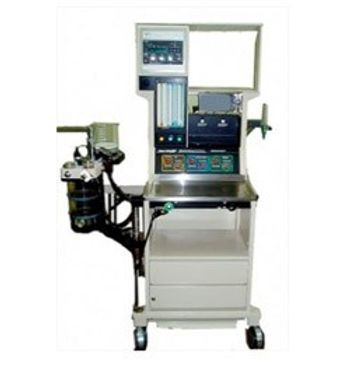
GE HealthCare Excel 210 SE
 GE HealthCare · Model Excel 210 SE
Key Features Supports 3 gas sources and 2 vaporizers Designed for powerful ventilation and monitoring in secondary anesthesia locations Compact frame ideal for space-constrained environments Integrated monitoring for oxygen (O‚), volume, and airway pressure Enclosed, non-interchangeable pneumatic circuitry for added safety Clearly differentiated pipeline and cylinder pressure gauges Master On/Off switch activates both electronic and pneumatic systems Link-25™ Hypoxic Mixture Guard System helps prevent delivery of hypoxic gas mixtures Pin-indexed, gas-specific dual O‚ and N‚O flowmeters Selectatec® vaporizer manifold accommodates two TEC 5 vaporizers Guarded oxygen flush button to reduce accidental activation Built-in oxygen power outlet Fixed shelving with additional space for patient monitoring equipment Two-drawer storage cabinet for accessories and supplies Single-action brake with integrated footrest Full-height dovetail accessory mounting system Large, smooth-rolling casters for easy mobility.
Key tips
- ·A failed daily leak test takes the machine out of service immediately - there is no acceptable workaround.
- ·Never run an agent-specific vaporizer with the wrong agent, even briefly, during testing.
- ·CO2-absorbent exhaustion mimics several unrelated fault symptoms - rule it out early.
Typical Failure Modes
Compiled for this model from its own documentation and established engineering knowledge for this equipment class - not from a verified service record. Confirm against the manufacturer's service manual.
Fails the pre-use check / leak test
HighSymptoms: Circuit leak test fails, self-test aborts, machine not released for use.
Root cause: Breathing-circuit / absorber leak, a worn bag-arm or APL valve, a CO2-absorber canister seal, or an internal pneumatic leak.
Ventilator: pressure / volume delivery fault
HighSymptoms: Set tidal volume or pressure not delivered, PEEP not held, ventilator alarm.
Root cause: Bellows / piston-drive fault, a flow-sensor fault, or an exhalation / drive-gas valve fault.
O2 / agent monitoring or delivery fault
HighSymptoms: FiO2 or agent value off vs a reference, hypoxic-guard alarm, agent not vaporising correctly.
Root cause: O2 sensor aging, a gas-analyser fault, a flowmeter / rotameter fault, or a vaporiser seating / back-bar leak.
Vacuum / AGSS (scavenging) fault
MediumSymptoms: Scavenging alarm, waste gas not evacuated.
Root cause: AGSS flow / connection or a receiver-valve fault.
Battery / power / display fault
MediumSymptoms: Short battery run time, blank or frozen display.
Root cause: Aged battery or a display / power-supply fault.
Serviceable Parts & Consumables
Serviceable items for this model, compiled from its documentation and engineering knowledge for this equipment class. Service class and relative cost are estimates, not manufacturer figures; no part numbers are given. Confirm intervals and pricing against the manufacturer.
Flow sensor(s)
Class Frequent wear itemRel. cost $$R&R Fairly easy
O2 sensor
Class Frequent wear itemRel. cost $$R&R Fairly easy
Bellows / drive assembly
Class Major service partRel. cost $$$R&R Difficult
APL valve / breathing-circuit gaskets
Class Periodic replacementRel. cost $$R&R Fairly easy
CO2 absorbent / canister seals
Class ConsumableRel. cost $R&R Easy
Battery pack
Class Periodic replacementRel. cost $$R&R Fairly easy
| Part | Service class | Relative cost | R&R difficulty |
|---|---|---|---|
| Flow sensor(s) | Frequent wear item | $$ | Fairly easy |
| O2 sensor | Frequent wear item | $$ | Fairly easy |
| Bellows / drive assembly | Major service part | $$$ | Difficult |
| APL valve / breathing-circuit gaskets | Periodic replacement | $$ | Fairly easy |
| CO2 absorbent / canister seals | Consumable | $ | Easy |
| Battery pack | Periodic replacement | $$ | Fairly easy |
Relative cost: $ lowest · $$$$ highest service-part cost for this equipment class. Not a price.
PM Checklist
Preventive-maintenance tasks typical of this equipment class. Perform to the manufacturer's procedure and your facility's policy - this is general reference, not a schedule for this specific unit.
- ·Daily pre-anesthesia machine check: leak test, O2 sensor calibration, per facility protocol
- ·Scheduled vaporizer calibration and agent-specific service
- ·Absorber / CO2 canister replacement
- ·Breathing circuit and hose inspection
- ·Annual full PM and electrical safety test
Troubleshooting Approach
A starting sequence for this model, compiled from its documentation and engineering knowledge for this equipment class. Follow the manufacturer's service documentation for the actual procedure.
Symptom: Pre-use check / leak test fails
- Run the machine's leak test with the exact circuit and absorber that will be used.
- Reseat the CO2-absorber canister and check its seal; replace exhausted absorbent.
- Inspect the breathing-circuit gaskets, the bag arm and the APL valve.
- Check each vaporiser is seated on the back bar with an intact O-ring.
- Fit a fresh flow sensor and re-run the test.
Symptom: Ventilator or FiO2 fault
- Verify FiO2 with a calibrated analyser at the common gas outlet / wye.
- Calibrate the O2 sensor.
- Check the bellows / drive for a leak or slow fill.
- Confirm the flow sensors read plausibly against a test lung.
- Escalate a confirmed drive / valve fault to the manufacturer.
Technical Specs
- Height
- 66 in
- Gases
- Air, Nitrous Oxide, Oxygen
- Length
- 27.5
- Vaporizers (Max)
- Two
- Scavenger
- Open or Closed Interface
- Weight
- 300 lbs
- Inspiratory Flow (max)
- 100 L/min
- Vaporizer Type
- Conventional pneumatic/mechanical
- Vent Modes
- CMV, Manual/Spontaneous.
- Width
- 22 in
Typical Location
Where this class of equipment is typically deployed - general reference, not this unit's own placement record.
- Operating rooms
- Procedure / endoscopy suites requiring sedation
- Obstetric delivery rooms
Documents & Manuals
Troubleshoot this device with Bio
Describe a symptom or error code. Bio answers from this device's own documented error codes, failure modes, parts, and guides.
Ask Bio