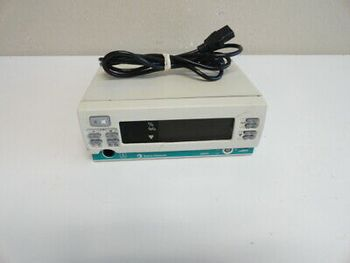
GE HealthCare Datex Ohmeda 3900
 GE HealthCare · Model Datex Ohmeda 3900
90-day warranty 110/ 220 volt compatible 60/ 50 Hz Excellent condition.
Key tips
- ·A no-signal/flatline alarm gets checked on the patient first, not the monitor - rule out a real clinical event before troubleshooting.
- ·Recalibrate NIBP against a reference manometer, not just a self-test pass.
- ·Reused patient cables (SpO2, ECG leads) are a common source of intermittent-fault complaints - swap the cable before the module.
Typical Failure Modes
Compiled for this model from its own documentation and established engineering knowledge for this equipment class - not from a verified service record. Confirm against the manufacturer's service manual.
No SpO2 / pulse reading or poor signal
HighSymptoms: No saturation / pulse value, "pulse search", low signal quality, implausible values.
Root cause: Worn or wrong SpO2 sensor, a damaged cable, poor site / perfusion, or motion.
Sensor / cable connector fault
MediumSymptoms: Reading drops when the cable is moved, sensor not recognised.
Root cause: Broken conductors in the sensor / extension cable, or a worn connector.
Inaccurate SpO2 vs a co-oximeter
MediumSymptoms: SpO2 consistently biased vs an arterial reference.
Root cause: Sensor degradation, or a monitor calibration / module fault.
Alarm / audio fault
MediumSymptoms: No or quiet audible alarm.
Root cause: Speaker or audio-board fault - a safety-critical failure.
Battery / power fault
MediumSymptoms: Short battery run time, will not power on.
Root cause: Aged battery.
Serviceable Parts & Consumables
Serviceable items for this model, compiled from its documentation and engineering knowledge for this equipment class. Service class and relative cost are estimates, not manufacturer figures; no part numbers are given. Confirm intervals and pricing against the manufacturer.
SpO2 sensor (reusable / disposable)
Class Frequent wear itemRel. cost $$R&R Easy
Pulse-oximetry extension cable
Class Frequent wear itemRel. cost $$R&R Easy
Battery
Class Periodic replacementRel. cost $$R&R Fairly easy
SpO2 module / board
Class Major service partRel. cost $$$R&R Moderate
Alarm speaker / audio board
Class Major service partRel. cost $$R&R Moderate
| Part | Service class | Relative cost | R&R difficulty |
|---|---|---|---|
| SpO2 sensor (reusable / disposable) | Frequent wear item | $$ | Easy |
| Pulse-oximetry extension cable | Frequent wear item | $$ | Easy |
| Battery | Periodic replacement | $$ | Fairly easy |
| SpO2 module / board | Major service part | $$$ | Moderate |
| Alarm speaker / audio board | Major service part | $$ | Moderate |
Relative cost: $ lowest · $$$$ highest service-part cost for this equipment class. Not a price.
PM Checklist
Preventive-maintenance tasks typical of this equipment class. Perform to the manufacturer's procedure and your facility's policy - this is general reference, not a schedule for this specific unit.
- ·Routine cable and lead-wire inspection for fraying/wear
- ·Battery conditioning cycle
- ·NIBP calibration check against a reference manometer
- ·ECG / SpO2 accuracy verification against a patient simulator
- ·Annual electrical safety test
Troubleshooting Approach
A starting sequence for this model, compiled from its documentation and engineering knowledge for this equipment class. Follow the manufacturer's service documentation for the actual procedure.
Symptom: No SpO2 or poor signal
- Fit a fresh, correct-size sensor on a well-perfused, still site.
- Swap the extension cable.
- Confirm the signal-quality / pleth indicator improves.
- Test the monitor with an SpO2 simulator.
- Replace the sensor / cable, or refer the monitor if the simulator also fails.
Symptom: Accuracy or alarm concern
- Compare SpO2 to a co-oximeter blood gas where clinically indicated.
- Try a known-good sensor.
- Verify against an SpO2 simulator at several saturations.
- Test the audible alarm at the set volume.
- Refer for module / audio service if it fails the simulator or alarm test.
Typical Location
Where this class of equipment is typically deployed - general reference, not this unit's own placement record.
- ICU / CCU
- Emergency Department
- OR / PACU
- General med-surg floors
- Step-down units
- Telemetry units
Documents & Manuals
No documents available for this device yet.
Safety & Recalls
Synced live from the FDA openFDA API.
- RECALL
Unintended shut-down: The anesthesia machine may start shutting down without human intervention due to a faulty On/Standby Switch. Prior to shutdown, the system will issue an alarm and play a message that shutdown will occur in 8 seconds. The failure only affects the electrical portion of the switch. If the clinician does not intervene, the patient could experience hypoventilation leading to h
- RECALL
GE Healthcare is providing information about two issues associated with iCentral L-NETO5 and L-NETC05 v4.3, 4.4, 4.5 and 5.0 when used in combination with Dash 2000, 3000, 4000 and 5000; Solar 7000, 8000, 8000M and 8000i; Eagle 3000 and 4000 and ApexPro. The iCentral does not provide audio or visual alarming for the following: A FIB, VT> and PVC(1) alarms when used with ApexPro and VT>2 and PVC
- RECALL
Issue 1 -Possible failure of CIC Pro audible alarms: Requests for telemetry defaults from Mobile Care Server could cause excessive CIC Pro memory consumption. This excessive memory consumption may lead to potential loss of audio at the CIC or a system reset or reboot. Issue 2 - Mobile Care software/Mobile Viewers don not recognize ApexPro FH Telemetry transmitter: Mobile Care server does not ac
- RECALL
There is a correction associated with Engstrom Carestation with an integrated Aerogen Professional Nebulizer System. There is an issue relating to the removal of the nebulizer cable from nebulizer connection port, which, when done while the nebulizer is active, may result in the discontinuance of mechanical ventilation. This issue affects all of the Engstrm Carestations shipped between 12/4/2006
- RECALL
Alarm sound-It is possible that the audible alarms from the speaker from the Datex-Ohmeda S/5 Anesthesia Delivery Unit (ADU) machine may dampen or disappear as a result of normal handling of the anesthesia machine. Visual alarms on the ADU are unaffected by this condition. The dampening or absence of audible alarms on the ADU may result in a delay in treatment.
Troubleshoot this device with Bio
Describe a symptom or error code. Bio answers from this device's own documented error codes, failure modes, parts, and guides.
Ask Bio