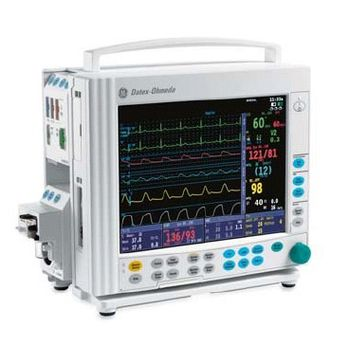
GE HealthCare Compact Anesthesia Monitor
 GE HealthCare · Model Compact Anesthesia Monitor
Modular, Flexible & Easy to Use Intuitive user interface provides comprehensive patient monitoring information at a glance Supports a wide variety of single-parameter and multiparameter modules for flexible monitoring Automatically adjusts the display layout to maximize the visibility of waveforms and numeric values Intelligent alarm system features preset alarm limits and dynamically adjusts alerts based on alarm duration, severity, and combinations of events Optional remote iTouch Pad provides quick, convenient access to monitor controls Versatility Throughout the Hospital Standardized GE parameter modules, connectors, and accessories support seamless patient transfers between care areas Optional E-PSM patient-side module travels with the patient to maintain monitoring continuity Ensures seamless data continuity through data cards, network connectivity, and iCentral Integrated wireless capability transforms virtually any bed into a monitored bed within seconds Built-in battery and carrying handle support monitored intra-hospital transport with multiple mounting options Device Interfacing Solution (DIS) integrates data from compatible patient care devices directly onto the monitor and hospital network Can operate as a standalone patient monitor or integrate with compatible ventilators using iDIS to combine ventilator and patient monitoring data on a single display.
Key tips
- ·A no-signal/flatline alarm gets checked on the patient first, not the monitor - rule out a real clinical event before troubleshooting.
- ·Recalibrate NIBP against a reference manometer, not just a self-test pass.
- ·Reused patient cables (SpO2, ECG leads) are a common source of intermittent-fault complaints - swap the cable before the module.
Typical Failure Modes
Compiled for this model from its own documentation and established engineering knowledge for this equipment class - not from a verified service record. Confirm against the manufacturer's service manual.
A parameter drops out or reads wrong
HighSymptoms: ECG, IBP, SpO2, temperature, CO2 or CO intermittently drops or is implausible.
Root cause: Worn patient cable / sensor, or a parameter-module / input-board fault.
NIBP will not measure or is inaccurate
MediumSymptoms: NIBP times out, cuff will not inflate / hold, readings implausible.
Root cause: Internal NIBP pump or valve, a cuff / hose leak, or a pressure-transducer fault.
Module / parameter not recognised
MediumSymptoms: The host does not display a plugged-in module or a built-in parameter.
Root cause: Docking / connector fault or an internal board fault.
Display / touchscreen fault
MediumSymptoms: Blank, dim or distorted display; unresponsive touchscreen.
Root cause: Display, backlight, or controller fault.
Battery / power fault
MediumSymptoms: Short battery run time, will not hold charge, will not power on.
Root cause: Aged battery pack or a power-supply fault.
Network / central-station connectivity fault
LowSymptoms: Monitor not shown at the central station, admit fails, intermittent drop.
Root cause: Wired / Wi-Fi network configuration or a communication board.
Serviceable Parts & Consumables
Serviceable items for this model, compiled from its documentation and engineering knowledge for this equipment class. Service class and relative cost are estimates, not manufacturer figures; no part numbers are given. Confirm intervals and pricing against the manufacturer.
Patient cable set (ECG / IBP / SpO2 / temp)
Class Frequent wear itemRel. cost $$R&R Easy
NIBP cuff and hose
Class Frequent wear itemRel. cost $R&R Easy
Internal NIBP pump / valve
Class Major service partRel. cost $$$R&R Difficult
Parameter module / input board
Class Major service partRel. cost $$$R&R Difficult
Battery pack
Class Periodic replacementRel. cost $$R&R Fairly easy
Display / touchscreen assembly
Class Major service partRel. cost $$$R&R Moderate
| Part | Service class | Relative cost | R&R difficulty |
|---|---|---|---|
| Patient cable set (ECG / IBP / SpO2 / temp) | Frequent wear item | $$ | Easy |
| NIBP cuff and hose | Frequent wear item | $ | Easy |
| Internal NIBP pump / valve | Major service part | $$$ | Difficult |
| Parameter module / input board | Major service part | $$$ | Difficult |
| Battery pack | Periodic replacement | $$ | Fairly easy |
| Display / touchscreen assembly | Major service part | $$$ | Moderate |
Relative cost: $ lowest · $$$$ highest service-part cost for this equipment class. Not a price.
PM Checklist
Preventive-maintenance tasks typical of this equipment class. Perform to the manufacturer's procedure and your facility's policy - this is general reference, not a schedule for this specific unit.
- ·Routine cable and lead-wire inspection for fraying/wear
- ·Battery conditioning cycle
- ·NIBP calibration check against a reference manometer
- ·ECG / SpO2 accuracy verification against a patient simulator
- ·Annual electrical safety test
Troubleshooting Approach
A starting sequence for this model, compiled from its documentation and engineering knowledge for this equipment class. Follow the manufacturer's service documentation for the actual procedure.
Symptom: A parameter drops out or reads wrong (ECG / IBP / SpO2 / temp / CO2 / CO)
- Reseat the patient cable at the module and at the monitor.
- Swap in a known-good cable / sensor for that parameter and re-test.
- Move the module to another host or slot to tell module from host.
- Inspect the module docking connector for bent or recessed pins.
- Verify against a patient simulator; replace the cable, or refer the parameter module / input board if the fault stays with it.
Symptom: NIBP will not measure or is inaccurate
- Leak-test the cuff and hose (occlude and watch for pressure decay).
- Run the monitor's NIBP calibration-verification against a calibrated manometer.
- Confirm correct cuff size and placement and check for a kinked hose.
- Verify against a NIBP simulator at several pressures.
- Refer the monitor for internal pump / valve service if it still fails.
Symptom: Blank / dim / frozen display or unresponsive touchscreen
- Power-cycle the monitor fully (mains removed, battery out where possible).
- Check the display backlight and the display / touchscreen cable.
- Note any boot or self-test error code.
- Re-calibrate the touchscreen if the touch offset is the issue.
- Replace the display / touchscreen assembly or refer the main board.
Symptom: Not shown at the central station / network dropout
- Confirm the wired drop or Wi-Fi settings and that other monitors on that segment are online.
- Check the monitor's network address / unit-bed assignment and re-admit.
- Reseat the network card / cable.
- Restart the monitor's network interface.
- Escalate a whole-unit outage to the central-station server / IT.
Technical Specs
- Height
- 340 mm
- Length
- 205 mm
- Power Requirements
- 100-240 VAC
- Weight
- 11 kg
- Width
- 335 mm
Typical Location
Where this class of equipment is typically deployed - general reference, not this unit's own placement record.
- ICU / CCU
- Emergency Department
- OR / PACU
- General med-surg floors
- Step-down units
- Telemetry units
Documents & Manuals
Safety & Recalls
Synced live from the FDA openFDA API.
- RECALL
Potential that one or more image series may be missing from an exam without a user warning displayed in the Viewer.
- RECALL
A potential safety issue due to loss of gas monitoring associated with occlusion of specific D-Fend / D-Fend+ water traps used with Compact Airway Modules E/M-C(Ai)O(V)(X) and Cardiocap/5 monitors. This water trap occlusion could cause a loss of respiratory airway gas monitoring.
- RECALL
Specific Aespire 7900 Anesthesia Machines have an increased likelihood of failure of the CPU circuit board. This could result in a blank display or loss of mechanical ventilation.
- RECALL
GE Healthcare has recently become aware of a potential risk of monitor dropping associated with the monitor suspension of the Advantx system that may impact patient safety. It has been reported that suspensions manufactured after March 8, 1995 did not have the required thread locking agent applied to the setscrew, allowing the setscrew to back out over time, which can lead to the monitor dropping
- RECALL
There exists the possibility that the ADU Fresh Gas Control unit (A-FGC1) can shut off during normal handling of the anesthesia machine and result in no anesthetic agent output.
- RECALL
In certain cases, one of the four collimator locking mechanisms that attach the collimator to the head may work itself free if collimator exchange has not been performed for an extended period of time. This situation, if neglected, could eventually cause the locking mechanism to unlock itself.
Troubleshoot this device with Bio
Describe a symptom or error code. Bio answers from this device's own documented error codes, failure modes, parts, and guides.
Ask Bio