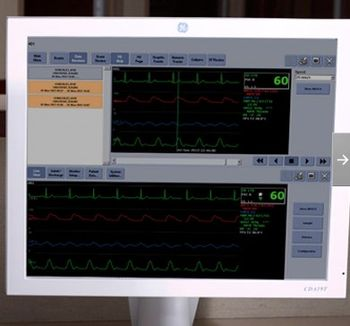
GE HealthCare CARESCAPE
 GE HealthCare · Model CARESCAPE
Admit - With a single button, patients can be easily admitted. Care notes - Write free-form care notes in the text box to communicate relevant patient information (e.g., allergy alert, nurse assignment, shift communication). Calipers - Calipers are used to electronically measure ECG waveforms, including the automatic calculation of QTc - helping to reduce measurement and calculation errors. Event review - Allows the clinician to select certain events from the patient’s history to build a specialized report. Strip report - Allows users to flag ECG strips for electronic reporting, eliminating manual paper strip cutting and gluing. These reports can be printed for the patient’s chart or sent as PDFs to the HIS/EMR or other third-party applications. Discharge - Discharging a patient from the monitoring device can easily be done with a single button.
Key tips
- ·A no-signal/flatline alarm gets checked on the patient first, not the monitor - rule out a real clinical event before troubleshooting.
- ·Recalibrate NIBP against a reference manometer, not just a self-test pass.
- ·Reused patient cables (SpO2, ECG leads) are a common source of intermittent-fault complaints - swap the cable before the module.
Typical Failure Modes
Compiled for this model from its own documentation and established engineering knowledge for this equipment class - not from a verified service record. Confirm against the manufacturer's service manual.
One or more telemetry transmitters drop / no waveform
HighSymptoms: A bed shows no ECG or dropped beats at the central station, noisy trace, frequent leads-off.
Root cause: Worn transmitter lead set, a weak transmitter battery, or antenna / receiver coverage.
Antenna / RF coverage fault
MediumSymptoms: Dropout in specific areas of the unit, multiple beds affected in one zone.
Root cause: Antenna cabling, a splitter / amplifier, or a receiver-module fault.
Central-station application / server fault
HighSymptoms: Central station hangs, will not admit, alarms not annunciating, display frozen.
Root cause: Central-station PC / server, the application, or the network link.
Printer / recorder fault
LowSymptoms: No strip on alarm or on demand.
Root cause: Central recorder / network printer fault.
Time / network sync fault
LowSymptoms: Timestamps wrong or drifting, full-disclosure gaps.
Root cause: Network time source or connectivity.
Serviceable Parts & Consumables
Serviceable items for this model, compiled from its documentation and engineering knowledge for this equipment class. Service class and relative cost are estimates, not manufacturer figures; no part numbers are given. Confirm intervals and pricing against the manufacturer.
Telemetry transmitter lead set
Class Frequent wear itemRel. cost $$R&R Easy
Transmitter battery (per pack)
Class ConsumableRel. cost $R&R Easy
Receiver module / antenna components
Class Major service partRel. cost $$$R&R Difficult
Central-station PC / server
Class Major service partRel. cost $$$$R&R Difficult
Network printer / recorder
Class Major service partRel. cost $$R&R Fairly easy
| Part | Service class | Relative cost | R&R difficulty |
|---|---|---|---|
| Telemetry transmitter lead set | Frequent wear item | $$ | Easy |
| Transmitter battery (per pack) | Consumable | $ | Easy |
| Receiver module / antenna components | Major service part | $$$ | Difficult |
| Central-station PC / server | Major service part | $$$$ | Difficult |
| Network printer / recorder | Major service part | $$ | Fairly easy |
Relative cost: $ lowest · $$$$ highest service-part cost for this equipment class. Not a price.
PM Checklist
Preventive-maintenance tasks typical of this equipment class. Perform to the manufacturer's procedure and your facility's policy - this is general reference, not a schedule for this specific unit.
- ·Routine cable and lead-wire inspection for fraying/wear
- ·Battery conditioning cycle
- ·NIBP calibration check against a reference manometer
- ·ECG / SpO2 accuracy verification against a patient simulator
- ·Annual electrical safety test
Troubleshooting Approach
A starting sequence for this model, compiled from its documentation and engineering knowledge for this equipment class. Follow the manufacturer's service documentation for the actual procedure.
Symptom: A telemetry bed drops or is noisy
- Fit a fresh transmitter battery and a known-good lead set.
- Re-prep the skin and re-site the electrodes.
- Confirm the bed is admitted to the correct transmitter.
- If a whole zone is affected, check the antenna / receiver for that area.
- Swap the transmitter to isolate transmitter vs infrastructure.
Symptom: Central station frozen or not alarming
- Confirm other clients / displays on the same server.
- Check the network link between the station and the antenna system.
- Restart the central-station application per the OEM procedure.
- Verify alarm audio and escalation settings.
- Escalate a server fault to the OEM / IT.
Typical Location
Where this class of equipment is typically deployed - general reference, not this unit's own placement record.
- ICU / CCU
- Emergency Department
- OR / PACU
- General med-surg floors
- Step-down units
- Telemetry units
Documents & Manuals
No documents available for this device yet.
Troubleshoot this device with Bio
Describe a symptom or error code. Bio answers from this device's own documented error codes, failure modes, parts, and guides.
Ask Bio