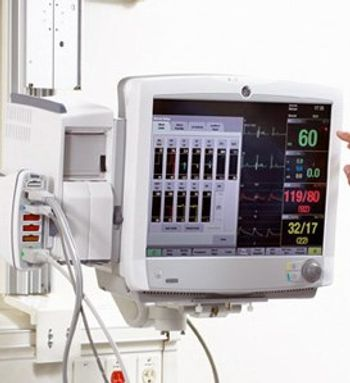
GE HealthCare Alarm Management
 GE HealthCare · Model Alarm Management
Smart Lead Fail - providing uninterrupted arrhythmia monitoring in the event of a disconnected lead. Telemetry Smart Alarms - helping to ensure uninterrupted monitoring. User-Configurable Alarm Priority Setting2 - allowing caregivers to tailor parameter and arrhythmia alarm priorities based on patient’s intrinsic rhythm and/or parameter value. Absolute Limits - prevents clinicians from adjusting parameter limits above and below what is considered a reasonable and safe range. Locking Alarms - prevent clinicians from turning a parameter limit alarm off. EK-Pro* Simultaneous Multi-lead Arrhythmia Detection. IntelliRate. DINAMAP SuperStat Non-invasive Blood Pressure. Pulse Oximetry.
Key tips
- ·A no-signal/flatline alarm gets checked on the patient first, not the monitor - rule out a real clinical event before troubleshooting.
- ·Recalibrate NIBP against a reference manometer, not just a self-test pass.
- ·Reused patient cables (SpO2, ECG leads) are a common source of intermittent-fault complaints - swap the cable before the module.
Typical Failure Modes
Failure patterns typical of this equipment class - general BMET reference, not verified against this exact unit's own service history unless flagged. Severity is a category-level estimate.
Will not power on or unexpected shutdown
HighSymptoms: The patient monitoring is dead, reboots, or shuts down mid-use.
Root cause: Mains lead / fuse, an aged battery, or a power-supply board fault.
Battery will not hold charge
MediumSymptoms: Short run time on battery; low-battery alarm soon after a full charge.
Root cause: Aged rechargeable battery pack or a charger fault.
Display / control-panel fault
MediumSymptoms: Blank, dim or distorted display; unresponsive keys or touchscreen.
Root cause: Display, backlight, or control-board fault.
Fails self-test or calibration
MediumSymptoms: Power-on self-test or the scheduled performance check fails or is out of tolerance.
Root cause: Sensor drift or an internal board fault; recalibration or repair needed.
Display / touch panel fault
LowSymptoms: Dim, flickering, or unresponsive screen.
Root cause: Backlight or digitizer failure.
Internal battery depletion
HighSymptoms: Short backup time, battery alarm on transport.
Root cause: Aged backup battery.
ECG lead-off / artifact
MediumSymptoms: Flat or noisy ECG, frequent lead-off alarms.
Root cause: Worn electrodes, loose leads, or dry gel.
SpO2 probe / sensor failure
MediumSymptoms: No pleth, SpO2 drops to --- or false low.
Root cause: LED/photodiode aging or cable damage.
Serviceable Parts & Consumables
The parts a BMET typically services on this class of equipment. Service class and relative cost are general engineering estimates for the category, not figures from this unit's documentation. Part numbers appear only when pulled from this unit's own service manual. Always confirm intervals and pricing against the manufacturer.
Rechargeable battery pack
Class Periodic replacementRel. cost $$R&R Fairly easy
Power supply / mains board
Class Major service partRel. cost $$$R&R Difficult
Display / control-panel assembly
Class Major service partRel. cost $$$R&R Moderate
Cooling fan
Class Major service partRel. cost $R&R Moderate
SpO2 sensor (adult/ped/neo)
Class Frequent wear itemRel. cost $$R&R Easy
NIBP cuff & hose
Consumable per patient.
Class Periodic replacementRel. cost $R&R Easy
Rechargeable backup battery
Class Periodic replacementRel. cost $$R&R Fairly easy
Display / touch assembly
Class Periodic replacementRel. cost $$$R&R Difficult
| Part | Service class | Relative cost | R&R difficulty |
|---|---|---|---|
| Rechargeable battery pack | Periodic replacement | $$ | Fairly easy |
| Power supply / mains board | Major service part | $$$ | Difficult |
| Display / control-panel assembly | Major service part | $$$ | Moderate |
| Cooling fan | Major service part | $ | Moderate |
| SpO2 sensor (adult/ped/neo) | Frequent wear item | $$ | Easy |
| NIBP cuff & hose Consumable per patient. | Periodic replacement | $ | Easy |
| Rechargeable backup battery | Periodic replacement | $$ | Fairly easy |
| Display / touch assembly | Periodic replacement | $$$ | Difficult |
Relative cost: $ lowest · $$$$ highest service-part cost for this equipment class. Not a price.
PM Checklist
Preventive-maintenance tasks typical of this equipment class. Perform to the manufacturer's procedure and your facility's policy - this is general reference, not a schedule for this specific unit.
- ·Routine cable and lead-wire inspection for fraying/wear
- ·Battery conditioning cycle
- ·NIBP calibration check against a reference manometer
- ·ECG / SpO2 accuracy verification against a patient simulator
- ·Annual electrical safety test
Troubleshooting Approach
A starting sequence for this model, compiled from its documentation and engineering knowledge for this equipment class. Follow the manufacturer's service documentation for the actual procedure.
Symptom: Will not power on
- Confirm the outlet, mains lead and fuse.
- Try on battery, then on mains only, to isolate the supply.
- Look for a power indicator or POST code.
- Replace the fuse / battery / power supply as isolated.
- Run the self-test after any repair.
Symptom: Fails self-test or calibration
- Note the exact failure message / code.
- Power-cycle and repeat the self-test.
- Verify against a reference / simulator where one applies.
- Recalibrate per the service manual.
- Refer the affected board for service if it will not hold calibration.
Typical Location
Where this class of equipment is typically deployed - general reference, not this unit's own placement record.
- ICU / CCU
- Emergency Department
- OR / PACU
- General med-surg floors
- Step-down units
- Telemetry units
Documents & Manuals
No documents available for this device yet.
Troubleshoot this device with Bio
Describe a symptom or error code. Bio answers from this device's own documented error codes, failure modes, parts, and guides.
Ask Bio