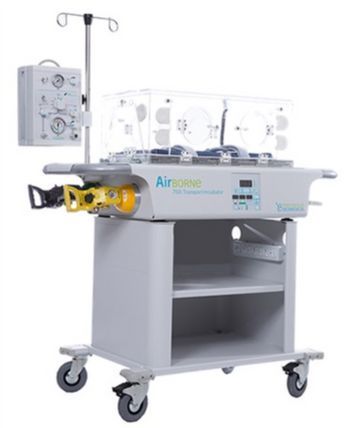
GE HealthCare Airborne 750i
 GE HealthCare · Model Airborne 750i
Double Wall Hood - Reduces radiant heat loss while providing total access with high visibility Internal Long Life Battery Adjustable, High-Intensity Exam Light - Improves visualization during transport Audible & Visual Alarms Lightweight - Easy to move by ground or air where weight is a critical factor Visible Temp Display & User-Friendly Controls Compact - Narrow enough to be mounted onto a stretcher and can be easily moved even in tight spaces by only one person IV Pole Large double-wall infant chamber with 360° visibility Head access door Front access door 2 hand ports 5 accessory ports for IV/respiratory tubing Slide out intubation tray and mattress High-intensity exam light Up to 5-hour battery life when transport time is critical.
Key tips
- ·Never skip temperature-accuracy verification to save time - it's the one check that directly prevents burns.
- ·Hose/blanket connector wear is the most common real fault and the easiest to miss on a quick visual check.
Typical Failure Modes
Compiled for this model from its own documentation and established engineering knowledge for this equipment class - not from a verified service record. Confirm against the manufacturer's service manual.
Air- or radiant-heater control fault
HighSymptoms: Chamber / patient will not reach or hold the set temperature, temperature alarm, self-test / "Check" fault.
Root cause: Heater element / infrared rod, the air- or skin-temperature sensor, the fan (incubator), or a control-board fault.
Skin-temperature (servo) control fault
HighSymptoms: Servo mode does not regulate to the skin probe, deviation alarm, probe-fault alarm.
Root cause: Damaged skin temperature probe or its connector, or the servo-control circuit.
Alarm / audible / power-fail-alarm fault
MediumSymptoms: No or quiet audible alarm, alarm lamp does not light on the self-test.
Root cause: Buzzer / speaker or the alarm board - a safety-critical failure.
Humidity / airflow fault (incubator)
MediumSymptoms: Set humidity not reached, uneven chamber temperature, airflow alarm.
Root cause: Humidifier reservoir / heater, or a worn circulation fan / blocked air filter.
Mattress / weigh-scale / tilt / access-port fault
LowSymptoms: In-bed scale inaccurate, tilt mechanism stiff, port latches or iris sleeves worn.
Root cause: Load cell, tilt actuator, or worn access-port hardware.
Serviceable Parts & Consumables
Serviceable items for this model, compiled from its documentation and engineering knowledge for this equipment class. Service class and relative cost are estimates, not manufacturer figures; no part numbers are given. Confirm intervals and pricing against the manufacturer.
Air / skin temperature sensors
Class Frequent wear itemRel. cost $$R&R Fairly easy
Heater element / infrared rod
Class Major service partRel. cost $$R&R Difficult
Circulation fan (incubator)
Class Major service partRel. cost $$R&R Moderate
Humidifier heater / reservoir (incubator)
Class Periodic replacementRel. cost $$R&R Moderate
Buzzer / alarm board
Class Major service partRel. cost $R&R Moderate
| Part | Service class | Relative cost | R&R difficulty |
|---|---|---|---|
| Air / skin temperature sensors | Frequent wear item | $$ | Fairly easy |
| Heater element / infrared rod | Major service part | $$ | Difficult |
| Circulation fan (incubator) | Major service part | $$ | Moderate |
| Humidifier heater / reservoir (incubator) | Periodic replacement | $$ | Moderate |
| Buzzer / alarm board | Major service part | $ | Moderate |
Relative cost: $ lowest · $$$$ highest service-part cost for this equipment class. Not a price.
PM Checklist
Preventive-maintenance tasks typical of this equipment class. Perform to the manufacturer's procedure and your facility's policy - this is general reference, not a schedule for this specific unit.
- ·Hose / blanket connector inspection
- ·Temperature-accuracy verification
- ·Annual electrical safety test
Troubleshooting Approach
A starting sequence for this model, compiled from its documentation and engineering knowledge for this equipment class. Follow the manufacturer's service documentation for the actual procedure.
Symptom: Heater / temperature control fault
- Run the readiness / self-test and confirm the alarm lamp and buzzer.
- Set a target temperature and confirm the unit reaches it.
- Compare the chamber / skin temperature to an independent calibrated reference.
- Check the fan runs and the air filter is clean (incubator).
- Replace the temperature sensor, heater element or infrared rod as isolated.
Symptom: Servo / skin-probe fault
- Fit a known-good skin temperature probe with good skin contact.
- Check the probe connector and cable.
- Verify the servo regulates to the probe with a warm reference.
- Replace the probe.
- Refer the servo-control circuit for service if it still will not regulate.
Technical Specs
- Height
- 48.25 in
- Length
- 50 in
- Weight
- 166.5 lbs
- Width
- 24 in
Typical Location
Where this class of equipment is typically deployed - general reference, not this unit's own placement record.
- Operating Room
- PACU
- Emergency Department
- Labor & Delivery
- NICU
Documents & Manuals
No documents available for this device yet.
Troubleshoot this device with Bio
Describe a symptom or error code. Bio answers from this device's own documented error codes, failure modes, parts, and guides.
Ask Bio