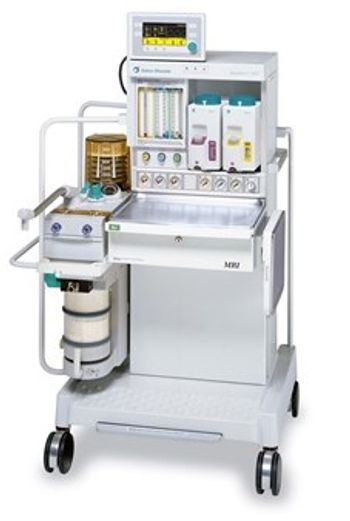
GE HealthCare Aestiva MRI
 GE HealthCare · Model Aestiva MRI
With integrated and proven 7900 SmartVent* ventilation, an exceptional tool for intraoperative MRI, it’s versatile enough to ventilate a broad range of patients. The physically integrated Magnetic Field Strength Monitor (Gauss Alarm) warns you when the machine is moved too close to the MRI magnet (up to 3T). The ergonomically designed handles make it easy to transport. The Tec* 7 Vaporizer with Easy-fil* is designed to simplify agent filling while helping to minimize leaks. Pressure control mode that allows you to choose a target pressure and deliver tidal volume for the desired time and pressure selected - a mode previously reserved for ICU-type ventilators. Volume control mode that helps provide consistent delivery of set tidal volumes by automatically adjusting for changes in fresh gas flows, small system leaks, changing lung compliance, or compression losses in the ventilator, absorber, and bellows. SIMV and PSVPRo* modes help expand the capabilities of the Aestiva MRI system and help simplify the care for a broad range of patients. SIMV provides a set number of ventilator-delivered breaths per minute, allowing the patient to breathe spontaneously between the mandatory breaths. PSVPro is designed to complement SIMV by assisting the patient's spontaneous breath. With PSVPro, the ventilator delivers a set pressure when the patient takes a breath; the patient, who must take a breath for the ventilator to provide support, controls the rate, volume, and timing of the breath.
Key tips
- ·A failed daily leak test takes the machine out of service immediately - there is no acceptable workaround.
- ·Never run an agent-specific vaporizer with the wrong agent, even briefly, during testing.
- ·CO2-absorbent exhaustion mimics several unrelated fault symptoms - rule it out early.
Typical Failure Modes
Compiled for this model from its own documentation and established engineering knowledge for this equipment class - not from a verified service record. Confirm against the manufacturer's service manual.
RF coil fault / poor SNR
HighSymptoms: Low signal-to-noise, shading, or a dead region in images; coil not detected or fails the coil check.
Root cause: Damaged RF coil element, a coil-cable / connector fault, or a preamp fault.
Gradient fault / image distortion
HighSymptoms: Geometric distortion, gradient-amplifier faults, acoustic change, over-temperature trips.
Root cause: Gradient-amplifier fault, gradient-coil cooling problem, or a gradient-coil fault.
Cryogen / cold-head / compressor fault
HighSymptoms: Rising helium boil-off, cold-head noise or stall, He level dropping, compressor alarms.
Root cause: Cold-head at end of life, a helium-compressor fault, or a chilled-water problem.
Chilled water / cooling fault
MediumSymptoms: System-cooling alarms, gradient or RF over-temperature, scans aborting.
Root cause: Facility chilled-water supply, the heat exchanger, or internal pumps.
Patient table / positioning fault
MediumSymptoms: Table will not dock, drive or index; landmarking errors.
Root cause: Table drive, docking sensor, or encoder fault.
Reconstruction / host / network fault
MediumSymptoms: Recon errors, host hangs, images will not reach PACS.
Root cause: Recon or host computer fault, or the network / storage.
Serviceable Parts & Consumables
Serviceable items for this model, compiled from its documentation and engineering knowledge for this equipment class. Service class and relative cost are estimates, not manufacturer figures; no part numbers are given. Confirm intervals and pricing against the manufacturer.
RF receive coil (exchange)
Class Major service partRel. cost $$$$R&R Moderate
Cold head
Planned replacement; He boil-off rises as it wears.
Class Periodic replacementRel. cost $$$$R&R Difficult
Helium compressor / adsorber
Class Major service partRel. cost $$$$R&R Difficult
Gradient amplifier module
Class Major service partRel. cost $$$$R&R Expert-level
Chilled-water pump / heat exchanger
Class Major service partRel. cost $$$R&R Difficult
Patient table drive / encoder
Class Major service partRel. cost $$$R&R Difficult
| Part | Service class | Relative cost | R&R difficulty |
|---|---|---|---|
| RF receive coil (exchange) | Major service part | $$$$ | Moderate |
| Cold head Planned replacement; He boil-off rises as it wears. | Periodic replacement | $$$$ | Difficult |
| Helium compressor / adsorber | Major service part | $$$$ | Difficult |
| Gradient amplifier module | Major service part | $$$$ | Expert-level |
| Chilled-water pump / heat exchanger | Major service part | $$$ | Difficult |
| Patient table drive / encoder | Major service part | $$$ | Difficult |
Relative cost: $ lowest · $$$$ highest service-part cost for this equipment class. Not a price.
PM Checklist
Preventive-maintenance tasks typical of this equipment class. Perform to the manufacturer's procedure and your facility's policy - this is general reference, not a schedule for this specific unit.
- ·Daily pre-anesthesia machine check: leak test, O2 sensor calibration, per facility protocol
- ·Scheduled vaporizer calibration and agent-specific service
- ·Absorber / CO2 canister replacement
- ·Breathing circuit and hose inspection
- ·Annual full PM and electrical safety test
Troubleshooting Approach
A starting sequence for this model, compiled from its documentation and engineering knowledge for this equipment class. Follow the manufacturer's service documentation for the actual procedure.
Symptom: Poor SNR or a dead region with one coil
- Swap in a known-good coil of the same type and repeat the scan.
- Run the coil-check / coil-QA tool.
- Inspect the coil housing and cable for damage; reseat the connector.
- Scan the ACR / QA phantom and compare SNR to baseline.
- Quarantine and exchange the faulty coil.
Symptom: Rising helium boil-off or cold-head noise
- Log the helium level and boil-off trend daily.
- Check the cold-head sound and the compressor pressures against spec.
- Confirm the chilled-water supply temperature and flow.
- Schedule a cold-head / compressor service before the level reaches the OEM action point.
- Never let the magnet approach a quench threshold - escalate urgently.
Typical Location
Where this class of equipment is typically deployed - general reference, not this unit's own placement record.
- Operating rooms
- Procedure / endoscopy suites requiring sedation
- Obstetric delivery rooms
Documents & Manuals
No documents available for this device yet.
Troubleshoot this device with Bio
Describe a symptom or error code. Bio answers from this device's own documented error codes, failure modes, parts, and guides.
Ask Bio