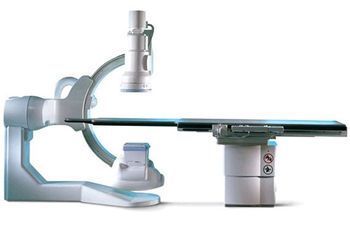
GE HealthCare Advantx LCV+
 GE HealthCare · Model Advantx LCV+
LCV+ Floor Mounted Three-Axis Positioner Design Provides Maximum Positioning Flexibility and Excellent Patient Access in All Views. With Three Motor Driven Axes, the Innovative Advantx LCV+ Positioner Makes it Easy to Achieve Even the Most Complex Angulations. Advantx 100 kW Three-Phase Power Unit. 32cm (12 in.) Four Fields-of View HX Image Intensifier Allows the Operator to Match the Field Size to the Relevant Anatomy, and is Well Suited for Both Cardiac and Angio Applications. MX-150 Water Cooled X-Ray Tube with Pulsed Fluoroscopy Provides Excellent Cardiovascular Imaging Capabilities. The Tube's 1.95 MHU Heat Capacity Along with a High Heat Dissipation Rate Minimizes the Need for Heat-cooling Delays, Even with Aggressive Techniques. Omega IV Angio Table with 4-Way Mechanical Float and Motorized Longitudinal 2-Way Travel Allows Easy Patient Positioning and Total body Coverage for 6 Foot 4 Inch Patient. Table Side System Control Mounted to the Table Side to Provide Fingertip Access to Common Imaging Functions. Vascular SRI Collimator Combines Both Rectangular and Circular Collimators. Autopositioner Increases Productivity Through Easy Table Side Storage and Access of Commonly Used Positions. This Option Allows Nine Different Operators to Store Eight Unique Positions for a Total of Seventy-Two Stored Positions. DLX - Cardiac/Angio Digital System is a Fully Integrated Imaging Subsystem that Meets Key Cardiovascular Imaging Demands Through Extensive Storage and Advanced Post Processing, Display and Quantitative Analysis Capabilities. The DLX-Digital System Utilizes a UNIX Architecture and Windows-like Environment Ensuring Upgradeability and Ease of Use. DLX High Speed Combo Gateway Provides Both Cardiac and DICOM ATM (150 Mbps) Output and Angio DICOM Fast Ethernet (100 Mbps) Output for Acquisitions From the DLX Digital System. Two Monitors on and Ceiling Mounted Overhead Suspension/Boom.
Key tips
- ·Never bypass a radiation interlock to "just get the image" - this is one of the few true zero-tolerance rules in BMET work.
- ·Trend image-quality phantom results over time - drift shows up before an outright failure does.
- ·Portable/mobile units take real physical abuse from transport - check wheel locks and cable strain reliefs more often than fixed units.
Typical Failure Modes
Compiled for this model from its own documentation and established engineering knowledge for this equipment class - not from a verified service record. Confirm against the manufacturer's service manual.
Fluoro image quality / dose fault
HighSymptoms: Noisy or dim fluoro, dose creep, poor DSA, ABC not tracking.
Root cause: Flat-panel detector degradation or the dose / image-processing chain.
No or inconsistent exposure / generator error
HighSymptoms: Fluoro or cine inhibited, generator error code, tube-arc faults.
Root cause: HV generator, the X-ray tube, or the filament supply.
C-arm / L-arm positioner fault
MediumSymptoms: Gantry will not angulate, rotate or reach a stored position; collision trips.
Root cause: Positioner drive, encoder, brake, or collision sensors.
Table motion / tableside-control fault
MediumSymptoms: Table float, tilt, height or cradle will not respond; tableside module dead.
Root cause: Table drive, the tableside control module, or its cable.
Hemodynamic / recording or injector-interface fault
MediumSymptoms: Pressures / ECG missing on the hemo system, injector arm / interface fault.
Root cause: Hemo transducer inputs, the recording PC, or the injector interface.
Tube cooling / duty-cycle lockout
LowSymptoms: Fluoro / cine inhibited after a run, tube-heat alarm.
Root cause: Tube heat limit or a heat-exchanger fault.
Serviceable Parts & Consumables
Serviceable items for this model, compiled from its documentation and engineering knowledge for this equipment class. Service class and relative cost are estimates, not manufacturer figures; no part numbers are given. Confirm intervals and pricing against the manufacturer.
Flat-panel detector (exchange)
Class Major service partRel. cost $$$$R&R Expert-level
X-ray tube assembly
Class Periodic replacementRel. cost $$$$R&R Expert-level
HV generator components
Class Major service partRel. cost $$$$R&R Expert-level
Positioner drive / encoder / brake
Class Major service partRel. cost $$$R&R Difficult
Table drive / tableside control module
Class Major service partRel. cost $$$R&R Difficult
Heat exchanger / cooling components
Class Major service partRel. cost $$$R&R Difficult
| Part | Service class | Relative cost | R&R difficulty |
|---|---|---|---|
| Flat-panel detector (exchange) | Major service part | $$$$ | Expert-level |
| X-ray tube assembly | Periodic replacement | $$$$ | Expert-level |
| HV generator components | Major service part | $$$$ | Expert-level |
| Positioner drive / encoder / brake | Major service part | $$$ | Difficult |
| Table drive / tableside control module | Major service part | $$$ | Difficult |
| Heat exchanger / cooling components | Major service part | $$$ | Difficult |
Relative cost: $ lowest · $$$$ highest service-part cost for this equipment class. Not a price.
PM Checklist
Preventive-maintenance tasks typical of this equipment class. Perform to the manufacturer's procedure and your facility's policy - this is general reference, not a schedule for this specific unit.
- ·Daily QC per modality: image-quality phantom test
- ·Tube and detector inspection
- ·Annual state-required radiation safety survey
- ·Vendor-scheduled preventive maintenance
Troubleshooting Approach
A starting sequence for this model, compiled from its documentation and engineering knowledge for this equipment class. Follow the manufacturer's service documentation for the actual procedure.
Symptom: Poor fluoro image or dose creeping
- Image a phantom at a fixed geometry and compare to the room baseline.
- Check the flat-panel detector performance via service diagnostics.
- Review the dose trend / DAP log.
- Escalate a confirmed detector degradation to the OEM.
- Re-verify dose rate and image quality after correction.
Symptom: Generator error / no exposure
- Record the exact error code and phase.
- Confirm mains and all room interlocks (doors, tube position).
- Confirm the tube is not in a thermal lockout.
- Run tube conditioning / seasoning.
- Escalate a confirmed HV / tube fault; verify output after repair.
Typical Location
Where this class of equipment is typically deployed - general reference, not this unit's own placement record.
- Radiology / Imaging department
- Emergency Department (portable units)
- Operating Room (C-arms)
- Cath lab
- Bedside ICU (portable X-ray)
Documents & Manuals
No documents available for this device yet.
Troubleshoot this device with Bio
Describe a symptom or error code. Bio answers from this device's own documented error codes, failure modes, parts, and guides.
Ask Bio