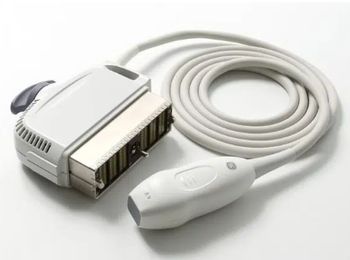
GE HealthCare 4VC-D
 GE HealthCare · Model 4VC-D
Ultrasound Transducer The 4V-D Probe Collector helps you achieve strong performance on every examination. This probe is used in the Vivid E9 series device which is an ultrasonic imaging system. This transducer comes under volume phased array probe transducer category. The volume phased array system can sweep a sound beam through a range of refracted angles or along linear path or focus at a number of different paths which helps in both flexibility and capability in the inspection areas. This probe is specially designed and utilized to diagnose Cardiac, LVO Contrast, Stress, Fetal Heart and contrast low MI. The transducer is used to pick up the reflected waves from the organ location and send them to a computer. Then, this computer transforms this reflected wave into an image. Each and every part in the transducer assembly is manufactured using high precision techniques which helps to achieve a very good surface finish as well as good product consistency. The design has been made with patient and user comfort in mind, to help reduce stress without compromising diagnostic performance. The transducer has the power to acquire extraordinary images on every patient, with transducer technology that maximizes penetration without sacrificing resolution.
Typical Failure Modes
Compiled for this model from its own documentation and established engineering knowledge for this equipment class - not from a verified service record. Confirm against the manufacturer's service manual.
Element drop-out / dead elements
HighSymptoms: Black vertical band in the image, halved sensitivity, artefact that stays with the probe on any port.
Root cause: Cracked or delaminated piezo elements, or broken cable conductors into the array.
Lens / membrane damage or delamination
HighSymptoms: Near-field haze, bubbles under the lens, visible crack or a bite mark (TEE).
Root cause: Impact, aggressive disinfectant, or age; the acoustic lens has lifted from the array.
Connector / strain-relief fault
MediumSymptoms: Image comes and goes when the cable or connector is flexed.
Root cause: Broken conductors at the connector or at the probe strain relief.
Electrical-safety / insulation failure
HighSymptoms: Fails the leakage / insulation test; unsafe for patient contact (critical for intracavitary and TEE probes).
Root cause: Fluid ingress or a lens breach compromising patient isolation.
Serviceable Parts & Consumables
Serviceable items for this model, compiled from its documentation and engineering knowledge for this equipment class. Service class and relative cost are estimates, not manufacturer figures; no part numbers are given. Confirm intervals and pricing against the manufacturer.
Transducer (exchange / repair)
Element or cable damage is usually an OEM/third-party repair, not a field fix.
Class Periodic replacementRel. cost $$$$R&R Fairly easy
Connector pins / housing
Class Major service partRel. cost $$R&R Moderate
Acoustic lens / membrane
Class Periodic replacementRel. cost $$$R&R Difficult
| Part | Service class | Relative cost | R&R difficulty |
|---|---|---|---|
| Transducer (exchange / repair) Element or cable damage is usually an OEM/third-party repair, not a field fix. | Periodic replacement | $$$$ | Fairly easy |
| Connector pins / housing | Major service part | $$ | Moderate |
| Acoustic lens / membrane | Periodic replacement | $$$ | Difficult |
Relative cost: $ lowest · $$$$ highest service-part cost for this equipment class. Not a price.
Troubleshooting Approach
A starting sequence for this model, compiled from its documentation and engineering knowledge for this equipment class. Follow the manufacturer's service documentation for the actual procedure.
Symptom: Dead band or drop-out in the image
- Confirm the artefact follows the probe onto a second port / system.
- Run the system's transducer element-test if available.
- Inspect the lens for cracks and the cable for kinks.
- Quarantine the probe and arrange an element/cable repair or exchange.
- Do not use an intracavitary/TEE probe that fails the element or leakage test.
Symptom: Image drops out when the cable is moved
- Flex the cable along its length and at both ends while scanning.
- Inspect the connector for bent pins and the strain relief for splits.
- Try the probe on another system to rule the system out.
- Send for a connector / cable repair.
- Re-test electrical safety before returning to service.
Documents & Manuals
No documents available for this device yet.
Troubleshoot this device with Bio
Describe a symptom or error code. Bio answers from this device's own documented error codes, failure modes, parts, and guides.
Ask Bio