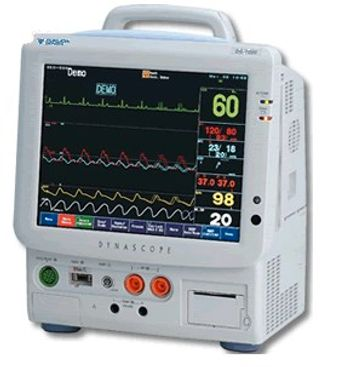
Fukuda Denshi DS-7200
 Fukuda Denshi · Model DS-7200
Flexible Performance -The basic model comes standard with the following parameters; 3/4/5 and 12-lead ECG, RESP, IBP (2 channels), TEMP(2 channels), NIBP and SpO2. Optional modules enable the DS-7200 to monitor additional IBP and TEMP inputs, and measure cardiac output. Also, an optional sidestream or main stream CO2module can be incorporated for CO2 monitoring. Abundant Connectivity -Multiple external interfaces enable the DS-7200 to connect devices such as ventilators and continuous cardiac output flow meters, thereby making the monitor appropriate to use in any critical care units. Efficient Expandability -Connection to external devices including CO/SvO2 monitors, BIS monitor and ventilators is possible. Data from these devices can be reviewed within parameter lists on the DS-7200. Quick Measurement -The NIBP measurement time is greatly reduced by 35% compared to other systems. Smart Inflation -Reduces the peak pressure by eliminating the excess inflation pressure (for patient comfort and measurement duration) using a preliminary systolic value. Dyna Alert -Dyna Alert allows the monitor to take NIBP measurement automatically when the current blood pressure appears to be changing rapidly during the interval time.
Key tips
- ·A no-signal/flatline alarm gets checked on the patient first, not the monitor - rule out a real clinical event before troubleshooting.
- ·Recalibrate NIBP against a reference manometer, not just a self-test pass.
- ·Reused patient cables (SpO2, ECG leads) are a common source of intermittent-fault complaints - swap the cable before the module.
Typical Failure Modes
Compiled for this model from its own documentation and established engineering knowledge for this equipment class - not from a verified service record. Confirm against the manufacturer's service manual.
One or more telemetry transmitters drop / no waveform
HighSymptoms: A bed shows no ECG or dropped beats at the central station, noisy trace, frequent leads-off.
Root cause: Worn transmitter lead set, a weak transmitter battery, or antenna / receiver coverage.
Antenna / RF coverage fault
MediumSymptoms: Dropout in specific areas of the unit, multiple beds affected in one zone.
Root cause: Antenna cabling, a splitter / amplifier, or a receiver-module fault.
Central-station application / server fault
HighSymptoms: Central station hangs, will not admit, alarms not annunciating, display frozen.
Root cause: Central-station PC / server, the application, or the network link.
Printer / recorder fault
LowSymptoms: No strip on alarm or on demand.
Root cause: Central recorder / network printer fault.
Time / network sync fault
LowSymptoms: Timestamps wrong or drifting, full-disclosure gaps.
Root cause: Network time source or connectivity.
Serviceable Parts & Consumables
Serviceable items for this model, compiled from its documentation and engineering knowledge for this equipment class. Service class and relative cost are estimates, not manufacturer figures; no part numbers are given. Confirm intervals and pricing against the manufacturer.
Telemetry transmitter lead set
Class Frequent wear itemRel. cost $$R&R Easy
Transmitter battery (per pack)
Class ConsumableRel. cost $R&R Easy
Receiver module / antenna components
Class Major service partRel. cost $$$R&R Difficult
Central-station PC / server
Class Major service partRel. cost $$$$R&R Difficult
Network printer / recorder
Class Major service partRel. cost $$R&R Fairly easy
| Part | Service class | Relative cost | R&R difficulty |
|---|---|---|---|
| Telemetry transmitter lead set | Frequent wear item | $$ | Easy |
| Transmitter battery (per pack) | Consumable | $ | Easy |
| Receiver module / antenna components | Major service part | $$$ | Difficult |
| Central-station PC / server | Major service part | $$$$ | Difficult |
| Network printer / recorder | Major service part | $$ | Fairly easy |
Relative cost: $ lowest · $$$$ highest service-part cost for this equipment class. Not a price.
PM Checklist
Preventive-maintenance tasks typical of this equipment class. Perform to the manufacturer's procedure and your facility's policy - this is general reference, not a schedule for this specific unit.
- ·Routine cable and lead-wire inspection for fraying/wear
- ·Battery conditioning cycle
- ·NIBP calibration check against a reference manometer
- ·ECG / SpO2 accuracy verification against a patient simulator
- ·Annual electrical safety test
Troubleshooting Approach
A starting sequence for this model, compiled from its documentation and engineering knowledge for this equipment class. Follow the manufacturer's service documentation for the actual procedure.
Symptom: A telemetry bed drops or is noisy
- Fit a fresh transmitter battery and a known-good lead set.
- Re-prep the skin and re-site the electrodes.
- Confirm the bed is admitted to the correct transmitter.
- If a whole zone is affected, check the antenna / receiver for that area.
- Swap the transmitter to isolate transmitter vs infrastructure.
Symptom: Central station frozen or not alarming
- Confirm other clients / displays on the same server.
- Check the network link between the station and the antenna system.
- Restart the central-station application per the OEM procedure.
- Verify alarm audio and escalation settings.
- Escalate a server fault to the OEM / IT.
Technical Specs
- Height
- 351 mm
- Length
- 245 mm
- Weight
- 10 kg
- Width
- 310 mm
Typical Location
Where this class of equipment is typically deployed - general reference, not this unit's own placement record.
- ICU / CCU
- Emergency Department
- OR / PACU
- General med-surg floors
- Step-down units
- Telemetry units
Documents & Manuals
Troubleshoot this device with Bio
Describe a symptom or error code. Bio answers from this device's own documented error codes, failure modes, parts, and guides.
Ask Bio