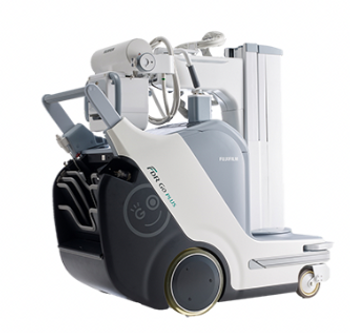
Fujifilm FDR Go Plus
 Fujifilm · Model FDR Go Plus
All new retractable column, ultra-low park position, and signature compact tube head for maximum visibility and agile maneuverability while traveling. System status indicators with bright LED status lights on the monitor and tube arm to provide exposure, charge, and system status at a glance. Extra-large touchscreen display with Dynamic Visualization™ image processing, which automatically optimizes images for greater diagnostic visibility. Virtual Grid™ (option) image processing simulates grid use, eliminating the need for a grid. It provides excellent image quality, up to 50% lower dose than grid exams, lighter easier positioning, and optimal patient comfort. Extensive dedicated storage areas for large and small items, including a covered storage compartment for smaller items and larger open slots for easy accessibility and cleaning. Inching controls at the tube head slowly move the system forward or backward for precise positioning at the bedside without needing to return to the drive handle. 3 sets of easy-to-reach tube positioning releases and front and rear collimation controls for fast, easy collimation and positioning exactly where you need it. Fun pediatric graphics (option) to help calm patients and parents in the NICU, PICU, and pediatric departments. Compatible with FDR D-EVO II detectors available in GOS and CsI, in standard 14x17'' or full field-of-view 17x17'' sizes, and a 24x30cm perfect for neonatal and extremity use, all featuring Fujifilm's patented ISS technology for exceptional image quality at low dose. System battery power lasts 3-4 hours and features emergency reserve mode for additional exposures and travel after low battery warning. Browser based RIS and PACS shortcut buttons let you close studies remotely from the mobile console.
Key tips
- ·Never bypass a radiation interlock to "just get the image" - this is one of the few true zero-tolerance rules in BMET work.
- ·Trend image-quality phantom results over time - drift shows up before an outright failure does.
- ·Portable/mobile units take real physical abuse from transport - check wheel locks and cable strain reliefs more often than fixed units.
Typical Failure Modes
Compiled for this model from its own documentation and established engineering knowledge for this equipment class - not from a verified service record. Confirm against the manufacturer's service manual.
No or inconsistent exposure
HighSymptoms: Exposure inhibited, kV / mAs error, images under- or over-exposed.
Root cause: HV generator / capacitor fault, exposure-switch fault, tube fault, or a thermal interlock.
Drive / propulsion fault (motor-driven units)
MediumSymptoms: Unit will not drive, drives weakly, or a drive fault code.
Root cause: Drive battery, drive motor / controller, or the throttle handle.
Battery pack will not hold charge
HighSymptoms: Few exposures per charge, will not reach full charge, unit dies mid-round.
Root cause: Aged exposure / drive battery bank or a charger fault.
Column / arm / brake fault
MediumSymptoms: Tube arm drifts, will not extend / rotate, or a brake will not hold.
Root cause: Worn arm bearings, counterbalance, or brakes.
Detector / console fault (DR units)
MediumSymptoms: Panel not detected, images not received, console errors.
Root cause: Wireless detector, its battery, or the acquisition PC.
Serviceable Parts & Consumables
Serviceable items for this model, compiled from its documentation and engineering knowledge for this equipment class. Service class and relative cost are estimates, not manufacturer figures; no part numbers are given. Confirm intervals and pricing against the manufacturer.
Battery bank (exposure / drive)
Class Periodic replacementRel. cost $$$R&R Moderate
HV generator / capacitor module
Class Major service partRel. cost $$$$R&R Expert-level
Drive motor / controller
Class Major service partRel. cost $$$R&R Difficult
Column arm brake / bearing kit
Class Major service partRel. cost $$R&R Moderate
Wireless detector / battery (DR)
Class Periodic replacementRel. cost $$$$R&R Fairly easy
| Part | Service class | Relative cost | R&R difficulty |
|---|---|---|---|
| Battery bank (exposure / drive) | Periodic replacement | $$$ | Moderate |
| HV generator / capacitor module | Major service part | $$$$ | Expert-level |
| Drive motor / controller | Major service part | $$$ | Difficult |
| Column arm brake / bearing kit | Major service part | $$ | Moderate |
| Wireless detector / battery (DR) | Periodic replacement | $$$$ | Fairly easy |
Relative cost: $ lowest · $$$$ highest service-part cost for this equipment class. Not a price.
PM Checklist
Preventive-maintenance tasks typical of this equipment class. Perform to the manufacturer's procedure and your facility's policy - this is general reference, not a schedule for this specific unit.
- ·Daily QC per modality: image-quality phantom test
- ·Tube and detector inspection
- ·Annual state-required radiation safety survey
- ·Vendor-scheduled preventive maintenance
Troubleshooting Approach
A starting sequence for this model, compiled from its documentation and engineering knowledge for this equipment class. Follow the manufacturer's service documentation for the actual procedure.
Symptom: No or inconsistent exposure
- Note the exact error code.
- Confirm the battery bank is fully charged (exposure energy depends on it).
- Check the exposure switch and cable.
- Confirm the tube is not in a thermal lockout.
- Escalate a confirmed generator / capacitor / tube fault; verify output with an analyser after repair.
Symptom: Will not drive or short battery life
- Check the charge level and that the charger reaches full charge overnight.
- Load-test or check the battery bank voltages against spec.
- For no-drive, check the drive fuse, motor controller and throttle.
- Replace the battery bank when capacity is low.
- Confirm exposure count per charge returns to spec.
Typical Location
Where this class of equipment is typically deployed - general reference, not this unit's own placement record.
- Radiology / Imaging department
- Emergency Department (portable units)
- Operating Room (C-arms)
- Cath lab
- Bedside ICU (portable X-ray)
Documents & Manuals
Troubleshoot this device with Bio
Describe a symptom or error code. Bio answers from this device's own documented error codes, failure modes, parts, and guides.
Ask Bio