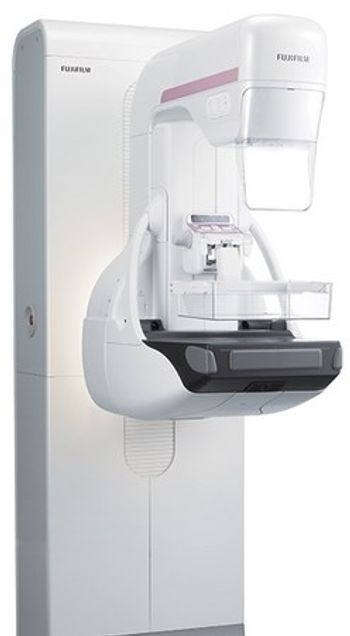
Fujifilm AspireCristalle
 Fujifilm · Model AspireCristalle
Hexagonal Close Pattern (HCP) is a detector pixel design, engineered to deliver higher acquisition efficiency, for finer detail, higher DQE, higher MTF and lower dose than conventional square pixel arrays. The system’s image quality is further enhanced with Fujifilm’s image processing, iAEC automated exposure controls and ISC precisely tuned contrast, to intelligently adapt to the specific characteristics for every breast type and to image implants with ease. Patented, flexible Comfort Paddle provides gentle, even compression of the breast and is designed to improve patient comfort. Intelligent AEC (iAEC) factors in breast density to calculate optimal dose for each exam. Optimized contrast and image quality - across all breast types - with ISC 50-micron pixel size output display. Automatic system start-up and calibration - Aspire Cristalle is ready for work when you are. Sleep mode can extend detector life as much as 300%. Lower* acquisition time - only 15 seconds. Adjust angle of swivel arm from +90° to -90° at a single touch. Set exposure and view exposure confirmation on a single screen. Easily adjust density and contrast while viewing images. Aspire QC Tools allow technologists to efficiently perform accurate routine QC tests.
Key tips
- ·Never bypass a radiation interlock to "just get the image" - this is one of the few true zero-tolerance rules in BMET work.
- ·Trend image-quality phantom results over time - drift shows up before an outright failure does.
- ·Portable/mobile units take real physical abuse from transport - check wheel locks and cable strain reliefs more often than fixed units.
Typical Failure Modes
Compiled for this model from its own documentation and established engineering knowledge for this equipment class - not from a verified service record. Confirm against the manufacturer's service manual.
Image quality / detector-calibration fault
HighSymptoms: Fixed-pattern artefacts, non-uniformity, dead lines, failed flat-field calibration, failed ACR / MQSA phantom.
Root cause: Detector degradation, a calibration issue, or a bad pixel map.
Compression / paddle fault
MediumSymptoms: Compression will not apply or hold the set force, paddle not recognised, force readout wrong.
Root cause: Compression drive / motor, the force sensor, or a paddle-detect fault.
Gantry / C-arm rotation or AWS-communication fault
MediumSymptoms: C-arm will not rotate / lock, angle readout wrong, or the acquisition workstation loses the gantry.
Root cause: Rotation drive / brake / encoder, or the gantry-to-AWS link.
X-ray generator / tube fault
HighSymptoms: Exposure inhibited, kV / mAs error, tube-overload interlock, AEC fault.
Root cause: Generator, the mammo tube / filters, or the AEC.
Acquisition workstation / PACS fault
MediumSymptoms: Images will not display, mark-up or send to PACS / review workstation.
Root cause: AWS PC or the DICOM configuration.
Serviceable Parts & Consumables
Serviceable items for this model, compiled from its documentation and engineering knowledge for this equipment class. Service class and relative cost are estimates, not manufacturer figures; no part numbers are given. Confirm intervals and pricing against the manufacturer.
Flat-panel detector (exchange)
Class Major service partRel. cost $$$$R&R Expert-level
Compression drive / force sensor
Class Major service partRel. cost $$$R&R Difficult
C-arm rotation drive / encoder
Class Major service partRel. cost $$$R&R Difficult
Mammo X-ray tube / filter assembly
Class Major service partRel. cost $$$$R&R Expert-level
Acquisition workstation PC
Class Major service partRel. cost $$$R&R Moderate
| Part | Service class | Relative cost | R&R difficulty |
|---|---|---|---|
| Flat-panel detector (exchange) | Major service part | $$$$ | Expert-level |
| Compression drive / force sensor | Major service part | $$$ | Difficult |
| C-arm rotation drive / encoder | Major service part | $$$ | Difficult |
| Mammo X-ray tube / filter assembly | Major service part | $$$$ | Expert-level |
| Acquisition workstation PC | Major service part | $$$ | Moderate |
Relative cost: $ lowest · $$$$ highest service-part cost for this equipment class. Not a price.
PM Checklist
Preventive-maintenance tasks typical of this equipment class. Perform to the manufacturer's procedure and your facility's policy - this is general reference, not a schedule for this specific unit.
- ·Daily QC per modality: image-quality phantom test
- ·Tube and detector inspection
- ·Annual state-required radiation safety survey
- ·Vendor-scheduled preventive maintenance
Troubleshooting Approach
A starting sequence for this model, compiled from its documentation and engineering knowledge for this equipment class. Follow the manufacturer's service documentation for the actual procedure.
Symptom: Image quality / detector-calibration fault / failed ACR phantom
- Run the detector flat-field / gain calibration and the bad-pixel map.
- Perform the daily / weekly QC (ACR phantom, SNR / CNR) and compare to the control chart.
- Inspect for physical detector damage.
- Keep the unit down and escalate anything affecting dose or diagnostic image quality (MQSA).
- Re-run the phantom QC after any correction.
Symptom: Compression will not apply / hold force / paddle not recognised
- Test compression apply / release and the force readout against a known weight.
- Check the paddle is recognised and the detect contacts are clean.
- Inspect the compression drive / motor and the force sensor.
- Replace the force sensor or drive as isolated.
- Confirm the force readout is accurate after repair.
Symptom: C-arm rotation / AWS communication fault
- Test C-arm rotation and lock at several angles.
- Check the rotation drive, brake and encoder.
- Confirm the acquisition workstation sees the gantry.
- Reseat the gantry-to-AWS link.
- Escalate a drive / encoder fault to the OEM.
Typical Location
Where this class of equipment is typically deployed - general reference, not this unit's own placement record.
- Radiology / Imaging department
- Emergency Department (portable units)
- Operating Room (C-arms)
- Cath lab
- Bedside ICU (portable X-ray)
Documents & Manuals
Troubleshoot this device with Bio
Describe a symptom or error code. Bio answers from this device's own documented error codes, failure modes, parts, and guides.
Ask Bio