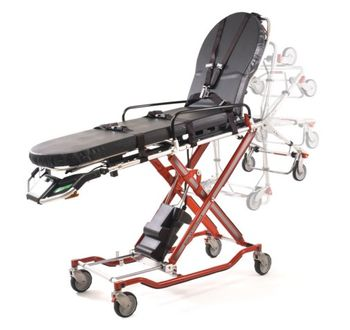
Ferno-Washington PoweFlexx Stattrac
 Ferno-Washington · Model PoweFlexx Stattrac
5-Position Head End Load Frame. Elongated Rectangular X-Frame. Non-Telescoping Tubing. Reflective Labeling. 360° Turn Radius. Ergonomic Control Panel at Operator End. User Intuitive Color Controls. On/Off Switch on Operator Panel. Power Pack Located Under Backrest. 24V Lead Acid Battery System. Auto Shutoff During Charging. Battery Charger Indicator. Clear Anodized Upper Mainframe. No Pinch Points Along Mainframe. Manual Override Mode Handle with Secondary Lock. One Hand Sidearm Release. Swing Out Sidearms Lock at 90°. X-Frame Runs on 4 Shafts Using Linear Bearings. Dual Piston Actuator. Extra-Wide Backrest Panel.
Key tips
- ·Mounting and securement hardware takes real fatigue from vibration and road shock - inspect it as carefully as the device itself.
- ·Post-call battery and function checks catch transport-induced faults that a scheduled PM would miss for months.
Typical Failure Modes
Compiled for this model from its own documentation and established engineering knowledge for this equipment class - not from a verified service record. Confirm against the manufacturer's service manual.
Hydraulic height / Trendelenburg will not lift or holds poorly
HighSymptoms: Pump will not raise the deck, or the deck settles under load.
Root cause: Worn hydraulic pump / seals, an internal valve leak, or low hydraulic fluid.
Brake / steer castor fault
MediumSymptoms: Brake will not hold, fifth-wheel steer ineffective, castor shimmy.
Root cause: Worn brake linkage, castors, or the fifth-wheel mechanism.
Backrest / Fowler mechanism fault
MediumSymptoms: Backrest will not raise / hold, gas strut weak, pneumatic assist failed.
Root cause: Worn gas spring / strut or the release mechanism.
Siderail / IV pole / accessory fault
LowSymptoms: Siderails will not latch or drop, IV pole loose, litter attachments worn.
Root cause: Worn latches, detents, or accessory sockets.
Powered drive fault (powered stretchers)
MediumSymptoms: Drive assist will not engage or is weak, drive-fault code.
Root cause: Drive battery, motor / controller, or the throttle.
Serviceable Parts & Consumables
Serviceable items for this model, compiled from its documentation and engineering knowledge for this equipment class. Service class and relative cost are estimates, not manufacturer figures; no part numbers are given. Confirm intervals and pricing against the manufacturer.
Hydraulic pump / seal kit
Class Major service partRel. cost $$R&R Moderate
Castor / brake-linkage set
Class Periodic replacementRel. cost $$R&R Moderate
Backrest gas spring / strut
Class Periodic replacementRel. cost $$R&R Fairly easy
Siderail latch / accessory sockets
Class Major service partRel. cost $$R&R Fairly easy
Drive battery (powered stretchers)
Class Periodic replacementRel. cost $$R&R Fairly easy
| Part | Service class | Relative cost | R&R difficulty |
|---|---|---|---|
| Hydraulic pump / seal kit | Major service part | $$ | Moderate |
| Castor / brake-linkage set | Periodic replacement | $$ | Moderate |
| Backrest gas spring / strut | Periodic replacement | $$ | Fairly easy |
| Siderail latch / accessory sockets | Major service part | $$ | Fairly easy |
| Drive battery (powered stretchers) | Periodic replacement | $$ | Fairly easy |
Relative cost: $ lowest · $$$$ highest service-part cost for this equipment class. Not a price.
PM Checklist
Preventive-maintenance tasks typical of this equipment class. Perform to the manufacturer's procedure and your facility's policy - this is general reference, not a schedule for this specific unit.
- ·Post-call function and battery check
- ·Mounting / securement inspection
- ·Annual full PM and vibration-tolerance check
Troubleshooting Approach
A starting sequence for this model, compiled from its documentation and engineering knowledge for this equipment class. Follow the manufacturer's service documentation for the actual procedure.
Symptom: Will not lift or settles under load
- Check the hydraulic fluid level.
- Pump the deck up under load and time how fast it settles.
- Inspect the pump and cylinder for external leaks.
- Rebuild the pump with the seal kit or bleed the system per the manual.
- Confirm it holds at full height under the rated load.
Symptom: Brake will not hold or castor shimmy
- Inspect the brake linkage and each castor.
- Adjust the central-brake linkage.
- Replace worn castors and the fifth-wheel components.
- Confirm the brake holds on an incline.
- Check steer-lock engagement.
Technical Specs
- Height
- 34 max loading hight
- Length
- 61 - 83 inch range
- Weight
- 133 lbs
- Patient Weight Capacity
- 700 lbs
- Width
- 24 in
Typical Location
Where this class of equipment is typically deployed - general reference, not this unit's own placement record.
- Ambulance / transport vehicles
- Emergency Department
- Inter-facility transport teams
Documents & Manuals
No documents available for this device yet.
Troubleshoot this device with Bio
Describe a symptom or error code. Bio answers from this device's own documented error codes, failure modes, parts, and guides.
Ask Bio