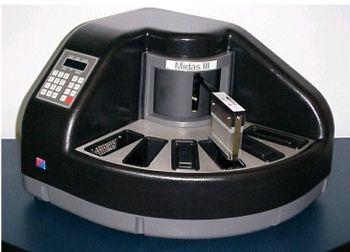
EMD Chemicals Inc. Midas III Stainer
 EMD Chemicals Inc. · Model Midas III Stainer
Specimen slides are loaded into the removable slide carrier, and the carrier is mounted onto the carrier arm of the tower. Stains and fixatives are added to staining vessels and inserted into the Stations on the stainer. During operation, the tower holding the slide carrier moves from Station to Station according to a programmed sequence. The carrier arm dips the slides by moving up and down automatically every three seconds in the staining vessel. This Dipping Mode can be turned on or off for Stations 1 through 6 by the operator. Temperature adjustable from room temp to 65ºC When the program is complete, the tower moves back to the far left, its Home Position. The Midas®III Stainer gives an audible beep six times to let the operator know that the process is complete. Staining Control Microprocessor Dipping mechanism ON/OFF selectable at all Stations Available Programs 9 user programmable, 29 steps in each; 1 test program Staining Vessel Capacity 300ml Available Stations 6 in total, 4 staining/reagent, 1 running water rinse, 1 warm forced-air dry or 6 staining/reagent Application Time 1 second to 99 minutes, 59 seconds per program step with 29 steps per program Slide Carrier Capability 20 slides, 3 x 1 inch or optional 30 slide carrier Coverslip Carrier Capability 20 coverslips, 22 x 22mm Rinse Station Flow Rate Application range - 500-2000ml/min Available Options Recirculating Water Bath, Product No. 64000WB-94. Vessels and Lids - Neutral White - package of 8 Product No. 64054W-95 Vessels and Lids - Black - package of 8 Product No. 64054B-95 Coverslip Carrier, Product No. 64053-94. Optional 30 Slide Carrier, Product No. 64052E-94.
Key tips
- ·Run QC controls before trusting any repair - an analyzer that passes self-test can still report clinically wrong results.
- ·Rule out a reagent lot change before opening the instrument - it can look exactly like a hardware fault.
- ·Centrifuge rotors have a hard retirement age/cycle limit regardless of visible condition - don't eyeball it.
Typical Failure Modes
Compiled for this model from its own documentation and established engineering knowledge for this equipment class - not from a verified service record. Confirm against the manufacturer's service manual.
Reagent / paraffin transfer or handling fault
HighSymptoms: Stations not filling or draining, retort not filling (processor), transport arm mis-places baskets, error alarm halts the run.
Root cause: Worn pump / valve, a blocked line, a level-sensor fault, or a transport-drive / gripper fault.
Retort / chamber pressure or vacuum fault (processor)
MediumSymptoms: Pressure / vacuum not achieved, poor infiltration, seal alarm.
Root cause: Worn retort door seal, a vacuum / pressure-pump fault, or a valve.
Poor or inconsistent staining
MediumSymptoms: Slides over- / under-stained, uneven, station-time drift.
Root cause: Exhausted reagents, wrong programme, incorrect agitation, or a timing / arm fault.
Heater / paraffin-bath / oven fault
MediumSymptoms: Paraffin not molten or too hot, oven not at temperature, bath alarm.
Root cause: Heater or temperature-sensor fault.
Fume-extraction / carbon-filter fault
LowSymptoms: Reagent fumes in the room, filter-change overdue.
Root cause: Saturated carbon filter or a fan fault.
Serviceable Parts & Consumables
Serviceable items for this model, compiled from its documentation and engineering knowledge for this equipment class. Service class and relative cost are estimates, not manufacturer figures; no part numbers are given. Confirm intervals and pricing against the manufacturer.
Reagent / paraffin pump & valves
Class Periodic replacementRel. cost $$$R&R Difficult
Retort / reagent-vessel seals
Class Periodic replacementRel. cost $$R&R Fairly easy
Transport-arm drive / gripper (stainer)
Class Periodic replacementRel. cost $$$R&R Difficult
Bath / oven heater & temperature sensor
Class Major service partRel. cost $$R&R Moderate
Activated-carbon fume filter
Class Frequent wear itemRel. cost $R&R Easy
| Part | Service class | Relative cost | R&R difficulty |
|---|---|---|---|
| Reagent / paraffin pump & valves | Periodic replacement | $$$ | Difficult |
| Retort / reagent-vessel seals | Periodic replacement | $$ | Fairly easy |
| Transport-arm drive / gripper (stainer) | Periodic replacement | $$$ | Difficult |
| Bath / oven heater & temperature sensor | Major service part | $$ | Moderate |
| Activated-carbon fume filter | Frequent wear item | $ | Easy |
Relative cost: $ lowest · $$$$ highest service-part cost for this equipment class. Not a price.
PM Checklist
Preventive-maintenance tasks typical of this equipment class. Perform to the manufacturer's procedure and your facility's policy - this is general reference, not a schedule for this specific unit.
- ·Daily QC controls run and reviewed
- ·Calibration verification per assay
- ·Routine cleaning and decontamination
- ·Scheduled reagent-path and pump-tubing maintenance
Troubleshooting Approach
A starting sequence for this model, compiled from its documentation and engineering knowledge for this equipment class. Follow the manufacturer's service documentation for the actual procedure.
Symptom: Error alarm halts a run
- Note the alarm / error code and check the history log.
- Confirm reagent, paraffin and water levels and correct vessel placement.
- Check the affected station / retort fills and drains fully.
- Inspect seals and the transport arm.
- Follow the service manual for the specific alarm; replace the pump, valve or seal as isolated.
Symptom: Poor or inconsistent staining / processing
- Confirm the correct programme and station times.
- Fit fresh reagents and confirm fill levels.
- Check agitation / dwell and the water supply where used.
- Run a control slide / block and compare to a reference.
- Escalate a timing or transport-arm fault to the OEM.
Typical Location
Where this class of equipment is typically deployed - general reference, not this unit's own placement record.
- Central / core laboratory
- Point-of-care testing stations
- Blood bank
- Microbiology lab
Documents & Manuals
Safety & Recalls
Synced live from the FDA openFDA API.
- RECALL
Stains may yield lower then expected absorbance levels resulting in under stained hematology specimens.
- RECALL
Incorrect concentration: 2 ampules measuring 2.0 mg/ml were found in a lot of 20 ampules of 1.0 mg/ml Ethanol Standard.
Troubleshoot this device with Bio
Describe a symptom or error code. Bio answers from this device's own documented error codes, failure modes, parts, and guides.
Ask Bio