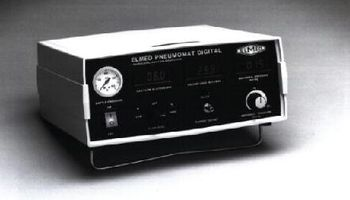
Elmed PNEUMOMAT DIGITAL 52-5100
 Elmed · Model PNEUMOMAT DIGITAL 52-5100
Extremely reliable - based on over 20 years of experience in the design and manufacture of insufflators, utilizing the highest quality components and production methods. Greater safety - maximum output pressure, under any conditions, is 48 mm Hg, in contrast to other insufflators, which under many circumstances can deliver up to 140 mm Hg pressure to the patient. Extra back-up safety features - all ELMED insufflators incorporate numerous pressure red uction and release valves, in addition to any electronic controls, which will prevent any high pressure from entering the low pressure system connected to the patient. Reliable performance - the advanced design and construction of these insufflators provide the most reliable measurements and readings to the operator, insuring accurate and reproducible results. High flow rate - permits optimum maintenance of the pneumoperitoneum, even during smoke evacuation or while suction is being employed. Aesthetic and ergonomic design - contemporary styling and portable. Easy to read digital displays for gas flow, volume used and intra-abdominal pressure on all electronic models. Audible "Over Pressure" alarm on all electronic models. Quiet operation. All units meet the latest electrical safety standards of OSHA, NFPA, CSA and UL 544.
Key tips
- ·Run QC controls before trusting any repair - an analyzer that passes self-test can still report clinically wrong results.
- ·Rule out a reagent lot change before opening the instrument - it can look exactly like a hardware fault.
- ·Centrifuge rotors have a hard retirement age/cycle limit regardless of visible condition - don't eyeball it.
Typical Failure Modes
Compiled for this model from its own documentation and established engineering knowledge for this equipment class - not from a verified service record. Confirm against the manufacturer's service manual.
Will not hold set temperature
HighSymptoms: Chamber above or below setpoint, temperature alarm, slow recovery after the door opens.
Root cause: Heater element, a temperature-sensor / controller fault, a door / gasket leak, or a circulation-fan fault.
CO2 concentration fault (CO2 incubator)
HighSymptoms: CO2 above or below setpoint, CO2 alarm, pH drift in cultures.
Root cause: CO2 sensor (TC or IR) drift, an empty / low CO2 supply, or a solenoid / regulator fault.
Humidity fault (CO2 incubator)
MediumSymptoms: Low humidity, plates drying out, condensation problems.
Root cause: Empty water pan, or an evaporation / airflow issue.
Over-temperature safety trip
MediumSymptoms: Chamber stops heating, over-temp alarm, will not restart.
Root cause: Controller / sensor fault driving the heater high, or an independent over-temp thermostat.
Door / gasket fault
LowSymptoms: Door will not seal, temperature swings, condensation at the door.
Root cause: Worn door gasket or a sagging hinge.
Serviceable Parts & Consumables
Serviceable items for this model, compiled from its documentation and engineering knowledge for this equipment class. Service class and relative cost are estimates, not manufacturer figures; no part numbers are given. Confirm intervals and pricing against the manufacturer.
Heater element
Class Major service partRel. cost $$R&R Moderate
Temperature sensor / controller
Class Major service partRel. cost $$R&R Moderate
CO2 sensor (CO2 incubator)
Class Periodic replacementRel. cost $$$R&R Moderate
CO2 solenoid / regulator (CO2 incubator)
Class Major service partRel. cost $$R&R Moderate
Door gasket
Class Periodic replacementRel. cost $R&R Fairly easy
| Part | Service class | Relative cost | R&R difficulty |
|---|---|---|---|
| Heater element | Major service part | $$ | Moderate |
| Temperature sensor / controller | Major service part | $$ | Moderate |
| CO2 sensor (CO2 incubator) | Periodic replacement | $$$ | Moderate |
| CO2 solenoid / regulator (CO2 incubator) | Major service part | $$ | Moderate |
| Door gasket | Periodic replacement | $ | Fairly easy |
Relative cost: $ lowest · $$$$ highest service-part cost for this equipment class. Not a price.
PM Checklist
Preventive-maintenance tasks typical of this equipment class. Perform to the manufacturer's procedure and your facility's policy - this is general reference, not a schedule for this specific unit.
- ·Daily QC controls run and reviewed
- ·Calibration verification per assay
- ·Routine cleaning and decontamination
- ·Scheduled reagent-path and pump-tubing maintenance
Troubleshooting Approach
A starting sequence for this model, compiled from its documentation and engineering knowledge for this equipment class. Follow the manufacturer's service documentation for the actual procedure.
Symptom: Will not hold set temperature
- Compare the chamber to an independent calibrated thermometer at several points.
- Confirm the door seals and the gasket is intact.
- Check the circulation fan runs.
- Verify the heater draws current.
- Replace the sensor, controller or heater as isolated, then verify stability over several hours.
Symptom: CO2 out of range (CO2 incubator)
- Verify CO2 with an independent calibrated analyser (Fyrite or electronic).
- Confirm the CO2 supply pressure and that the cylinder is not empty.
- Check / calibrate the CO2 sensor per the manual (TC sensors drift with humidity and door openings).
- Inspect the inlet filter and solenoid.
- Recalibrate and re-verify against the reference.
Typical Location
Where this class of equipment is typically deployed - general reference, not this unit's own placement record.
- Central / core laboratory
- Point-of-care testing stations
- Blood bank
- Microbiology lab
Documents & Manuals
No documents available for this device yet.
Related calculators
From BioLab, for work done with this kind of equipment.
Troubleshoot this device with Bio
Describe a symptom or error code. Bio answers from this device's own documented error codes, failure modes, parts, and guides.
Ask Bio