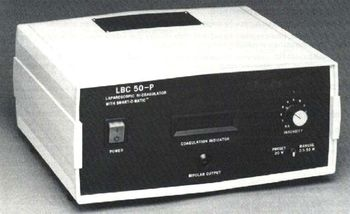
Elmed LBC 50-P
 Elmed · Model LBC 50-P
The low voltage RF-current and the optimal output impedance make this generator particularly suitable for bipolar laparoscopic coagulation. The uniquely designed and performing bar graph gives visual indications regarding the degree of dehydration of the fallopian tube, offering additional safe-guards against the improper closing of the lumen. The musical coagulation indicator, operating in conjunction with the bar graph, gives the surgeon the confidence of the coagulation process without looking up to the unit or having an assistant interpret the meter. The tone scale refers directly to each step or degree of coagulation. At the point of total dehydration, the current "stops flowing" and an audible signal clearly indicates it. At this moment the footswitch may be released. May be used to test the viability of accessories prior to surgery. The intensify may be precisely regulated within the full range of the dial setting. Investigations have demonstrated, 20 W at 100 Ohms achieves optimal results; therefore, we have incorporated a preset selection and a 20 W range indication. Operation by conventional or special water-sealed footswitch. Compatible with all reliable bipolar laparoscopic forceps. Respective connecting cables are available or may be modified. (Excluding coaxial type). Full complement of bipolar forceps for single and double puncture techniques are available. The sophisticated, solid state circuitry guarantees reproducible output, trouble free service, and the ultimate in reliability for bipolar sterilization. Our SMART-O-MATIC, automatic compensation circuit, provides the desired output for all electrodes or tissue conditions. The automatic range control, which is divided into ten steps, requires no readjustment within the set range. The SMART-O-MATIC operates also in the preset mode.
Key tips
- ·A failed leak test means the scope does not get reprocessed or used - send it for repair, full stop.
- ·A shortened reprocessing cycle is a real infection-control failure, not a minor deviation - follow AAMI ST91 exactly.
- ·Track light-source lamp-hours against the manufacturer's limit rather than running to failure.
Typical Failure Modes
Compiled for this model from its own documentation and established engineering knowledge for this equipment class - not from a verified service record. Confirm against the manufacturer's service manual.
Will not reach or hold set intra-abdominal pressure
HighSymptoms: Pressure alarm, insufflation stops, cannot maintain pneumoperitoneum, high-flow alarm.
Root cause: CO2 supply low, a leak in the tubing / trocar, a solenoid / valve fault, or a pressure-sensor fault.
Poor video image
HighSymptoms: Noisy, dark, discoloured or out-of-focus image, dropouts, no image.
Root cause: Camera head / coupler fault, a camera-cable fault, or a CCU / video-processor fault.
White-balance / colour fault
MediumSymptoms: Cannot white-balance, persistent colour cast.
Root cause: Camera head sensor drift, a dirty coupler, or the light source colour temperature.
Gas heater fault (if fitted)
LowSymptoms: Gas delivered cold, heater alarm.
Root cause: Heating element or its sensor in the heated tubing / unit.
Output / connector fault
LowSymptoms: Signal only on one output, connector damage, HD/SDI dropout.
Root cause: Worn video output connector or an output board fault.
Serviceable Parts & Consumables
Serviceable items for this model, compiled from its documentation and engineering knowledge for this equipment class. Service class and relative cost are estimates, not manufacturer figures; no part numbers are given. Confirm intervals and pricing against the manufacturer.
Insufflator solenoid / valve block
Class Major service partRel. cost $$$R&R Difficult
Camera head / coupler
Class Periodic replacementRel. cost $$$R&R Moderate
Camera cable
Class Periodic replacementRel. cost $$R&R Fairly easy
Pressure-sensor / regulator assembly
Class Major service partRel. cost $$R&R Moderate
CCU / video-processor board
Class Major service partRel. cost $$$R&R Difficult
| Part | Service class | Relative cost | R&R difficulty |
|---|---|---|---|
| Insufflator solenoid / valve block | Major service part | $$$ | Difficult |
| Camera head / coupler | Periodic replacement | $$$ | Moderate |
| Camera cable | Periodic replacement | $$ | Fairly easy |
| Pressure-sensor / regulator assembly | Major service part | $$ | Moderate |
| CCU / video-processor board | Major service part | $$$ | Difficult |
Relative cost: $ lowest · $$$$ highest service-part cost for this equipment class. Not a price.
PM Checklist
Preventive-maintenance tasks typical of this equipment class. Perform to the manufacturer's procedure and your facility's policy - this is general reference, not a schedule for this specific unit.
- ·Leak testing before each reprocessing cycle
- ·Scope reprocessing per AAMI ST91
- ·Light source lamp-hour tracking
- ·Annual full PM
Troubleshooting Approach
A starting sequence for this model, compiled from its documentation and engineering knowledge for this equipment class. Follow the manufacturer's service documentation for the actual procedure.
Symptom: Will not hold set pressure
- Confirm the CO2 cylinder / supply is not empty and is at pressure.
- Leak-test the tubing set and all trocar / stopcock connections.
- Run the insufflator's self-test / calibration.
- Check the solenoid and pressure sensor per the service manual.
- Replace the tubing set; refer the valve block or sensor if the fault persists.
Symptom: Poor video image
- Clean and re-white-balance; inspect the scope lens / coupler.
- Swap the camera head and cable to isolate head vs CCU.
- Check the light cable and lamp hours.
- Try a second monitor / output cable.
- Replace the camera head or refer the CCU as isolated.
Typical Location
Where this class of equipment is typically deployed - general reference, not this unit's own placement record.
- Endoscopy suite / GI lab
- Operating Room
- Bronchoscopy suite
Documents & Manuals
Troubleshoot this device with Bio
Describe a symptom or error code. Bio answers from this device's own documented error codes, failure modes, parts, and guides.
Ask Bio