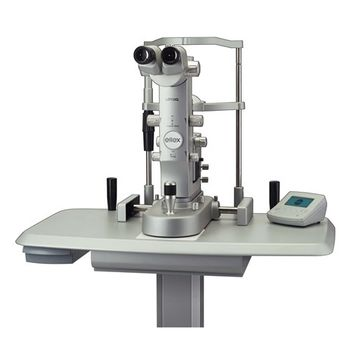
Ellex Ultra Q
 Ellex · Model Ultra Q
IOL-Friendly Photodisruption - Ultra Q™ achieves the industry’s lowest energy optical breakdown at 1.8mJ (in air) to cut tissue more efficiently with fewer shots and less cumulative energy. Featuring an Ultra Gaussian beam profile, Ultra Q™ focuses more energy into the center of the beam profile to deliver greater energy density. Not only does this reduce the amount of energy needed to effectively perform capsulotomy and iridotomy treatments, it also greatly reduces the risk of lens pitting. Capsulotomy for Presbyopic IOLs - A precise capsulotomy is essential for IOLs that correct presbyopia through implantation in the posterior chamber’s capsular bag. Good IOL centration, in terms of the pupil, optimizes lens performance. In contrast, decentration can cause halos and poor vision. The goal is a perfectly centered, precise capsulotomy that will not affect the tension of the bag and the position of the IOL in the visual axis. The precision and ultra-low energy optical breakdown provided by Ultra Q™ creates a capsulotomy opening that is precisely controlled, without causing damage to the lens – even if the lack of a ridge makes the capsule adhere to the optic. Iridotomy for Phakic IOLs - Refractive IOLs that are designed to correct myopia, or hyperopia (also known as Phakic IOLs) can be placed in front of the iris or between the iris and the natural lens. To prevent any possibility of IOL-induced pupillary block, these lenses require peripheral iridotomies prior to surgery. The iridotomy aperture must be large enough to ensure a balanced aqueous flow, yet small enough so that no light is transmitted back to the pupil, which can cause double vision. Ultra Q™ enables you to create a precise size of the iridotomy, often in a single shot that uses lower energy than other YAG lasers.
Key tips
- ·Verify laser output with a real power meter, not the unit's own display - the display can drift independently of true output.
- ·Take "the image looks a little off" reports seriously - optical alignment drift is usually gradual, not sudden.
Typical Failure Modes
Compiled for this model from its own documentation and established engineering knowledge for this equipment class - not from a verified service record. Confirm against the manufacturer's service manual.
No or low laser output
HighSymptoms: Weak or no output at the delivery device, treatment ineffective, power not reaching the set value.
Root cause: Laser module / lamp / diode-bar ageing, a damaged delivery fibre / handpiece / applicator, or a driver / power-supply fault.
Cooling / thermal shutdown
HighSymptoms: Unit shuts down after a period, over-temperature or low-flow alarm.
Root cause: Chiller / TEC fault, low or contaminated coolant, a failed pump, or blocked airflow.
Delivery fibre / handpiece / applicator fault
MediumSymptoms: Burn marks at the tip, high loss, intermittent output, applicator not recognised.
Root cause: Damaged or contaminated fibre / applicator / connector.
Skin-cooling / contact-cooling fault (aesthetic)
MediumSymptoms: Skin cooling not delivered, cooling / cryogen alarm.
Root cause: Contact-cooling / cryogen supply, a valve, or the tip.
Footswitch / interlock / key fault
MediumSymptoms: Laser will not fire, key / interlock / footswitch error.
Root cause: Footswitch, door interlock, or key-switch fault.
Serviceable Parts & Consumables
Serviceable items for this model, compiled from its documentation and engineering knowledge for this equipment class. Service class and relative cost are estimates, not manufacturer figures; no part numbers are given. Confirm intervals and pricing against the manufacturer.
Laser module / lamp / diode bar
Power re-calibration required after replacement.
Class Periodic replacementRel. cost $$$$R&R Expert-level
Delivery fibre / handpiece / applicator
Class Frequent wear itemRel. cost $$$R&R Fairly easy
Chiller / TEC components & coolant filter
Class Periodic replacementRel. cost $$$R&R Difficult
Contact-cooling tip / cryogen valve (aesthetic)
Class Periodic replacementRel. cost $$R&R Moderate
Footswitch
Class Periodic replacementRel. cost $$R&R Fairly easy
| Part | Service class | Relative cost | R&R difficulty |
|---|---|---|---|
| Laser module / lamp / diode bar Power re-calibration required after replacement. | Periodic replacement | $$$$ | Expert-level |
| Delivery fibre / handpiece / applicator | Frequent wear item | $$$ | Fairly easy |
| Chiller / TEC components & coolant filter | Periodic replacement | $$$ | Difficult |
| Contact-cooling tip / cryogen valve (aesthetic) | Periodic replacement | $$ | Moderate |
| Footswitch | Periodic replacement | $$ | Fairly easy |
Relative cost: $ lowest · $$$$ highest service-part cost for this equipment class. Not a price.
PM Checklist
Preventive-maintenance tasks typical of this equipment class. Perform to the manufacturer's procedure and your facility's policy - this is general reference, not a schedule for this specific unit.
- ·Optical alignment / calibration check
- ·Lamp or laser output verification
- ·Annual full PM
Troubleshooting Approach
A starting sequence for this model, compiled from its documentation and engineering knowledge for this equipment class. Follow the manufacturer's service documentation for the actual procedure.
Symptom: No or low output
- Measure output at the delivery device with a laser power meter against the setting.
- Fit a known-good delivery fibre / handpiece / applicator.
- Confirm the cooling system runs and coolant is at level and clean.
- Check the key, interlock and footswitch are satisfied.
- Escalate a confirmed laser-module or driver fault to the OEM; recalibrate power after any module work.
Symptom: Thermal shutdown
- Confirm the cooling fans / pump run and airflow is clear.
- Check the coolant level and replace the coolant filter.
- Let the unit cool and restart.
- Clean the air filters / vents.
- Monitor for recurrence during a treatment.
Technical Specs
- Laser Type
- Nd:Yag
- Height
- 57 cm laser only
- Length
- 44 cm laser only
- Weight
- 30 kg
- Wavelength
- 1064 nm
- Width
- 75 cm laser only
Typical Location
Where this class of equipment is typically deployed - general reference, not this unit's own placement record.
- Eye clinic / ophthalmology suite
- Operating Room (ophthalmic surgery)
Documents & Manuals
No documents available for this device yet.
Safety & Recalls
Synced live from the FDA openFDA API.
- RECALL
Unintended laser emission while the user was moving the joystick for targeting.
Troubleshoot this device with Bio
Describe a symptom or error code. Bio answers from this device's own documented error codes, failure modes, parts, and guides.
Ask Bio