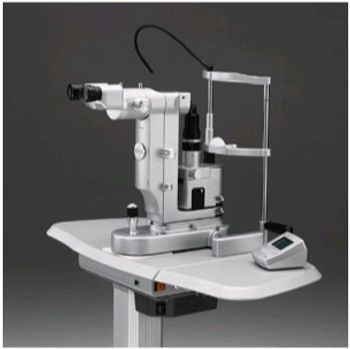
Ellex Tango
 Ellex · Model Tango
Built-In, Fully Integrated Design - Ellex’s fully integrated design optimizes laser treatment and provides a number of advantages, including a shorter travel distance for the laser beam, no add-ons or cables, and more stable, reliable and consistent delivery of energy. The Solo’s built-in slit lamp features converging optics to provide a more natural stereoscopic view that is ideal for anterior segment viewing. This compact, efficient design creates more working space for the physician, as well as convenient, simultaneous access to the patient and laser controls. Proprietary Dual Mode Laser Cavity - The Ellex design team capitalized on 20 years of ophthalmic laser innovation to create an SLT and YAG combination laser that incorporates a number of laser industry firsts. These include a proprietary dual mode cavity specifically designed to make procedures as effective as possible. In addition, the laser cavity has been combined with the slit lampand other system components for optimized performance. Ultra Gaussian Beam Profile in YAG Mode - The Ultra Gaussian beam profile and fast plasma rise time achieve ultra-low optical breakdown (in air) at approximately 1.8 mJ. This optimized laser energy enables capsulotomies and iridotomies to be performed at lower, more efficient power levels, resulting in a much lower risk of lens pitting, more efficient tissue cutting with fewer shots and less cumulative energy delivered. Fine, Two-Point Focusing System in YAG Mode - With the Tango’s tolerance range of ±8 microns, the physician can easily detect if the system is out of focus, and can ensure that energy is placed where intended in relation to the target. SLT Photoregeneration - SLT is a highly effective approach for first-line glaucoma treatments, adjunct therapy with drugs, and alternative therapy when drugs or surgery fail. It is also a flexible treatment option, because it can be repeated, if necessary, depending on the individual patient’s response. SLT uses short pulses of lowenergy light to target the melanin in specific cells of the affected eye. In response, the body’s natural healing mechanisms rebuild these cells, improving drainage and lowering intraocular pressure. The surrounding, non-pigmented cells – as well as the rest of the eye structure – are untouched and undamaged.
Key tips
- ·Verify laser output with a real power meter, not the unit's own display - the display can drift independently of true output.
- ·Take "the image looks a little off" reports seriously - optical alignment drift is usually gradual, not sudden.
Typical Failure Modes
Compiled for this model from its own documentation and established engineering knowledge for this equipment class - not from a verified service record. Confirm against the manufacturer's service manual.
No or low laser output
HighSymptoms: Weak or no output at the delivery device, treatment ineffective, power not reaching the set value.
Root cause: Laser module / lamp / diode-bar ageing, a damaged delivery fibre / handpiece / applicator, or a driver / power-supply fault.
Cooling / thermal shutdown
HighSymptoms: Unit shuts down after a period, over-temperature or low-flow alarm.
Root cause: Chiller / TEC fault, low or contaminated coolant, a failed pump, or blocked airflow.
Delivery fibre / handpiece / applicator fault
MediumSymptoms: Burn marks at the tip, high loss, intermittent output, applicator not recognised.
Root cause: Damaged or contaminated fibre / applicator / connector.
Skin-cooling / contact-cooling fault (aesthetic)
MediumSymptoms: Skin cooling not delivered, cooling / cryogen alarm.
Root cause: Contact-cooling / cryogen supply, a valve, or the tip.
Footswitch / interlock / key fault
MediumSymptoms: Laser will not fire, key / interlock / footswitch error.
Root cause: Footswitch, door interlock, or key-switch fault.
Serviceable Parts & Consumables
Serviceable items for this model, compiled from its documentation and engineering knowledge for this equipment class. Service class and relative cost are estimates, not manufacturer figures; no part numbers are given. Confirm intervals and pricing against the manufacturer.
Laser module / lamp / diode bar
Power re-calibration required after replacement.
Class Periodic replacementRel. cost $$$$R&R Expert-level
Delivery fibre / handpiece / applicator
Class Frequent wear itemRel. cost $$$R&R Fairly easy
Chiller / TEC components & coolant filter
Class Periodic replacementRel. cost $$$R&R Difficult
Contact-cooling tip / cryogen valve (aesthetic)
Class Periodic replacementRel. cost $$R&R Moderate
Footswitch
Class Periodic replacementRel. cost $$R&R Fairly easy
| Part | Service class | Relative cost | R&R difficulty |
|---|---|---|---|
| Laser module / lamp / diode bar Power re-calibration required after replacement. | Periodic replacement | $$$$ | Expert-level |
| Delivery fibre / handpiece / applicator | Frequent wear item | $$$ | Fairly easy |
| Chiller / TEC components & coolant filter | Periodic replacement | $$$ | Difficult |
| Contact-cooling tip / cryogen valve (aesthetic) | Periodic replacement | $$ | Moderate |
| Footswitch | Periodic replacement | $$ | Fairly easy |
Relative cost: $ lowest · $$$$ highest service-part cost for this equipment class. Not a price.
PM Checklist
Preventive-maintenance tasks typical of this equipment class. Perform to the manufacturer's procedure and your facility's policy - this is general reference, not a schedule for this specific unit.
- ·Optical alignment / calibration check
- ·Lamp or laser output verification
- ·Annual full PM
Troubleshooting Approach
A starting sequence for this model, compiled from its documentation and engineering knowledge for this equipment class. Follow the manufacturer's service documentation for the actual procedure.
Symptom: No or low output
- Measure output at the delivery device with a laser power meter against the setting.
- Fit a known-good delivery fibre / handpiece / applicator.
- Confirm the cooling system runs and coolant is at level and clean.
- Check the key, interlock and footswitch are satisfied.
- Escalate a confirmed laser-module or driver fault to the OEM; recalibrate power after any module work.
Symptom: Thermal shutdown
- Confirm the cooling fans / pump run and airflow is clear.
- Check the coolant level and replace the coolant filter.
- Let the unit cool and restart.
- Clean the air filters / vents.
- Monitor for recurrence during a treatment.
Technical Specs
- Laser Type
- Nd:Yag
- Height
- 53 in
- Length
- 20 in
- Weight
- 99 lbs
- Wavelength
- 532 nm
- Width
- 36
Typical Location
Where this class of equipment is typically deployed - general reference, not this unit's own placement record.
- Eye clinic / ophthalmology suite
- Operating Room (ophthalmic surgery)
Documents & Manuals
Troubleshoot this device with Bio
Describe a symptom or error code. Bio answers from this device's own documented error codes, failure modes, parts, and guides.
Ask Bio