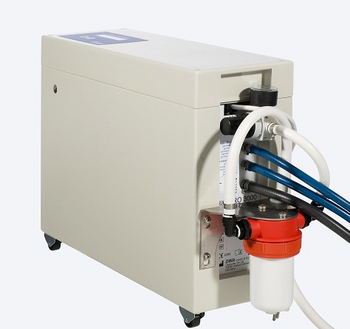
DWA HemoRO 3000
 DWA · Model HemoRO 3000
Hard water operation at 50 l/h up to 25 °dH / at 70 l/h up to 15 °dH Loop line to the dialysis unit Fully automatic standby flushing Integrated cleaning and disinfection program Compact design with easy disinfectable housing and castors Microprocessor controlled Standardized sample-taking Conformity declared with directive 93/42/EEC Optional with practical transport cart Optional with water guard for building protection Optional standardized permeate sample sets Optional citric acid injection sets (50% / 100 ml)
Key tips
- ·Conductivity and water-quality checks are non-negotiable before every shift - dialysate chemistry errors are a direct patient-harm mechanism.
- ·Confirm disinfection cycle completion, never assume it, after every use.
- ·Treat a blood-leak detector fault as real until proven otherwise - never silence and continue.
Typical Failure Modes
Compiled for this model from its own documentation and established engineering knowledge for this equipment class - not from a verified service record. Confirm against the manufacturer's service manual.
Conductivity / temperature / dialysate-prep alarm
HighSymptoms: Conductivity or temperature out of range, dialysate-preparation alarm, treatment will not start.
Root cause: Concentrate connection / supply, a heater fault, a conductivity-cell fault, or a proportioning-pump / valve fault.
Blood or dialysate pump fault
MediumSymptoms: Pump will not run at set speed, occlusion or flow alarms, tubing walking in the raceway.
Root cause: Worn pump rotor / rollers or a motor / control fault.
Pressure-monitoring / air-detector fault
MediumSymptoms: Venous / arterial / TMP pressure implausible, air-detector false alarms or fails to detect.
Root cause: Transducer-protector wetting, a pressure-sensor fault, or an air-detector fault.
UF / balancing-chamber fault
MediumSymptoms: Fluid-balance / UF alarms, weight loss inaccurate, balancing-chamber leak.
Root cause: Balancing-chamber diaphragm / valve wear or a flow-sensor fault.
Disinfection / rinse fault
MediumSymptoms: Heat or chemical disinfection will not complete, residual disinfectant test fails.
Root cause: Heater, a dosing / rinse valve, or a conductivity-verification fault.
Serviceable Parts & Consumables
Serviceable items for this model, compiled from its documentation and engineering knowledge for this equipment class. Service class and relative cost are estimates, not manufacturer figures; no part numbers are given. Confirm intervals and pricing against the manufacturer.
Blood / dialysate pump rotor & rollers
Class Periodic replacementRel. cost $$R&R Moderate
Conductivity cell / temperature sensor
Class Periodic replacementRel. cost $$R&R Moderate
Pressure sensors / transducer protectors
Class Periodic replacementRel. cost $$R&R Fairly easy
Balancing-chamber diaphragm / valve kit
Class Periodic replacementRel. cost $$$R&R Difficult
Proportioning pump / valves
Class Major service partRel. cost $$$R&R Difficult
| Part | Service class | Relative cost | R&R difficulty |
|---|---|---|---|
| Blood / dialysate pump rotor & rollers | Periodic replacement | $$ | Moderate |
| Conductivity cell / temperature sensor | Periodic replacement | $$ | Moderate |
| Pressure sensors / transducer protectors | Periodic replacement | $$ | Fairly easy |
| Balancing-chamber diaphragm / valve kit | Periodic replacement | $$$ | Difficult |
| Proportioning pump / valves | Major service part | $$$ | Difficult |
Relative cost: $ lowest · $$$$ highest service-part cost for this equipment class. Not a price.
PM Checklist
Preventive-maintenance tasks typical of this equipment class. Perform to the manufacturer's procedure and your facility's policy - this is general reference, not a schedule for this specific unit.
- ·Disinfection cycle verification
- ·Conductivity and water-quality check
- ·Blood-leak detector test
- ·Scheduled tubing / filter replacement
- ·Annual full PM
Troubleshooting Approach
A starting sequence for this model, compiled from its documentation and engineering knowledge for this equipment class. Follow the manufacturer's service documentation for the actual procedure.
Symptom: Conductivity or temperature alarm
- Confirm the concentrate is connected, correct and not empty.
- Verify dialysate conductivity and temperature with independent calibrated meters.
- Check / calibrate the conductivity cell and temperature sensor.
- Inspect the proportioning pumps / valves and de-air the hydraulics.
- Do not treat until conductivity and temperature are verified in range.
Symptom: Pump or pressure fault
- Inspect the pump rotor and rollers for wear and correct occlusion.
- Reseat the tubing segment in the raceway.
- Check the pressure transducers and protectors for wetting.
- Calibrate the pressure channels.
- Replace the rotor / rollers or a faulty sensor as isolated.
Typical Location
Where this class of equipment is typically deployed - general reference, not this unit's own placement record.
- Dialysis unit / clinic
- ICU (acute dialysis)
- Home hemodialysis
Documents & Manuals
Troubleshoot this device with Bio
Describe a symptom or error code. Bio answers from this device's own documented error codes, failure modes, parts, and guides.
Ask Bio