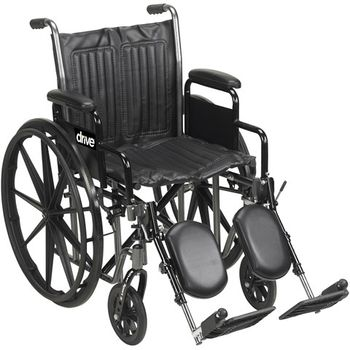
Drive Medical Silver Sport 2
 Drive Medical · Model Silver Sport 2
8" front casters, adjustable in 3 positions Carry pocket on backrest provides additional convenience Push to lock brakes Swing-away footrests or elevating leg rests with tool free length adjustable front riggings Embossed vinyl upholstery is durable, lightweight, attractive, and easy to clean Padded armrests Plastic footplates Powder coated silver vein steel frame Urethane tires mounted on composite wheel provides durability and low maintenance.
Key tips
- ·Casters and the wheel-lock brake take the most day-to-day wear - check both every PM, not just on complaint.
- ·A cracked weld or loose frame joint is a safety-critical finding - pull the unit from service until it's repaired.
Typical Failure Modes
Compiled for this model from its own documentation and established engineering knowledge for this equipment class - not from a verified service record. Confirm against the manufacturer's service manual.
Wheel / castor fault
MediumSymptoms: Wobble, drag, flat-spot, bearing noise, castor flutter.
Root cause: Worn wheel bearings, a damaged rim / tyre, or worn castor forks.
Wheel-lock (brake) fault
HighSymptoms: Brake will not hold, chair creeps, lever loose or bent.
Root cause: Worn or mis-adjusted wheel-lock, or a worn tyre reducing brake bite.
Folding / frame mechanism fault
MediumSymptoms: Cross-brace stiff or sloppy, frame flex, squeaks.
Root cause: Worn cross-brace pivots or loose frame hardware.
Upholstery / armrest / footrest fault
LowSymptoms: Torn seat / back sling, loose or missing armrest / footrest, hanger will not latch.
Root cause: Worn upholstery or worn latch hardware.
Anti-tipper / caster-lock fault
LowSymptoms: Anti-tip tubes bent or missing, will not swing down.
Root cause: Damaged or missing anti-tip hardware - a safety item.
Serviceable Parts & Consumables
Serviceable items for this model, compiled from its documentation and engineering knowledge for this equipment class. Service class and relative cost are estimates, not manufacturer figures; no part numbers are given. Confirm intervals and pricing against the manufacturer.
Wheel / castor bearing set
Class Periodic replacementRel. cost $$R&R Fairly easy
Wheel locks (pair)
Class Periodic replacementRel. cost $R&R Fairly easy
Seat / back upholstery
Class Periodic replacementRel. cost $$R&R Fairly easy
Armrest / footrest / hanger hardware
Class Periodic replacementRel. cost $$R&R Fairly easy
Tyres / inserts
Class Periodic replacementRel. cost $R&R Fairly easy
| Part | Service class | Relative cost | R&R difficulty |
|---|---|---|---|
| Wheel / castor bearing set | Periodic replacement | $$ | Fairly easy |
| Wheel locks (pair) | Periodic replacement | $ | Fairly easy |
| Seat / back upholstery | Periodic replacement | $$ | Fairly easy |
| Armrest / footrest / hanger hardware | Periodic replacement | $$ | Fairly easy |
| Tyres / inserts | Periodic replacement | $ | Fairly easy |
Relative cost: $ lowest · $$$$ highest service-part cost for this equipment class. Not a price.
PM Checklist
Preventive-maintenance tasks typical of this equipment class. Perform to the manufacturer's procedure and your facility's policy - this is general reference, not a schedule for this specific unit.
- ·Caster / wheel and brake function check
- ·Frame, weld, and mounting-hardware inspection
- ·Upholstery / surface condition check
- ·Annual full PM
Troubleshooting Approach
A starting sequence for this model, compiled from its documentation and engineering knowledge for this equipment class. Follow the manufacturer's service documentation for the actual procedure.
Symptom: Drag, wobble or bearing noise
- Lift each wheel and spin it, feeling for roughness and checking for play.
- Inspect the tyres / rims for damage.
- Repack or replace the wheel / castor bearings.
- Check castor-fork alignment and stem tightness.
- Confirm the chair rolls straight and free.
Symptom: Brake will not hold
- Check tyre condition and pressure (pneumatic) - a soft tyre kills brake bite.
- Adjust the wheel-lock to the manufacturer's engagement gap.
- Replace a bent or worn wheel-lock.
- Confirm the chair holds on a ramp with a load.
- Check both sides engage evenly.
Typical Location
Where this class of equipment is typically deployed - general reference, not this unit's own placement record.
- Ambulance / transport vehicles
- Emergency Department
- Inter-facility transport teams
Documents & Manuals
Troubleshoot this device with Bio
Describe a symptom or error code. Bio answers from this device's own documented error codes, failure modes, parts, and guides.
Ask Bio