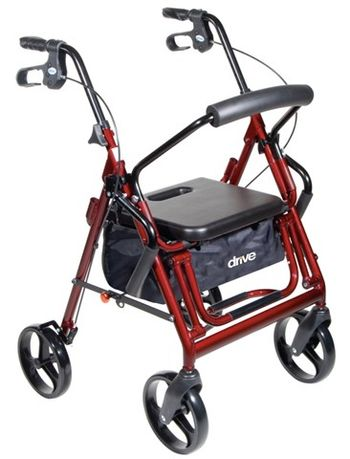
Drive Medical Duet Transport Rollator Walker Chair
 Drive Medical · Model Duet Transport Rollator Walker Chair
A safety lock release is used to store the arms and a hook & loop fastener strap is used to store the footrest while using the Duet for ambulation An individual can ambulate independently or be pushed safely by a care giver Combines the features of a rollator or transport chair in one unit Comfortable padded seat with a large under seat pouch for safe storage of personal items Easy release loop locks Inside the pouch is a handle to aid with the folding Large 8" casters are used for both indoor and outdoor activities The Duet has locking flip up armrests and a flip down footrest to aid the user while the Duet is used in the transport chair mode The folding frame has a lock out feature to insure the unit stays open while in use and insures the unit will stay folded during transport The tool-free two position contoured padded back rest is reversible depending on whether you are using the Duet in an ambulatory or transport chair mode.
Key tips
- ·Casters and the wheel-lock brake take the most day-to-day wear - check both every PM, not just on complaint.
- ·A cracked weld or loose frame joint is a safety-critical finding - pull the unit from service until it's repaired.
Typical Failure Modes
Compiled for this model from its own documentation and established engineering knowledge for this equipment class - not from a verified service record. Confirm against the manufacturer's service manual.
Wheel / castor fault
MediumSymptoms: Wobble, drag, flat-spot, bearing noise, castor flutter.
Root cause: Worn wheel bearings, a damaged rim / tyre, or worn castor forks.
Wheel-lock (brake) fault
HighSymptoms: Brake will not hold, chair creeps, lever loose or bent.
Root cause: Worn or mis-adjusted wheel-lock, or a worn tyre reducing brake bite.
Folding / frame mechanism fault
MediumSymptoms: Cross-brace stiff or sloppy, frame flex, squeaks.
Root cause: Worn cross-brace pivots or loose frame hardware.
Upholstery / armrest / footrest fault
LowSymptoms: Torn seat / back sling, loose or missing armrest / footrest, hanger will not latch.
Root cause: Worn upholstery or worn latch hardware.
Anti-tipper / caster-lock fault
LowSymptoms: Anti-tip tubes bent or missing, will not swing down.
Root cause: Damaged or missing anti-tip hardware - a safety item.
Serviceable Parts & Consumables
Serviceable items for this model, compiled from its documentation and engineering knowledge for this equipment class. Service class and relative cost are estimates, not manufacturer figures; no part numbers are given. Confirm intervals and pricing against the manufacturer.
Wheel / castor bearing set
Class Periodic replacementRel. cost $$R&R Fairly easy
Wheel locks (pair)
Class Periodic replacementRel. cost $R&R Fairly easy
Seat / back upholstery
Class Periodic replacementRel. cost $$R&R Fairly easy
Armrest / footrest / hanger hardware
Class Periodic replacementRel. cost $$R&R Fairly easy
Tyres / inserts
Class Periodic replacementRel. cost $R&R Fairly easy
| Part | Service class | Relative cost | R&R difficulty |
|---|---|---|---|
| Wheel / castor bearing set | Periodic replacement | $$ | Fairly easy |
| Wheel locks (pair) | Periodic replacement | $ | Fairly easy |
| Seat / back upholstery | Periodic replacement | $$ | Fairly easy |
| Armrest / footrest / hanger hardware | Periodic replacement | $$ | Fairly easy |
| Tyres / inserts | Periodic replacement | $ | Fairly easy |
Relative cost: $ lowest · $$$$ highest service-part cost for this equipment class. Not a price.
PM Checklist
Preventive-maintenance tasks typical of this equipment class. Perform to the manufacturer's procedure and your facility's policy - this is general reference, not a schedule for this specific unit.
- ·Caster / wheel and brake function check
- ·Frame, weld, and mounting-hardware inspection
- ·Upholstery / surface condition check
- ·Annual full PM
Troubleshooting Approach
A starting sequence for this model, compiled from its documentation and engineering knowledge for this equipment class. Follow the manufacturer's service documentation for the actual procedure.
Symptom: Drag, wobble or bearing noise
- Lift each wheel and spin it, feeling for roughness and checking for play.
- Inspect the tyres / rims for damage.
- Repack or replace the wheel / castor bearings.
- Check castor-fork alignment and stem tightness.
- Confirm the chair rolls straight and free.
Symptom: Brake will not hold
- Check tyre condition and pressure (pneumatic) - a soft tyre kills brake bite.
- Adjust the wheel-lock to the manufacturer's engagement gap.
- Replace a bent or worn wheel-lock.
- Confirm the chair holds on a ramp with a load.
- Check both sides engage evenly.
Technical Specs
- Height
- 37 inches overall
- Length
- 26 inches overall
- Weight
- 20 lbs
- Patient Weight Capacity
- 300 lbs
- Width
- 25.5 inches overall
Typical Location
Where this class of equipment is typically deployed - general reference, not this unit's own placement record.
- Ambulance / transport vehicles
- Emergency Department
- Inter-facility transport teams
Documents & Manuals
Troubleshoot this device with Bio
Describe a symptom or error code. Bio answers from this device's own documented error codes, failure modes, parts, and guides.
Ask Bio