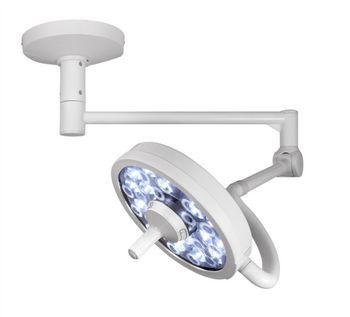
DRE Vision EX5
 DRE · Model Vision EX5
Affordable midsize light for minor surgery and procedures. LED array delivers maximum sharpness and color accuracy. Three-stage dimming for easily controlling the brightness within the illumination field. Maximum output rated at 75,000 Lux. 4,300° K bright white illumination. Color Rendering Index: 97. Long-life LED’s rated at 50,000 hours. Dimming and on/off switch controlled by autoclavable handle. Light array emits virtually no radiated heat.
Key tips
- ·Never defeat or bypass a return-electrode monitoring (REM) alarm to finish a case - it's a direct burn risk.
- ·Verify OR table battery backup - a table that loses power mid-procedure is a real, documented incident type.
- ·Track surgical light lamp-hours rather than waiting for failure - a sudden failure mid-case is avoidable.
Typical Failure Modes
Compiled for this model from its own documentation and established engineering knowledge for this equipment class - not from a verified service record. Confirm against the manufacturer's service manual.
Lamp / LED failure or reduced illuminance
MediumSymptoms: One or more heads / LED segments out, dim head, uneven or discoloured light field.
Root cause: Halogen lamp at end of life or a failed LED module / driver, a lamp-changeover fault, or a power-supply fault.
Spring-arm / suspension drift
HighSymptoms: Light head drifts up or down, will not stay positioned.
Root cause: Spring-arm counterbalance out of adjustment or worn friction brakes.
Intensity / focus control fault
MediumSymptoms: Brightness or spot size will not adjust from the wall panel or sterile handle.
Root cause: Control PCB, the wall-plate keypad, or the handle switch.
Sterilizable handle fault
LowSymptoms: Handle loose or not detected.
Root cause: Worn handle mount / contacts.
Power-supply fault
MediumSymptoms: Whole head dark, flicker, or will not power on.
Root cause: Failed lamp / LED power supply.
Serviceable Parts & Consumables
Serviceable items for this model, compiled from its documentation and engineering knowledge for this equipment class. Service class and relative cost are estimates, not manufacturer figures; no part numbers are given. Confirm intervals and pricing against the manufacturer.
Light-head lamp / LED module
Class Frequent wear itemRel. cost $$R&R Fairly easy
Lamp / LED power supply
Class Major service partRel. cost $$R&R Moderate
Spring-arm counterbalance / friction-brake kit
Class Major service partRel. cost $$$R&R Difficult
Control PCB / wall-plate keypad
Class Major service partRel. cost $$R&R Moderate
Sterilizable handle
Class Periodic replacementRel. cost $$R&R Easy
| Part | Service class | Relative cost | R&R difficulty |
|---|---|---|---|
| Light-head lamp / LED module | Frequent wear item | $$ | Fairly easy |
| Lamp / LED power supply | Major service part | $$ | Moderate |
| Spring-arm counterbalance / friction-brake kit | Major service part | $$$ | Difficult |
| Control PCB / wall-plate keypad | Major service part | $$ | Moderate |
| Sterilizable handle | Periodic replacement | $$ | Easy |
Relative cost: $ lowest · $$$$ highest service-part cost for this equipment class. Not a price.
PM Checklist
Preventive-maintenance tasks typical of this equipment class. Perform to the manufacturer's procedure and your facility's policy - this is general reference, not a schedule for this specific unit.
- ·Pre-case functional check
- ·Electrosurgical return-electrode cable inspection
- ·Table hydraulic / mechanical inspection
- ·Annual electrical safety test and full PM
Troubleshooting Approach
A starting sequence for this model, compiled from its documentation and engineering knowledge for this equipment class. Follow the manufacturer's service documentation for the actual procedure.
Symptom: Light out or dim / uneven
- Confirm mains power to the light and the wall-plate control.
- Replace the lamp / LED module (let a halogen head cool) and check the changeover mechanism.
- Replace the power supply if the head is unpowered.
- Verify even, full-illuminance output.
- Check the handle detection.
Symptom: Head will not hold position
- Adjust the spring-arm counterbalance for the head weight per the manual.
- Check the friction brakes at each joint.
- Replace the counterbalance / friction-brake kit if adjustment does not hold.
- Cycle the arm through its range.
- Confirm the head stays put at several positions.
Typical Location
Where this class of equipment is typically deployed - general reference, not this unit's own placement record.
- Operating rooms
- Procedure rooms
- Interventional suites
Documents & Manuals
Troubleshoot this device with Bio
Describe a symptom or error code. Bio answers from this device's own documented error codes, failure modes, parts, and guides.
Ask Bio