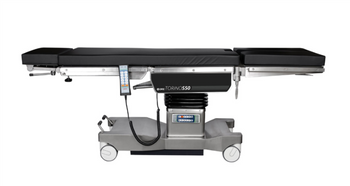
DRE Torino 550
 DRE · Model Torino 550
Adjustable height from 28 to 40 inches for improved access to the operative field. Table movements include: Trendelenburg, reverse Trendelenburg, leg and back section adjustment, lateral tilt, longitudinal slide for C-arm access, and kidney bridge. Large casters and convenient braking system for easy and convenient maneuvering throughout any surgical facility. Battery backup for continued use in the event of a power loss. Powered or manual solid leg rest. Corded remote control panel for exact positioning. Comfortable memory padding is waterproof and antistatic. Added safety with override panel controls on the base of the unit.
Key tips
- ·Never defeat or bypass a return-electrode monitoring (REM) alarm to finish a case - it's a direct burn risk.
- ·Verify OR table battery backup - a table that loses power mid-procedure is a real, documented incident type.
- ·Track surgical light lamp-hours rather than waiting for failure - a sudden failure mid-case is avoidable.
Typical Failure Modes
Compiled for this model from its own documentation and established engineering knowledge for this equipment class - not from a verified service record. Confirm against the manufacturer's service manual.
A powered function will not run
HighSymptoms: Height, tilt, Trendelenburg, back or leg section does not respond to the hand control / pendant.
Root cause: Hand control fault, an electro-hydraulic actuator, a control-board fault, or a low battery (mobile column).
Section drifts or will not hold
MediumSymptoms: Table settles under load after positioning.
Root cause: Hydraulic valve internal leak or an actuator backdrive.
Battery will not hold charge (mobile column)
MediumSymptoms: Short run time, table dies mid-procedure, battery alarm.
Root cause: Aged battery pack or a charger fault.
Hand control / pendant / cable fault
MediumSymptoms: Intermittent or dead hand control.
Root cause: Worn hand control or a damaged cable.
Table-top segment / rail / pad fault
LowSymptoms: Segments loose, accessory rails will not clamp, pads torn, radiolucent top damaged.
Root cause: Worn segment latches, rail clamps, or upholstery.
Serviceable Parts & Consumables
Serviceable items for this model, compiled from its documentation and engineering knowledge for this equipment class. Service class and relative cost are estimates, not manufacturer figures; no part numbers are given. Confirm intervals and pricing against the manufacturer.
Electro-hydraulic actuator
Class Major service partRel. cost $$$R&R Difficult
Hydraulic control valve block
Class Major service partRel. cost $$$R&R Difficult
Battery pack (mobile column)
Class Periodic replacementRel. cost $$R&R Fairly easy
Hand control / pendant
Class Periodic replacementRel. cost $$R&R Fairly easy
Table-top segment pads / rail clamps
Class Major service partRel. cost $$R&R Fairly easy
| Part | Service class | Relative cost | R&R difficulty |
|---|---|---|---|
| Electro-hydraulic actuator | Major service part | $$$ | Difficult |
| Hydraulic control valve block | Major service part | $$$ | Difficult |
| Battery pack (mobile column) | Periodic replacement | $$ | Fairly easy |
| Hand control / pendant | Periodic replacement | $$ | Fairly easy |
| Table-top segment pads / rail clamps | Major service part | $$ | Fairly easy |
Relative cost: $ lowest · $$$$ highest service-part cost for this equipment class. Not a price.
PM Checklist
Preventive-maintenance tasks typical of this equipment class. Perform to the manufacturer's procedure and your facility's policy - this is general reference, not a schedule for this specific unit.
- ·Pre-case functional check
- ·Electrosurgical return-electrode cable inspection
- ·Table hydraulic / mechanical inspection
- ·Annual electrical safety test and full PM
Troubleshooting Approach
A starting sequence for this model, compiled from its documentation and engineering knowledge for this equipment class. Follow the manufacturer's service documentation for the actual procedure.
Symptom: A powered function is dead
- Confirm the battery is charged or the table is on mains, and any lock-out is off.
- Operate the function and listen for the actuator / pump.
- Substitute a known-good hand control.
- Check the control cable for damage.
- Replace the actuator, valve or control board as isolated, then load-test.
Symptom: Section drifts down
- Note how fast it settles and under what load.
- Check the hydraulic valve for internal leakage and the actuator for backdrive.
- Bleed / top up the hydraulic system per the manual.
- Rebuild or replace the leaking valve / actuator.
- Confirm it holds at several positions under load.
Technical Specs
- Length
- 81.1 in
- Tredelenburg
- 25 degrees
- Lateral Tilt
- 15 degrees
- Patient Weight Capacity
- 550
- Width
- 21.7 in
Typical Location
Where this class of equipment is typically deployed - general reference, not this unit's own placement record.
- Operating rooms
- Procedure rooms
- Interventional suites
Documents & Manuals
Troubleshoot this device with Bio
Describe a symptom or error code. Bio answers from this device's own documented error codes, failure modes, parts, and guides.
Ask Bio