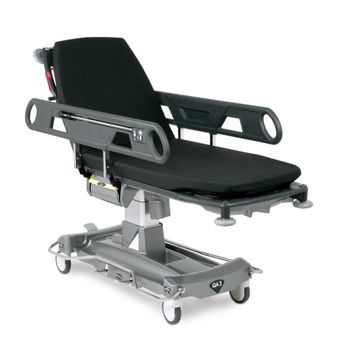
DRE Savoy QA3
 DRE · Model Savoy QA3
Vertically operated patient safety rails store away under the mattress giving a virtually zero transfer gap. Spring counterbalancing allows effortless ease of operation. Fixed transfusion pole provides innovative, quick release safety locking mechanism and integrates into either head or foot end of patient safety rails for easy access and storage. Hydraulic lift mechanism has an exceptional low height capability adjusted by means of independently operating pedals located on both sides of the stretcher. Castors are constructed with polyurethane tires to offer low rolling resistance for high maneuverability. 5th wheel steering is a unique mechanism to ensures high maneuverability and so the stretcher is easily guided by one person. Cylinder trough allows side loading for accessibility, suitable for a wide range of cylinder options including F, E, or D. Gas assisted backlift has a unique design, precision control, and an easy lift system for enhanced user and patient comfort. Trendelenburg tilt allows rapid Trendelenburg to be achieved extremely smoothly and with control even when the stretcher is at its lowest height. Four Ergonomically Positioned Pushing handles give supreme maneuverability either with the patient lying flat or sitting up. K8 pressure care mattress is manufactured from temperature-sensitive gel feel foam that molds to the patient's body shape, relieving pressure by distributing the load as evenly as possible. Developed with the flexible properties of lycra, this outer material is anti-microbacterial, water resistant, vapor permeable, and latex free. Patient Utility Trays Rotating Buffers at head and foot ends Anti-bacterial Properties and Smooth Molded Surfaces.
Key tips
- ·Casters and the wheel-lock brake take the most day-to-day wear - check both every PM, not just on complaint.
- ·A cracked weld or loose frame joint is a safety-critical finding - pull the unit from service until it's repaired.
Typical Failure Modes
Compiled for this model from its own documentation and established engineering knowledge for this equipment class - not from a verified service record. Confirm against the manufacturer's service manual.
Hydraulic height / Trendelenburg will not lift or holds poorly
HighSymptoms: Pump will not raise the deck, or the deck settles under load.
Root cause: Worn hydraulic pump / seals, an internal valve leak, or low hydraulic fluid.
Brake / steer castor fault
MediumSymptoms: Brake will not hold, fifth-wheel steer ineffective, castor shimmy.
Root cause: Worn brake linkage, castors, or the fifth-wheel mechanism.
Backrest / Fowler mechanism fault
MediumSymptoms: Backrest will not raise / hold, gas strut weak, pneumatic assist failed.
Root cause: Worn gas spring / strut or the release mechanism.
Siderail / IV pole / accessory fault
LowSymptoms: Siderails will not latch or drop, IV pole loose, litter attachments worn.
Root cause: Worn latches, detents, or accessory sockets.
Powered drive fault (powered stretchers)
MediumSymptoms: Drive assist will not engage or is weak, drive-fault code.
Root cause: Drive battery, motor / controller, or the throttle.
Serviceable Parts & Consumables
Serviceable items for this model, compiled from its documentation and engineering knowledge for this equipment class. Service class and relative cost are estimates, not manufacturer figures; no part numbers are given. Confirm intervals and pricing against the manufacturer.
Hydraulic pump / seal kit
Class Major service partRel. cost $$R&R Moderate
Castor / brake-linkage set
Class Periodic replacementRel. cost $$R&R Moderate
Backrest gas spring / strut
Class Periodic replacementRel. cost $$R&R Fairly easy
Siderail latch / accessory sockets
Class Major service partRel. cost $$R&R Fairly easy
Drive battery (powered stretchers)
Class Periodic replacementRel. cost $$R&R Fairly easy
| Part | Service class | Relative cost | R&R difficulty |
|---|---|---|---|
| Hydraulic pump / seal kit | Major service part | $$ | Moderate |
| Castor / brake-linkage set | Periodic replacement | $$ | Moderate |
| Backrest gas spring / strut | Periodic replacement | $$ | Fairly easy |
| Siderail latch / accessory sockets | Major service part | $$ | Fairly easy |
| Drive battery (powered stretchers) | Periodic replacement | $$ | Fairly easy |
Relative cost: $ lowest · $$$$ highest service-part cost for this equipment class. Not a price.
PM Checklist
Preventive-maintenance tasks typical of this equipment class. Perform to the manufacturer's procedure and your facility's policy - this is general reference, not a schedule for this specific unit.
- ·Caster / wheel and brake function check
- ·Frame, weld, and mounting-hardware inspection
- ·Upholstery / surface condition check
- ·Annual full PM
Troubleshooting Approach
A starting sequence for this model, compiled from its documentation and engineering knowledge for this equipment class. Follow the manufacturer's service documentation for the actual procedure.
Symptom: Will not lift or settles under load
- Check the hydraulic fluid level.
- Pump the deck up under load and time how fast it settles.
- Inspect the pump and cylinder for external leaks.
- Rebuild the pump with the seal kit or bleed the system per the manual.
- Confirm it holds at full height under the rated load.
Symptom: Brake will not hold or castor shimmy
- Inspect the brake linkage and each castor.
- Adjust the central-brake linkage.
- Replace worn castors and the fifth-wheel components.
- Confirm the brake holds on an incline.
- Check steer-lock engagement.
Typical Location
Where this class of equipment is typically deployed - general reference, not this unit's own placement record.
- Ambulance / transport vehicles
- Emergency Department
- Inter-facility transport teams
Documents & Manuals
Troubleshoot this device with Bio
Describe a symptom or error code. Bio answers from this device's own documented error codes, failure modes, parts, and guides.
Ask Bio