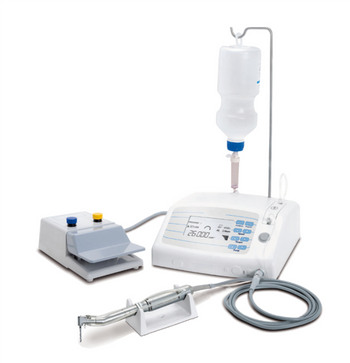
DRE OS-150
 DRE · Model OS-150
Large, illuminated display: Reduction to the essential. All treatment parameter are clearly shown and legibly on the large display Keyboard: Easy to navigate with the up and down button to change the respective values (torque and speed) Two selected programs for drilling and placing the implant 3 programs for drilling, cutting threads, screwing in the implants and placing the cover screw Automatic memorize parameters Calibration mode for contra angles Integrated pump system for cooling the instrument to prevent tissue damage Modern design – no sharp edges – easy to clean Irrigation pump: built in low noise peristaltic pump – easy to load.
Key tips
- ·Never defeat or bypass a return-electrode monitoring (REM) alarm to finish a case - it's a direct burn risk.
- ·Verify OR table battery backup - a table that loses power mid-procedure is a real, documented incident type.
- ·Track surgical light lamp-hours rather than waiting for failure - a sudden failure mid-case is avoidable.
Typical Failure Modes
Compiled for this model from its own documentation and established engineering knowledge for this equipment class - not from a verified service record. Confirm against the manufacturer's service manual.
Weak or no power / stalls under load
HighSymptoms: Handpiece runs slow, stalls when drilling / cutting, or does not run at all.
Root cause: Worn motor / turbine, worn gears / bearings, a low or aged battery, or (pneumatic) low supply pressure / a worn hose.
Overheats in use
MediumSymptoms: Handpiece or attachment gets hot quickly, burn / thermal-necrosis risk.
Root cause: Worn bearings / gears, a dry / seized attachment, or over-duty use.
Battery will not hold charge (battery tools)
HighSymptoms: Few cases per charge, will not reach full charge, sudden shutdown.
Root cause: Aged battery pack or a charger fault.
Chuck / coupling / attachment fault
MediumSymptoms: Bur / blade / pin slips or will not lock, attachment wobbles, quick-coupler worn.
Root cause: Worn chuck / collet or coupling.
Trigger / control fault
MediumSymptoms: Speed will not vary, forward/reverse or oscillate will not select, trigger sticks.
Root cause: Worn trigger / control mechanism or its seals.
Serviceable Parts & Consumables
Serviceable items for this model, compiled from its documentation and engineering knowledge for this equipment class. Service class and relative cost are estimates, not manufacturer figures; no part numbers are given. Confirm intervals and pricing against the manufacturer.
Motor / turbine assembly
Class Periodic replacementRel. cost $$$R&R Difficult
Gear / bearing service kit
Class Periodic replacementRel. cost $$R&R Difficult
Battery pack (battery tools)
Class Periodic replacementRel. cost $$$R&R Fairly easy
Chuck / collet / quick-coupler
Class Periodic replacementRel. cost $$R&R Moderate
Trigger / seal kit
Class Periodic replacementRel. cost $$R&R Moderate
| Part | Service class | Relative cost | R&R difficulty |
|---|---|---|---|
| Motor / turbine assembly | Periodic replacement | $$$ | Difficult |
| Gear / bearing service kit | Periodic replacement | $$ | Difficult |
| Battery pack (battery tools) | Periodic replacement | $$$ | Fairly easy |
| Chuck / collet / quick-coupler | Periodic replacement | $$ | Moderate |
| Trigger / seal kit | Periodic replacement | $$ | Moderate |
Relative cost: $ lowest · $$$$ highest service-part cost for this equipment class. Not a price.
PM Checklist
Preventive-maintenance tasks typical of this equipment class. Perform to the manufacturer's procedure and your facility's policy - this is general reference, not a schedule for this specific unit.
- ·Pre-case functional check
- ·Electrosurgical return-electrode cable inspection
- ·Table hydraulic / mechanical inspection
- ·Annual electrical safety test and full PM
Troubleshooting Approach
A starting sequence for this model, compiled from its documentation and engineering knowledge for this equipment class. Follow the manufacturer's service documentation for the actual procedure.
Symptom: Weak, stalling or no power
- Fit a fully charged battery (battery tools) or confirm the pneumatic supply pressure and hose.
- Fit a fresh, sharp attachment and confirm it seats and locks.
- Run the handpiece off the patient and listen / feel for bearing or gear roughness.
- Service the handpiece (bearings / gears / seals) or replace the motor.
- Confirm rated speed and torque and normal running temperature after service.
Symptom: Overheats
- Use sharp attachments and observe the duty cycle.
- Check the attachment / coupling is not dragging or dry.
- Feel for bearing roughness.
- Service the bearings / gears.
- Confirm the handpiece runs cool under a normal load.
Typical Location
Where this class of equipment is typically deployed - general reference, not this unit's own placement record.
- Operating rooms
- Procedure rooms
- Interventional suites
Documents & Manuals
No documents available for this device yet.
Troubleshoot this device with Bio
Describe a symptom or error code. Bio answers from this device's own documented error codes, failure modes, parts, and guides.
Ask Bio