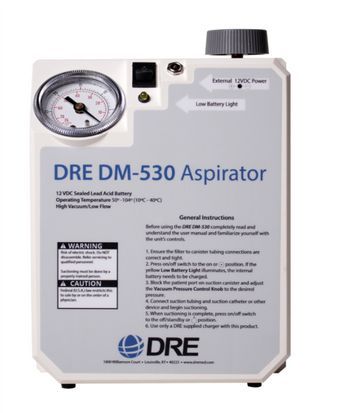
DRE DM 530
 DRE · Model DM 530
Uses any standard 800 cc canister The ABS plastic cabinet is durable, attractive, easy-to-clean and infection control friendly Two Safeguards A float shut-off in the canister to protect overflow and An Inline Hydrophobic Filter to prevent back flow of fluid as well as airborne contaminants from entering the pump.
Key tips
- ·When no category-specific guidance fits, default to the manufacturer's own service manual and the general troubleshooting method in the Engineer's Guide.
- ·Run an incoming and annual electrical safety test regardless of how niche the device is.
Typical Failure Modes
Compiled for this model from its own documentation and established engineering knowledge for this equipment class - not from a verified service record. Confirm against the manufacturer's service manual.
Aspirator will not run
HighSymptoms: Nothing happens on power-up.
Root cause: On/off switch, power cord, or a tripped thermal cut-off.
No or weak vacuum
HighSymptoms: Gauge low or zero, poor suction at the catheter.
Root cause: Hydrophobic filter not seated or clogged, canister lid not sealed, a defective canister, or worn pump vanes/diaphragm.
Vacuum at the gauge but not at the patient tubing
MediumSymptoms: Gauge builds vacuum, none at the catheter.
Root cause: Clogged filter or an overfilled canister.
Unable to adjust vacuum
MediumSymptoms: Regulator knob has no effect.
Root cause: Defective regulator.
Serviceable Parts & Consumables
Serviceable items for this model, compiled from its documentation and engineering knowledge for this equipment class. Service class and relative cost are estimates, not manufacturer figures; no part numbers are given. Confirm intervals and pricing against the manufacturer.
Hydrophobic / bacterial filter
Class ConsumableRel. cost $R&R Easy
Collection canister and lid float
Class Frequent wear itemRel. cost $R&R Easy
Pump rebuild kit
Class Periodic replacementRel. cost $$R&R Difficult
Vacuum regulator
Class Major service partRel. cost $$R&R Moderate
Vacuum gauge
Class Major service partRel. cost $R&R Moderate
| Part | Service class | Relative cost | R&R difficulty |
|---|---|---|---|
| Hydrophobic / bacterial filter | Consumable | $ | Easy |
| Collection canister and lid float | Frequent wear item | $ | Easy |
| Pump rebuild kit | Periodic replacement | $$ | Difficult |
| Vacuum regulator | Major service part | $$ | Moderate |
| Vacuum gauge | Major service part | $ | Moderate |
Relative cost: $ lowest · $$$$ highest service-part cost for this equipment class. Not a price.
PM Checklist
Preventive-maintenance tasks typical of this equipment class. Perform to the manufacturer's procedure and your facility's policy - this is general reference, not a schedule for this specific unit.
- ·Follow the manufacturer's PM schedule
- ·Perform incoming and annual electrical safety testing per facility biomedical program
Troubleshooting Approach
A starting sequence for this model, compiled from its documentation and engineering knowledge for this equipment class. Follow the manufacturer's service documentation for the actual procedure.
Symptom: Will not run
- Push the on/off switch firmly to ON.
- Check the plug at the outlet.
- If it overheated, switch off, wait 15 minutes and clear the vents.
- If still dead, refer for service.
Symptom: No or weak vacuum
- Confirm and tighten the filter and canister lid.
- Replace a clogged filter or a cracked canister.
- With the tubing occluded, check the pump reaches its rated vacuum.
- Rebuild the pump if vacuum is weak with a sealed system.
- Replace the regulator if vacuum cannot be adjusted.
Technical Specs
- Height
- 10 in
- Length
- 12 in
- Weight
- 9.6 lbs
- Width
- 9.5 in
Typical Location
Where this class of equipment is typically deployed - general reference, not this unit's own placement record.
- Varies by device - check the unit's own manual for facility placement guidance
Documents & Manuals
Troubleshoot this device with Bio
Describe a symptom or error code. Bio answers from this device's own documented error codes, failure modes, parts, and guides.
Ask Bio