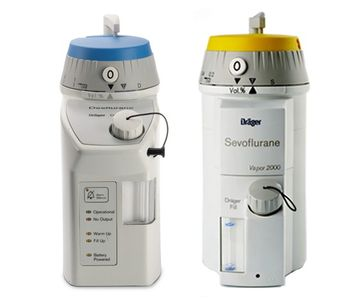
Draeger Vapor 2000/ D Vapor
 Dräger · Model Vapor 2000/ D Vapor
Safe and Simple Transport - When set in transport position, both the Dräger Vapor 2000 and the D-Vapor can withstand tipping or even being turned upside down without any ill effects Highly Compatible - Designed to work with practically any Dräger anesthesia workstation Operational Within a Wider Temperature Range - Can be safely operated at temperatures ranging from 10 – 40 °C Zero Calibration - Requires absolutely no calibration: This saves you time Backup Power - It is electrically driven and comes equipped with a battery which maintains function in case of a power failure.
Key tips
- ·A failed daily leak test takes the machine out of service immediately - there is no acceptable workaround.
- ·Never run an agent-specific vaporizer with the wrong agent, even briefly, during testing.
- ·CO2-absorbent exhaustion mimics several unrelated fault symptoms - rule it out early.
Typical Failure Modes
Compiled for this model from its own documentation and established engineering knowledge for this equipment class - not from a verified service record. Confirm against the manufacturer's service manual.
Delivered agent concentration inaccurate
HighSymptoms: Agent analyser shows the output does not match the dial beyond the vaporiser's stated tolerance.
Root cause: The vaporiser is out of calibration - recalibration is done only at an authorised service centre.
Back-bar / mounting leak
MediumSymptoms: Machine leak test fails with this vaporiser fitted, agent smell.
Root cause: Worn back-bar O-rings / mounting seal, or the vaporiser not fully locked / Selectatec latched onto the manifold.
Filling / drain fault
MediumSymptoms: Will not fill (keyed or funnel filler), spills, or overfills; sight glass hard to read.
Root cause: Worn filler seal / valve, or the wrong agent bottle adapter.
Concentration-dial / interlock fault
MediumSymptoms: Dial stiff, will not turn past the 0 / T interlock, or does not stay at a setting; Selectatec interlock not releasing.
Root cause: Worn dial detent / interlock or an internal control-cone fault.
Tipped / contaminated with agent in the bypass
LowSymptoms: Grossly high output for a period after the vaporiser was tipped or moved.
Root cause: Agent carried into the bypass channel after tipping - purge at high flow before clinical use.
Serviceable Parts & Consumables
Serviceable items for this model, compiled from its documentation and engineering knowledge for this equipment class. Service class and relative cost are estimates, not manufacturer figures; no part numbers are given. Confirm intervals and pricing against the manufacturer.
Back-bar / mounting O-ring & seal kit
Class Periodic replacementRel. cost $R&R Fairly easy
Filler seal / valve
Class Periodic replacementRel. cost $R&R Fairly easy
Agent-specific fill adapter
Class Major service partRel. cost $R&R Easy
Vaporiser recalibration (authorised service centre)
Vaporizers are calibrated only at an authorised service centre.
Class Frequent wear itemRel. cost $$R&R Easy
| Part | Service class | Relative cost | R&R difficulty |
|---|---|---|---|
| Back-bar / mounting O-ring & seal kit | Periodic replacement | $ | Fairly easy |
| Filler seal / valve | Periodic replacement | $ | Fairly easy |
| Agent-specific fill adapter | Major service part | $ | Easy |
| Vaporiser recalibration (authorised service centre) Vaporizers are calibrated only at an authorised service centre. | Frequent wear item | $$ | Easy |
Relative cost: $ lowest · $$$$ highest service-part cost for this equipment class. Not a price.
PM Checklist
Preventive-maintenance tasks typical of this equipment class. Perform to the manufacturer's procedure and your facility's policy - this is general reference, not a schedule for this specific unit.
- ·Daily pre-anesthesia machine check: leak test, O2 sensor calibration, per facility protocol
- ·Scheduled vaporizer calibration and agent-specific service
- ·Absorber / CO2 canister replacement
- ·Breathing circuit and hose inspection
- ·Annual full PM and electrical safety test
Troubleshooting Approach
A starting sequence for this model, compiled from its documentation and engineering knowledge for this equipment class. Follow the manufacturer's service documentation for the actual procedure.
Symptom: Fails the pre-use leak / machine self-test
- Run the check with the exact breathing circuit, absorber and vaporisers that will be used.
- Reseat the CO2-absorber canister and check its seal; replace exhausted absorbent.
- Inspect the breathing-system gaskets, the bag arm and the APL valve.
- Confirm each vaporiser is seated / Selectatec-latched with an intact back-bar O-ring.
- Re-run the test; escalate an internal low-pressure leak that cannot be localised.
Symptom: Ventilator not delivering the set tidal volume / bellows or piston fault
- Verify tidal volume with a calibrated gas-flow analyser.
- Inspect the bellows (or piston seal) for a leak and the drive-gas valve.
- Calibrate the flow sensors.
- Check circuit-compliance compensation is enabled and the circuit is intact.
- Replace the bellows / flow sensors as isolated and re-verify.
Symptom: O2 flow wrong / hypoxic-guard fault / no O2 flush
- Verify O2 flow with a calibrated flow meter.
- Tap a sticking flowmeter float; replace the rotameter tube if it sticks.
- Check the hypoxic-guard link maintains the minimum O2:N2O ratio.
- Confirm the O2-failure alarm sounds when O2 pressure is removed.
- Refer the flowmeter block / hypoxic guard for service.
Symptom: Agent concentration wrong / vaporiser back-bar leak
- Verify output with a calibrated agent analyser across the dial range.
- Confirm the correct agent is filled.
- Reseat the vaporiser and replace the back-bar O-rings.
- Repeat the machine leak test.
- Send the vaporiser to an authorised service centre for recalibration if output is out of spec.
Technical Specs
- Flow Rate Range
- 0.2 to 15 L/min
- Concentration Range
- 0.2 to 8 %
Typical Location
Where this class of equipment is typically deployed - general reference, not this unit's own placement record.
- Operating rooms
- Procedure / endoscopy suites requiring sedation
- Obstetric delivery rooms
Documents & Manuals
Troubleshoot this device with Bio
Describe a symptom or error code. Bio answers from this device's own documented error codes, failure modes, parts, and guides.
Ask Bio