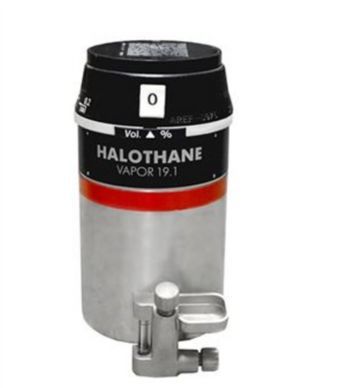
Draeger Vapor 19.1 Halothane
 Dräger · Model Vapor 19.1 Halothane
Used for accurately-controlled enrichment of fresh gas with the vapor of Halothane The Drager Vapor 19.1 Halothane anesthesia vaporizer inserts the vapor into the fresh gas line leading to the breathing system of an inhalation anesthesia machine. The Drager-Vapor 19.1 can be supplied with either a key-indexed filling system or with a filling spout.
Key tips
- ·A failed daily leak test takes the machine out of service immediately - there is no acceptable workaround.
- ·Never run an agent-specific vaporizer with the wrong agent, even briefly, during testing.
- ·CO2-absorbent exhaustion mimics several unrelated fault symptoms - rule it out early.
Typical Failure Modes
Compiled for this model from its own documentation and established engineering knowledge for this equipment class - not from a verified service record. Confirm against the manufacturer's service manual.
Delivered agent concentration inaccurate
HighSymptoms: Agent analyser shows the output does not match the dial beyond the vaporiser's stated tolerance.
Root cause: The vaporiser is out of calibration - recalibration is done only at an authorised service centre.
Back-bar / mounting leak
MediumSymptoms: Machine leak test fails with this vaporiser fitted, agent smell.
Root cause: Worn back-bar O-rings / mounting seal, or the vaporiser not fully locked / Selectatec latched onto the manifold.
Filling / drain fault
MediumSymptoms: Will not fill (keyed or funnel filler), spills, or overfills; sight glass hard to read.
Root cause: Worn filler seal / valve, or the wrong agent bottle adapter.
Concentration-dial / interlock fault
MediumSymptoms: Dial stiff, will not turn past the 0 / T interlock, or does not stay at a setting; Selectatec interlock not releasing.
Root cause: Worn dial detent / interlock or an internal control-cone fault.
Tipped / contaminated with agent in the bypass
LowSymptoms: Grossly high output for a period after the vaporiser was tipped or moved.
Root cause: Agent carried into the bypass channel after tipping - purge at high flow before clinical use.
Serviceable Parts & Consumables
Serviceable items for this model, compiled from its documentation and engineering knowledge for this equipment class. Service class and relative cost are estimates, not manufacturer figures; no part numbers are given. Confirm intervals and pricing against the manufacturer.
Back-bar / mounting O-ring & seal kit
Class Periodic replacementRel. cost $R&R Fairly easy
Filler seal / valve
Class Periodic replacementRel. cost $R&R Fairly easy
Agent-specific fill adapter
Class Major service partRel. cost $R&R Easy
Vaporiser recalibration (authorised service centre)
Vaporizers are calibrated only at an authorised service centre.
Class Frequent wear itemRel. cost $$R&R Easy
| Part | Service class | Relative cost | R&R difficulty |
|---|---|---|---|
| Back-bar / mounting O-ring & seal kit | Periodic replacement | $ | Fairly easy |
| Filler seal / valve | Periodic replacement | $ | Fairly easy |
| Agent-specific fill adapter | Major service part | $ | Easy |
| Vaporiser recalibration (authorised service centre) Vaporizers are calibrated only at an authorised service centre. | Frequent wear item | $$ | Easy |
Relative cost: $ lowest · $$$$ highest service-part cost for this equipment class. Not a price.
PM Checklist
Preventive-maintenance tasks typical of this equipment class. Perform to the manufacturer's procedure and your facility's policy - this is general reference, not a schedule for this specific unit.
- ·Daily pre-anesthesia machine check: leak test, O2 sensor calibration, per facility protocol
- ·Scheduled vaporizer calibration and agent-specific service
- ·Absorber / CO2 canister replacement
- ·Breathing circuit and hose inspection
- ·Annual full PM and electrical safety test
Troubleshooting Approach
A starting sequence for this model, compiled from its documentation and engineering knowledge for this equipment class. Follow the manufacturer's service documentation for the actual procedure.
Symptom: Concentration inaccurate
- Verify output with a calibrated agent analyser at ~5 L/min O2, 21 +/- 2 C, across the dial range.
- Confirm the correct agent is in the vaporiser.
- Rule out a back-bar leak (machine leak test).
- If output is out of spec, send the vaporiser to an authorised service centre for recalibration.
- Check the calibration certificate for the due date.
Symptom: Back-bar leak or fill fault
- Reseat and fully lock / latch the vaporiser on the manifold.
- Replace the back-bar O-rings / mounting seal.
- Repeat the anaesthesia machine leak test.
- Inspect the filler seal / valve and use the correct agent adapter.
- Purge at high flow if the vaporiser was tipped.
Technical Specs
- Height
- 21.3 cm
- Length
- 14.3 cm
- Weight
- 6.5 kg
- Width
- 11.6 cm
Typical Location
Where this class of equipment is typically deployed - general reference, not this unit's own placement record.
- Operating rooms
- Procedure / endoscopy suites requiring sedation
- Obstetric delivery rooms
Documents & Manuals
No documents available for this device yet.
Troubleshoot this device with Bio
Describe a symptom or error code. Bio answers from this device's own documented error codes, failure modes, parts, and guides.
Ask Bio