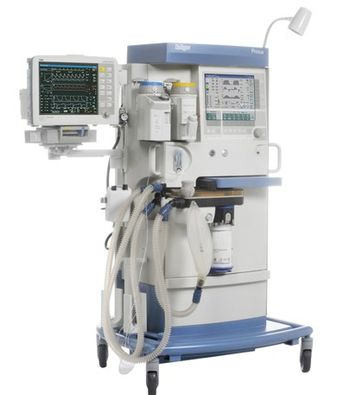
Draeger Primus
 Dräger · Model Primus
Personal anaesthesia assistant - The Dräger Primus was designed to be nothing less than your personal anaesthesia assistant. It’s a combination of time-tested design and state-of-the-art technology created to answer the demand for a modern, comprehensive anaesthesia solution for today’s increasingly complex healthcare environment. Common operating philosophy - The Primus® uses the familiar user interface and operating philosophy common to all current Dräger medical devices. This means that in spite of its impressive level of sophistication, your staff will spend a minimum amount of time learning how to use the Primus. Enhanced workflow - Features like fully automatic self-check, open architecture, standard user interfaces and flexible monitoring options were designed to help reduce costs, save time and allow caregivers to focus on their primary task – the patient. ICU standard ventilation - An increasing percentage of critically ill patients in the operating room calls for new standards in anaesthesia platforms. With the E-Vent® plus high-speed electronic piston ventilator, the Primus® delivers just that – peak flow comparable to ICU ventilators while avoiding the need for drive gas. A full range of volume and pressure oriented modes provides the various options for every clinical situation. Additional advanced monitoring and ventilation mode packages are also available that will expand your capabilities. Comprehensive monitoring - The Dräger Primus?® lets you monitor pulmonary function and ventilation parameters on a large, user-configurable 12,1“TFT colour display. Its open architecture design provides the option to add additional displays, permitting you to expand your monitoring capability to include haemodynamic and other data.
Key tips
- ·A failed daily leak test takes the machine out of service immediately - there is no acceptable workaround.
- ·Never run an agent-specific vaporizer with the wrong agent, even briefly, during testing.
- ·CO2-absorbent exhaustion mimics several unrelated fault symptoms - rule it out early.
Typical Failure Modes
Compiled for this model from its own documentation and established engineering knowledge for this equipment class - not from a verified service record. Confirm against the manufacturer's service manual.
Fails the pre-use leak / machine check
HighSymptoms: Low-pressure or circle-system leak test fails, machine not ready for use.
Root cause: Breathing-circuit / absorber leak, a worn APL valve or bag arm, a CO2-absorber canister seal, or a vaporiser back-bar leak.
Ventilator / bellows or piston fault
HighSymptoms: Set tidal volume not delivered, bellows will not fill or hangs up, piston fault, PEEP not held.
Root cause: Bellows leak, a drive-gas valve fault, a flow-sensor fault, or a piston-seal fault.
O2 flowmeter / hypoxic-guard fault
MediumSymptoms: O2 flow not matching the setting, flowmeter float sticking, hypoxic-guard / ratio fault, no O2 flush.
Root cause: Worn flowmeter (rotameter), a hypoxic-guard link fault, or a flush-valve fault.
Vaporiser fault
MediumSymptoms: Agent output does not match the dial, back-bar leak, dial stiff.
Root cause: Vaporiser seating / O-ring, or an internal vaporiser fault (calibrate at an authorised centre).
Gas-supply / pipeline / O2-failure alarm
MediumSymptoms: O2-failure whistle / alarm, anti-hypoxia device cuts N2O, pipeline-pressure fault.
Root cause: Loss of pipeline / cylinder pressure, or a pressure-sensor fault.
Scavenging (AGSS) fault
LowSymptoms: Waste-gas scavenging alarm or not evacuating, theatre pollution.
Root cause: Scavenging flow / connection or a receiver-valve fault.
Serviceable Parts & Consumables
Serviceable items for this model, compiled from its documentation and engineering knowledge for this equipment class. Service class and relative cost are estimates, not manufacturer figures; no part numbers are given. Confirm intervals and pricing against the manufacturer.
APL valve / breathing-system gaskets & seals
Class Periodic replacementRel. cost $$R&R Fairly easy
CO2 absorbent / canister seals
Class ConsumableRel. cost $R&R Easy
Ventilator bellows / piston seal
Class Major service partRel. cost $$$R&R Difficult
Flow sensor(s)
Class Frequent wear itemRel. cost $$R&R Fairly easy
O2 flowmeter (rotameter)
Class Major service partRel. cost $$R&R Moderate
Vaporiser O-ring / back-bar seal
Class Periodic replacementRel. cost $R&R Fairly easy
| Part | Service class | Relative cost | R&R difficulty |
|---|---|---|---|
| APL valve / breathing-system gaskets & seals | Periodic replacement | $$ | Fairly easy |
| CO2 absorbent / canister seals | Consumable | $ | Easy |
| Ventilator bellows / piston seal | Major service part | $$$ | Difficult |
| Flow sensor(s) | Frequent wear item | $$ | Fairly easy |
| O2 flowmeter (rotameter) | Major service part | $$ | Moderate |
| Vaporiser O-ring / back-bar seal | Periodic replacement | $ | Fairly easy |
Relative cost: $ lowest · $$$$ highest service-part cost for this equipment class. Not a price.
PM Checklist
Preventive-maintenance tasks typical of this equipment class. Perform to the manufacturer's procedure and your facility's policy - this is general reference, not a schedule for this specific unit.
- ·Daily pre-anesthesia machine check: leak test, O2 sensor calibration, per facility protocol
- ·Scheduled vaporizer calibration and agent-specific service
- ·Absorber / CO2 canister replacement
- ·Breathing circuit and hose inspection
- ·Annual full PM and electrical safety test
Troubleshooting Approach
A starting sequence for this model, compiled from its documentation and engineering knowledge for this equipment class. Follow the manufacturer's service documentation for the actual procedure.
Symptom: Fails the pre-use leak / machine self-test
- Run the check with the exact breathing circuit, absorber and vaporisers that will be used.
- Reseat the CO2-absorber canister and check its seal; replace exhausted absorbent.
- Inspect the breathing-system gaskets, the bag arm and the APL valve.
- Confirm each vaporiser is seated / Selectatec-latched with an intact back-bar O-ring.
- Re-run the test; escalate an internal low-pressure leak that cannot be localised.
Symptom: Ventilator not delivering the set tidal volume / bellows or piston fault
- Verify tidal volume with a calibrated gas-flow analyser.
- Inspect the bellows (or piston seal) for a leak and the drive-gas valve.
- Calibrate the flow sensors.
- Check circuit-compliance compensation is enabled and the circuit is intact.
- Replace the bellows / flow sensors as isolated and re-verify.
Symptom: O2 flow wrong / hypoxic-guard fault / no O2 flush
- Verify O2 flow with a calibrated flow meter.
- Tap a sticking flowmeter float; replace the rotameter tube if it sticks.
- Check the hypoxic-guard link maintains the minimum O2:N2O ratio.
- Confirm the O2-failure alarm sounds when O2 pressure is removed.
- Refer the flowmeter block / hypoxic guard for service.
Symptom: Agent concentration wrong / vaporiser back-bar leak
- Verify output with a calibrated agent analyser across the dial range.
- Confirm the correct agent is filled.
- Reseat the vaporiser and replace the back-bar O-rings.
- Repeat the machine leak test.
- Send the vaporiser to an authorised service centre for recalibration if output is out of spec.
Technical Specs
- Vaporizers (Max)
- Two
Typical Location
Where this class of equipment is typically deployed - general reference, not this unit's own placement record.
- Operating rooms
- Procedure / endoscopy suites requiring sedation
- Obstetric delivery rooms
Documents & Manuals
Troubleshoot this device with Bio
Describe a symptom or error code. Bio answers from this device's own documented error codes, failure modes, parts, and guides.
Ask Bio