Draeger Infinity Gateway Suite
 Dräger · Model Infinity Gateway Suite
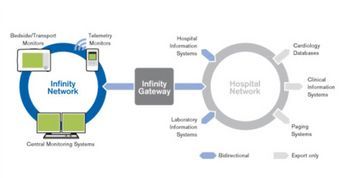
Makes Comprehensive Clinical Data Available at the Point-of-Care - Infinity Gateway’s HL7 and ASTM interfaces facilitate the exchange of patient information between the Dräger Infinity Network and other hospital systems, enabling you to see a more complete picture of your patients Import/Export Interfaces HL7 2.3 protocol enables export of vital signs, solicited and unsolicited import of admission data, and import and export of laboratory data IHE-compliant (Integrating the Healthcare Enterprise) HL7 option utilizes the 2.6 HL7 protocol, enabling export of vital signs to other IHE-compliant systems Paging interface exports alarm data from Infinity telemetry and bedside/transport monitors to the hospital’s paging system (supports alphanumeric pagers using TAP1.7 and ESPA 4.4.4 protocols) ASTM stat lab interface connects Infinity monitors to ‘stat’ laboratory devices that use the ASTM protocol 12-lead export interface, as part of the API option, exports 12-lead rest ECG data reports from the Infinity Network to cardiology databases.
Key tips
- ·A no-signal/flatline alarm gets checked on the patient first, not the monitor - rule out a real clinical event before troubleshooting.
- ·Recalibrate NIBP against a reference manometer, not just a self-test pass.
- ·Reused patient cables (SpO2, ECG leads) are a common source of intermittent-fault complaints - swap the cable before the module.
Typical Failure Modes
Failure patterns typical of this equipment class - general BMET reference, not verified against this exact unit's own service history unless flagged. Severity is a category-level estimate.
SpO2 probe / sensor failure
MediumSymptoms: No pleth, SpO2 drops to --- or false low.
Root cause: LED/photodiode aging or cable damage.
NIBP measurement error
MediumSymptoms: Cuff fails to inflate, erroneous BP, long cycle.
Root cause: Pump/valve wear or cuff leak.
Display / touch panel fault
LowSymptoms: Dim, flickering, or unresponsive screen.
Root cause: Backlight or digitizer failure.
Internal battery depletion
HighSymptoms: Short backup time, battery alarm on transport.
Root cause: Aged backup battery.
Serviceable Parts & Consumables
The parts a BMET typically services on this class of equipment. Service class and relative cost are general engineering estimates for the category, not figures from this unit's documentation. Part numbers appear only when pulled from this unit's own service manual. Always confirm intervals and pricing against the manufacturer.
Display / touch assembly
Class Periodic replacementRel. cost $$$R&R Difficult
ECG patient cable & lead set
High-turnover; keep inventory.
Class Frequent wear itemRel. cost $$R&R Easy
SpO2 sensor (adult/ped/neo)
Class Frequent wear itemRel. cost $$R&R Easy
NIBP cuff & hose
Consumable per patient.
Class Periodic replacementRel. cost $R&R Easy
| Part | Service class | Relative cost | R&R difficulty |
|---|---|---|---|
| Display / touch assembly | Periodic replacement | $$$ | Difficult |
| ECG patient cable & lead set High-turnover; keep inventory. | Frequent wear item | $$ | Easy |
| SpO2 sensor (adult/ped/neo) | Frequent wear item | $$ | Easy |
| NIBP cuff & hose Consumable per patient. | Periodic replacement | $ | Easy |
Relative cost: $ lowest · $$$$ highest service-part cost for this equipment class. Not a price.
PM Checklist
Preventive-maintenance tasks typical of this equipment class. Perform to the manufacturer's procedure and your facility's policy - this is general reference, not a schedule for this specific unit.
- ·Routine cable and lead-wire inspection for fraying/wear
- ·Battery conditioning cycle
- ·NIBP calibration check against a reference manometer
- ·ECG / SpO2 accuracy verification against a patient simulator
- ·Annual electrical safety test
Troubleshooting Approach
A structured starting point derived from the failure modes above. Follow the manufacturer's service documentation for the actual procedure.
Symptom: ECG lead-off / artifact
- Confirm the presentation - typically flat or noisy ECG, frequent lead-off alarms - and note the exact alarm or message and the conditions when it occurs.
- Check the most likely cause first: worn electrodes, loose leads, or dry gel.
- Isolate the affected subsystem using the manufacturer's functional check or self-test, where one is provided.
- If the fault is confirmed and not a field adjustment, service or replace the eCG patient cable & lead set per the manufacturer's service documentation.
- Return the device to service only after the manufacturer's functional and applicable electrical-safety checks pass.
- Record the findings, any parts used, and the verification results in the maintenance history.
Symptom: SpO2 probe / sensor failure
- Confirm the presentation - typically no pleth, SpO2 drops to --- or false low - and note the exact alarm or message and the conditions when it occurs.
- Check the most likely cause first: lED/photodiode aging or cable damage.
- Isolate the affected subsystem using the manufacturer's functional check or self-test, where one is provided.
- If the fault is confirmed and not a field adjustment, service or replace the spO2 sensor (adult/ped/neo) per the manufacturer's service documentation.
- Return the device to service only after the manufacturer's functional and applicable electrical-safety checks pass.
- Record the findings, any parts used, and the verification results in the maintenance history.
Typical Location
Where this class of equipment is typically deployed - general reference, not this unit's own placement record.
- ICU / CCU
- Emergency Department
- OR / PACU
- General med-surg floors
- Step-down units
- Telemetry units
Documents & Manuals
Troubleshoot this device with Bio
Describe a symptom or error code. Bio answers from this device's own documented error codes, failure modes, parts, and guides.
Ask Bio