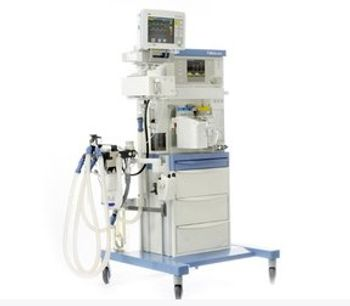
Draeger Fabius Plus
 Dräger · Model Fabius Plus
Powerful, accurate ventilation without drive gas. Modular open architecture and connectivity. Enhanced safety features. Designed around your workflow. Comprehensive information management.
Key tips
- ·A failed daily leak test takes the machine out of service immediately - there is no acceptable workaround.
- ·Never run an agent-specific vaporizer with the wrong agent, even briefly, during testing.
- ·CO2-absorbent exhaustion mimics several unrelated fault symptoms - rule it out early.
Typical Failure Modes
Compiled for this model from its own documentation and established engineering knowledge for this equipment class - not from a verified service record. Confirm against the manufacturer's service manual.
Fails the pre-use leak / machine check
HighSymptoms: Low-pressure or circle-system leak test fails, machine not ready for use.
Root cause: Breathing-circuit / absorber leak, a worn APL valve or bag arm, a CO2-absorber canister seal, or a vaporiser back-bar leak.
Ventilator / bellows or piston fault
HighSymptoms: Set tidal volume not delivered, bellows will not fill or hangs up, piston fault, PEEP not held.
Root cause: Bellows leak, a drive-gas valve fault, a flow-sensor fault, or a piston-seal fault.
O2 flowmeter / hypoxic-guard fault
MediumSymptoms: O2 flow not matching the setting, flowmeter float sticking, hypoxic-guard / ratio fault, no O2 flush.
Root cause: Worn flowmeter (rotameter), a hypoxic-guard link fault, or a flush-valve fault.
Vaporiser fault
MediumSymptoms: Agent output does not match the dial, back-bar leak, dial stiff.
Root cause: Vaporiser seating / O-ring, or an internal vaporiser fault (calibrate at an authorised centre).
Gas-supply / pipeline / O2-failure alarm
MediumSymptoms: O2-failure whistle / alarm, anti-hypoxia device cuts N2O, pipeline-pressure fault.
Root cause: Loss of pipeline / cylinder pressure, or a pressure-sensor fault.
Scavenging (AGSS) fault
LowSymptoms: Waste-gas scavenging alarm or not evacuating, theatre pollution.
Root cause: Scavenging flow / connection or a receiver-valve fault.
Serviceable Parts & Consumables
Serviceable items for this model, compiled from its documentation and engineering knowledge for this equipment class. Service class and relative cost are estimates, not manufacturer figures; no part numbers are given. Confirm intervals and pricing against the manufacturer.
APL valve / breathing-system gaskets & seals
Class Periodic replacementRel. cost $$R&R Fairly easy
CO2 absorbent / canister seals
Class ConsumableRel. cost $R&R Easy
Ventilator bellows / piston seal
Class Major service partRel. cost $$$R&R Difficult
Flow sensor(s)
Class Frequent wear itemRel. cost $$R&R Fairly easy
O2 flowmeter (rotameter)
Class Major service partRel. cost $$R&R Moderate
Vaporiser O-ring / back-bar seal
Class Periodic replacementRel. cost $R&R Fairly easy
| Part | Service class | Relative cost | R&R difficulty |
|---|---|---|---|
| APL valve / breathing-system gaskets & seals | Periodic replacement | $$ | Fairly easy |
| CO2 absorbent / canister seals | Consumable | $ | Easy |
| Ventilator bellows / piston seal | Major service part | $$$ | Difficult |
| Flow sensor(s) | Frequent wear item | $$ | Fairly easy |
| O2 flowmeter (rotameter) | Major service part | $$ | Moderate |
| Vaporiser O-ring / back-bar seal | Periodic replacement | $ | Fairly easy |
Relative cost: $ lowest · $$$$ highest service-part cost for this equipment class. Not a price.
PM Checklist
Preventive-maintenance tasks typical of this equipment class. Perform to the manufacturer's procedure and your facility's policy - this is general reference, not a schedule for this specific unit.
- ·Daily pre-anesthesia machine check: leak test, O2 sensor calibration, per facility protocol
- ·Scheduled vaporizer calibration and agent-specific service
- ·Absorber / CO2 canister replacement
- ·Breathing circuit and hose inspection
- ·Annual full PM and electrical safety test
Troubleshooting Approach
A starting sequence for this model, compiled from its documentation and engineering knowledge for this equipment class. Follow the manufacturer's service documentation for the actual procedure.
Symptom: Leak / machine check fails
- Run the check with the exact circuit and absorber.
- Reseat the CO2-absorber canister and check its seal; replace exhausted absorbent.
- Inspect the breathing-system gaskets, bag arm and APL valve.
- Check each vaporiser is seated with an intact O-ring.
- Re-run the check; escalate an internal leak that cannot be localised.
Symptom: Ventilator not delivering set volume
- Verify tidal volume with a calibrated gas-flow analyser.
- Inspect the bellows / piston and its seal for leaks.
- Calibrate the flow sensors.
- Check the drive-gas valve and circuit compliance compensation.
- Replace the bellows / flow sensors as isolated and re-verify.
Typical Location
Where this class of equipment is typically deployed - general reference, not this unit's own placement record.
- Operating rooms
- Procedure / endoscopy suites requiring sedation
- Obstetric delivery rooms
Documents & Manuals
Troubleshoot this device with Bio
Describe a symptom or error code. Bio answers from this device's own documented error codes, failure modes, parts, and guides.
Ask Bio