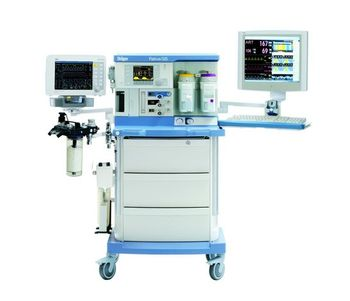
Draeger Fabius GS
 Dräger · Model Fabius GS
Proven Ventilation Versatility - The electrically driven and electronically controlled Fabius GS E-vent ventilator requires no drive gas. This makes it more flexible and economical to use than traditional gas-driven bellows ventilators by limiting the consumption of expensive medical grade gas to patient use only. Motor-driven hardware and software-controlled functionality also offer virtually unlimited upgradeability. The Fabius GS is suitable for any patient -- pediatric to adult -- and provides Volume Controlled Ventilation, Pressure Controlled Ventilation, Synchronized Volume Control (SIMV), Pressure Support and Manual/Spontaneous modes. Pressure Support mode facilitates spontaneous breathing by removing the work of breathing due to circuit resistance, improving comfort levels and enhancing quality of patient care. Electronic Gas-Flow Measurement - The Fabius GS is the world’s first anesthesia machine with vertical flow controls and electronic fresh gas flow indicators, enabling you to compare gas flows more easily and intuitively. Additionally, the export of fresh gas data to an information system allows monitoring of gas usage and to promote the use of low-flow anesthesia. Compact, Convenient Breathing System - The flexible, ergonomic design of the Fabius GS allows for optimal positioning of the semi-closed breathing system (COSY). The COSY can be height- adjusted, pre-assembled on the left or right side of the machine and can be easily removed from the machine for cleaning and sterilization. The COSY not only minimizes set-up and installation time but also substantially reduces the potential for leaks, OR pollution and overall gas consumption. It is simply a smarter and much more ergonomic design. Intelligent Cable Management - The Infinity monitoring line offers an outstanding cable management approach: The MultiMed parameter module reduces cable clutter and simplifies patient transfer. Moreover the unique Pick and Go® capabilities of the Infinity patient monitoring system provide continuous monitoring during transport and automatic reconfiguration of site specific parameters with Dräger Medical’s innovative Infinity Docking Stations (IDS). Universal Mounting Platform - The Pick and Go concept also provides significant efficiency and quality benefits. Because the monitor moves with the patient, no separate transport monitor is required and you will need fewer monitors throughout the patient care process. The choice of a fixed-mount monitoring solution or the Pick and Go transport concept gives you maximum flexibility to adapt your complete anesthesia solution to today’s evolving requirements. ClinicalVisio - Their latest monitoring solutions allow you to choose the high efficiency data-access tools that make the most sense for your viewing needs. The new Infinity Omega solution uses a two-screen system approach so you can see patient monitoring data and clinical data simultaneously. It includes a Delta patient monitor with the Infinity Docking Station and a 17“ touch screen smart display all to help eliminate information access bottlenecks, keep you confidently on top of your entire environment and offer maximum flexibility for your longterm IT needs. With an optional web browser you can access web-based applications as well.
Key tips
- ·A failed daily leak test takes the machine out of service immediately - there is no acceptable workaround.
- ·Never run an agent-specific vaporizer with the wrong agent, even briefly, during testing.
- ·CO2-absorbent exhaustion mimics several unrelated fault symptoms - rule it out early.
Typical Failure Modes
Compiled for this model from its own documentation and established engineering knowledge for this equipment class - not from a verified service record. Confirm against the manufacturer's service manual.
Fails the pre-use leak / machine check
HighSymptoms: Low-pressure or circle-system leak test fails, machine not ready for use.
Root cause: Breathing-circuit / absorber leak, a worn APL valve or bag arm, a CO2-absorber canister seal, or a vaporiser back-bar leak.
Ventilator / bellows or piston fault
HighSymptoms: Set tidal volume not delivered, bellows will not fill or hangs up, piston fault, PEEP not held.
Root cause: Bellows leak, a drive-gas valve fault, a flow-sensor fault, or a piston-seal fault.
O2 flowmeter / hypoxic-guard fault
MediumSymptoms: O2 flow not matching the setting, flowmeter float sticking, hypoxic-guard / ratio fault, no O2 flush.
Root cause: Worn flowmeter (rotameter), a hypoxic-guard link fault, or a flush-valve fault.
Vaporiser fault
MediumSymptoms: Agent output does not match the dial, back-bar leak, dial stiff.
Root cause: Vaporiser seating / O-ring, or an internal vaporiser fault (calibrate at an authorised centre).
Gas-supply / pipeline / O2-failure alarm
MediumSymptoms: O2-failure whistle / alarm, anti-hypoxia device cuts N2O, pipeline-pressure fault.
Root cause: Loss of pipeline / cylinder pressure, or a pressure-sensor fault.
Scavenging (AGSS) fault
LowSymptoms: Waste-gas scavenging alarm or not evacuating, theatre pollution.
Root cause: Scavenging flow / connection or a receiver-valve fault.
Serviceable Parts & Consumables
Serviceable items for this model, compiled from its documentation and engineering knowledge for this equipment class. Service class and relative cost are estimates, not manufacturer figures; no part numbers are given. Confirm intervals and pricing against the manufacturer.
APL valve / breathing-system gaskets & seals
Class Periodic replacementRel. cost $$R&R Fairly easy
CO2 absorbent / canister seals
Class ConsumableRel. cost $R&R Easy
Ventilator bellows / piston seal
Class Major service partRel. cost $$$R&R Difficult
Flow sensor(s)
Class Frequent wear itemRel. cost $$R&R Fairly easy
O2 flowmeter (rotameter)
Class Major service partRel. cost $$R&R Moderate
Vaporiser O-ring / back-bar seal
Class Periodic replacementRel. cost $R&R Fairly easy
| Part | Service class | Relative cost | R&R difficulty |
|---|---|---|---|
| APL valve / breathing-system gaskets & seals | Periodic replacement | $$ | Fairly easy |
| CO2 absorbent / canister seals | Consumable | $ | Easy |
| Ventilator bellows / piston seal | Major service part | $$$ | Difficult |
| Flow sensor(s) | Frequent wear item | $$ | Fairly easy |
| O2 flowmeter (rotameter) | Major service part | $$ | Moderate |
| Vaporiser O-ring / back-bar seal | Periodic replacement | $ | Fairly easy |
Relative cost: $ lowest · $$$$ highest service-part cost for this equipment class. Not a price.
PM Checklist
Preventive-maintenance tasks typical of this equipment class. Perform to the manufacturer's procedure and your facility's policy - this is general reference, not a schedule for this specific unit.
- ·Daily pre-anesthesia machine check: leak test, O2 sensor calibration, per facility protocol
- ·Scheduled vaporizer calibration and agent-specific service
- ·Absorber / CO2 canister replacement
- ·Breathing circuit and hose inspection
- ·Annual full PM and electrical safety test
Error Codes
Extracted directly from this unit's own service manual.
C001Handler Busy Bad processor, external device incorrect operation
C002Incoming Overflow Bad processor, bad cable or connector, incorrect settings, external device incorrect operation
C003Outgoing queue overflow Bad processor, external device incorrect operation
C004Message not registered External communications error
C005Character not transmitted Bad processor, external device incorrect operation
C006Interrupt problem Bad processor
C007Continuous interrupts Bad processor
C008Excessive Breaks Bad processor, incorrect settings, external device incorrect operation
C009Excessive Framing Bad processor, incorrect settings, external device incorrect operation
C010Excessive Parity Bad processor, incorrect settings, external device incorrect operation
C011Excessive Overrun Bad processor, incorrect settings, external device incorrect operation
C012Non-existent UART Bad processor Table 4-2: Monitor Errors Code Description Possible Cause
M001O2 <10% O2 cell not working properly
M002O2 LOW INOP O2 cell inoperative or disconnected
M003O2 DIFF HIGH Difference between Cell A and Cell B >25%
M004BATTERY <10% Battery level below 10% of capacity while operating without mains power
F001Diag Watchdog Bad hardware
F002Diag System Ram System RAM fails on pwr up, bad RAM chip, bad CPU, bad trace, etc.
F003Diag Program Memory Bad flash download, bad flash chip
F004Diag Video Test Video memory failed, bad video chip
F005Diag Interrupts Bad hardware
F006Diag A/D Converter Bad A/D hardware
F007Diag NM Ram Corrupt entry on pwr up
F008Diag Serial Port Failed pwr up loopback test, bad UART chip
F009Diag Clock Bad hardware
F010Diag Speaker Speaker not connected on pwr up
F011Diag Main Power Mains pwr not detected on pwr up
F012Diag Battery Battery voltage on pwr up below 20% Table 4-4: System Errors Code Description Possible Cause
I011L2 SW Watchdog Bad processor board
I012L2 Recovered, wLevelTwoErrorCount Bad processor board
I021L3 SW Watchdog Bad processor board
I022L3 Recovered, wLevelThreeErrorCount Bad processor board
I031L4 SW Watchdog Bad processor board
S006Service Log Clear Log cleared by service tech, SW upgrade SS90 test message Factory test - no failure
I001CPU Diag Recovery CPU recovered from bad initialization Table 4-6: User Interface Events Code Description Possible Cause
U001New Device ID Created Machine detected a new device ID was needed because of NVRAM corruption or previously did not exist
U002Option Enabled A secure option was enabled
U003Option Disabled A secure option was disabled
U007Model Changed to FGS Model-type change
U008Model Changed to Tiro Model-type change
U009Monitoring Disabled Monitoring-mode change
U010Monitoring Enabled Monitoring-mode change
U012SOS Recovered A Secure Option Setting was recovered after a partial NVRAM corruption
U013FGS SOS Invalid The FGS Secure Options Setting NVRAM file was found corrupt and no Options were recovered
V001VENT PEEP NOT CAL Auto ventilation was attempted without valid PEEP calibration
V002ZERO POS INVALID Crossing of light barrier at bottom vent not detected
V037EX VALVE LEAK Greater than 15 mL of Tidal Volume during inspiration, and this Vt is greater than 10% of Vt flow during expiration
V042Motor Voltage Error Motor voltage has dropped below minimum required for auto ventilation while in Volume or PCV Ventilation mode
V043MOTOR LIM STOP Incident of excessive motor current during auto ventilation
V045MEMBRANE PRES HIGH Membrane vacuum above normal operating range
V049MOTOR OVER CURRENT Persistent excessive motor current during auto ventilation: caused ventilator motor shut off
V050LT Pres Failed>350 Leak in path from vent to hoses to peep valve to bag
V051LT Pres Rose>250 Leak in path from vent to hoses to peep valve
V052LT SYS FAIL Leak in path from vent to hoses to peep valve to bag
V053LT PC FAIL Leak in path from vent to hoses to peep valve
V060Comp Unexp State Compliance test entered an unexpected test state
V061Comp Bag Pres Too High Compliance test start pressure too high
V062Comp Cant Fully Pres Compliance test could not attain complete pressurization
V063Comp Cant Hold Pres Compliance test could not maintain plat. pressure
Troubleshooting Approach
A starting sequence for this model, compiled from its documentation and engineering knowledge for this equipment class. Follow the manufacturer's service documentation for the actual procedure.
Symptom: Fails the pre-use leak / machine self-test
- Run the check with the exact breathing circuit, absorber and vaporisers that will be used.
- Reseat the CO2-absorber canister and check its seal; replace exhausted absorbent.
- Inspect the breathing-system gaskets, the bag arm and the APL valve.
- Confirm each vaporiser is seated / Selectatec-latched with an intact back-bar O-ring.
- Re-run the test; escalate an internal low-pressure leak that cannot be localised.
Symptom: Ventilator not delivering the set tidal volume / bellows or piston fault
- Verify tidal volume with a calibrated gas-flow analyser.
- Inspect the bellows (or piston seal) for a leak and the drive-gas valve.
- Calibrate the flow sensors.
- Check circuit-compliance compensation is enabled and the circuit is intact.
- Replace the bellows / flow sensors as isolated and re-verify.
Symptom: O2 flow wrong / hypoxic-guard fault / no O2 flush
- Verify O2 flow with a calibrated flow meter.
- Tap a sticking flowmeter float; replace the rotameter tube if it sticks.
- Check the hypoxic-guard link maintains the minimum O2:N2O ratio.
- Confirm the O2-failure alarm sounds when O2 pressure is removed.
- Refer the flowmeter block / hypoxic guard for service.
Symptom: Agent concentration wrong / vaporiser back-bar leak
- Verify output with a calibrated agent analyser across the dial range.
- Confirm the correct agent is filled.
- Reseat the vaporiser and replace the back-bar O-rings.
- Repeat the machine leak test.
- Send the vaporiser to an authorised service centre for recalibration if output is out of spec.
Technical Specs
- Height
- 51.2 in
- Gases
- Oxygen, Air
- Length
- 32.3
- Scavenger
- Open interface
- Weight
- 224 lbs
- Inspiratory Flow (max)
- 75 L/min
- Vaporizer Type
- Variable-bypass
- Vent Modes
- VCV, PCV, PSV, SIMV-Volume with PSV, Manual/Spontaneous.
- Width
- 35.2
Typical Location
Where this class of equipment is typically deployed - general reference, not this unit's own placement record.
- Operating rooms
- Procedure / endoscopy suites requiring sedation
- Obstetric delivery rooms
Documents & Manuals
Troubleshoot this device with Bio
Describe a symptom or error code. Bio answers from this device's own documented error codes, failure modes, parts, and guides.
Ask Bio