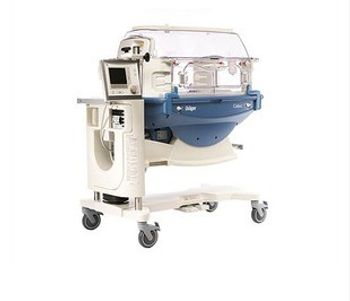
Draeger Caleo
 Dräger · Model Caleo
Infant Incubator Caleo® works to deliver an ideal microenvironment for neonates by delivering the appropriate temperature, humidity, oxygen levels. It is designed to create a microclimate that minimizes the effect of disturbances and time out of the Thermo-Neutral Zone. Double air curtain acts as a security blanket for the neonate, providing a balanced climate even when access doors are open. Continuously measuring both central and peripheral body temperature. Truest, most accurate early indicator of cold or heat stress, or temperature instability. Caleo® offers caregivers and parents easier, closer access to a premature baby while balancing the baby’s need for a stable, controlled microclimate with your need for continuous access, especially in an emergency. Caleo’s generously designed JumboPorts™ gives full, climate-controlled access to any part of the bed so that endotracheal intubation and minor surgical procedures can be carried out inside the incubator.
Key tips
- ·Never skip temperature-accuracy verification to save time - it's the one check that directly prevents burns.
- ·Hose/blanket connector wear is the most common real fault and the easiest to miss on a quick visual check.
Typical Failure Modes
Compiled for this model from its own documentation and established engineering knowledge for this equipment class - not from a verified service record. Confirm against the manufacturer's service manual.
Air-temperature control fault
HighSymptoms: Chamber will not reach or hold the set air temperature (e.g. 31 C), temperature alarm, self-test fault.
Root cause: Heater element, the air-temperature sensor, the fan / air circulation, or a control-board fault.
Skin-temperature (servo) control fault
HighSymptoms: Servo mode does not regulate to the skin probe, deviation alarm, probe-fault alarm.
Root cause: Damaged skin temperature probe or its connector, or the servo-control circuit.
Humidity system fault
MediumSymptoms: Set humidity not reached, humidity-fault alarm, water not evaporating.
Root cause: Humidifier reservoir empty / scaled, the humidifier heater, or a level sensor.
Airflow / fan fault
MediumSymptoms: Uneven chamber temperature, airflow alarm, fan noise.
Root cause: Worn circulation fan or a blocked air path / filter.
Access-port / mattress-tilt or hood fault
LowSymptoms: Port doors / iris ports not sealing, mattress tilt will not adjust, hood latch loose.
Root cause: Worn port gaskets / latches or the tilt mechanism.
Serviceable Parts & Consumables
Serviceable items for this model, compiled from its documentation and engineering knowledge for this equipment class. Service class and relative cost are estimates, not manufacturer figures; no part numbers are given. Confirm intervals and pricing against the manufacturer.
Air / skin temperature sensors
Class Frequent wear itemRel. cost $$R&R Fairly easy
Heater element
Class Major service partRel. cost $$R&R Difficult
Circulation fan
Class Major service partRel. cost $$R&R Moderate
Humidifier heater / reservoir
Class Periodic replacementRel. cost $$R&R Moderate
Air-intake filter
Class Frequent wear itemRel. cost $R&R Easy
| Part | Service class | Relative cost | R&R difficulty |
|---|---|---|---|
| Air / skin temperature sensors | Frequent wear item | $$ | Fairly easy |
| Heater element | Major service part | $$ | Difficult |
| Circulation fan | Major service part | $$ | Moderate |
| Humidifier heater / reservoir | Periodic replacement | $$ | Moderate |
| Air-intake filter | Frequent wear item | $ | Easy |
Relative cost: $ lowest · $$$$ highest service-part cost for this equipment class. Not a price.
PM Checklist
Preventive-maintenance tasks typical of this equipment class. Perform to the manufacturer's procedure and your facility's policy - this is general reference, not a schedule for this specific unit.
- ·Hose / blanket connector inspection
- ·Temperature-accuracy verification
- ·Annual electrical safety test
Troubleshooting Approach
A starting sequence for this model, compiled from its documentation and engineering knowledge for this equipment class. Follow the manufacturer's service documentation for the actual procedure.
Symptom: Air-temperature control fault
- Run the readiness-for-operation check and the self-test.
- Set the air-temperature target to 31 C and confirm the Caleo reaches it.
- Compare the chamber temperature to an independent, calibrated reference.
- Check the circulation fan runs and the air filter is clean.
- Replace the air-temperature sensor or heater as isolated.
Symptom: Skin-temperature / servo fault
- Fit a known-good skin temperature probe and confirm good skin contact.
- Check the probe connector and cable.
- Verify the servo regulates to the probe with a warm reference.
- Replace the probe.
- Refer the servo-control circuit for service if it still will not regulate.
Typical Location
Where this class of equipment is typically deployed - general reference, not this unit's own placement record.
- Operating Room
- PACU
- Emergency Department
- Labor & Delivery
- NICU
Documents & Manuals
Troubleshoot this device with Bio
Describe a symptom or error code. Bio answers from this device's own documented error codes, failure modes, parts, and guides.
Ask Bio