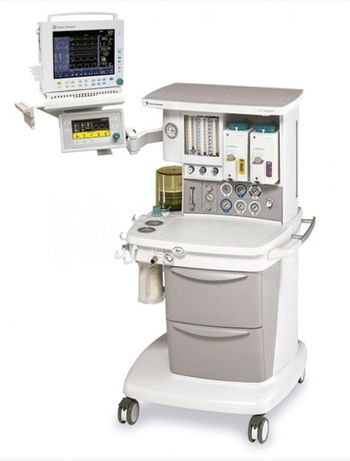
Datex Ohmeda Aespire 7900
 Datex Ohmeda · Model Aespire 7900
Unparalleled ventilation Advanced ventilation modes include PSVPro System is lightweight and compact for easy maneuverability Large work surface offers more room for supplies and chart LED light strip provides bi-level work surface illumination Bellows provide quick visual confirmation of the integrity of breathing system High-quality pneumatic flow mixing Auxiliary common gas outlet facilitates low-pressure leak test PSV Pro Assists in overcoming the resistance within the breathing circuit and patient circuit, helping decrease the patient's work of breathing Helps counter the reduction in the patient’s functional residual capacity (FRC) and the decrease in muscle contraction due to the anesthetics May be used with LMAs due to its lower airway pressures With automatic apnea backup mode, uses an SIMV-PC + PSV mode to maintain a minimum minute ventilation in the event the patient stops spontaneously breathing. With adjustable inspiration termination, allows fine-tuning to the patient’s breathing pattern. Supports virtually all spontaneous breaths Uses a decelerating flow pattern (optimizes inspiratory flow) Sustains or enhances the patient’s tidal volume and etCO2 maintenance.
Key tips
- ·A failed daily leak test takes the machine out of service immediately - there is no acceptable workaround.
- ·Never run an agent-specific vaporizer with the wrong agent, even briefly, during testing.
- ·CO2-absorbent exhaustion mimics several unrelated fault symptoms - rule it out early.
Typical Failure Modes
Compiled for this model from its own documentation and established engineering knowledge for this equipment class - not from a verified service record. Confirm against the manufacturer's service manual.
Fails the pre-use leak / machine check
HighSymptoms: Low-pressure or circle-system leak test fails, machine not ready for use.
Root cause: Breathing-circuit / absorber leak, a worn APL valve or bag arm, a CO2-absorber canister seal, or a vaporiser back-bar leak.
Ventilator / bellows or piston fault
HighSymptoms: Set tidal volume not delivered, bellows will not fill or hangs up, piston fault, PEEP not held.
Root cause: Bellows leak, a drive-gas valve fault, a flow-sensor fault, or a piston-seal fault.
O2 flowmeter / hypoxic-guard fault
MediumSymptoms: O2 flow not matching the setting, flowmeter float sticking, hypoxic-guard / ratio fault, no O2 flush.
Root cause: Worn flowmeter (rotameter), a hypoxic-guard link fault, or a flush-valve fault.
Vaporiser fault
MediumSymptoms: Agent output does not match the dial, back-bar leak, dial stiff.
Root cause: Vaporiser seating / O-ring, or an internal vaporiser fault (calibrate at an authorised centre).
Gas-supply / pipeline / O2-failure alarm
MediumSymptoms: O2-failure whistle / alarm, anti-hypoxia device cuts N2O, pipeline-pressure fault.
Root cause: Loss of pipeline / cylinder pressure, or a pressure-sensor fault.
Scavenging (AGSS) fault
LowSymptoms: Waste-gas scavenging alarm or not evacuating, theatre pollution.
Root cause: Scavenging flow / connection or a receiver-valve fault.
Serviceable Parts & Consumables
Serviceable items for this model, compiled from its documentation and engineering knowledge for this equipment class. Service class and relative cost are estimates, not manufacturer figures; no part numbers are given. Confirm intervals and pricing against the manufacturer.
APL valve / breathing-system gaskets & seals
Class Periodic replacementRel. cost $$R&R Fairly easy
CO2 absorbent / canister seals
Class ConsumableRel. cost $R&R Easy
Ventilator bellows / piston seal
Class Major service partRel. cost $$$R&R Difficult
Flow sensor(s)
Class Frequent wear itemRel. cost $$R&R Fairly easy
O2 flowmeter (rotameter)
Class Major service partRel. cost $$R&R Moderate
Vaporiser O-ring / back-bar seal
Class Periodic replacementRel. cost $R&R Fairly easy
| Part | Service class | Relative cost | R&R difficulty |
|---|---|---|---|
| APL valve / breathing-system gaskets & seals | Periodic replacement | $$ | Fairly easy |
| CO2 absorbent / canister seals | Consumable | $ | Easy |
| Ventilator bellows / piston seal | Major service part | $$$ | Difficult |
| Flow sensor(s) | Frequent wear item | $$ | Fairly easy |
| O2 flowmeter (rotameter) | Major service part | $$ | Moderate |
| Vaporiser O-ring / back-bar seal | Periodic replacement | $ | Fairly easy |
Relative cost: $ lowest · $$$$ highest service-part cost for this equipment class. Not a price.
PM Checklist
Preventive-maintenance tasks typical of this equipment class. Perform to the manufacturer's procedure and your facility's policy - this is general reference, not a schedule for this specific unit.
- ·Daily pre-anesthesia machine check: leak test, O2 sensor calibration, per facility protocol
- ·Scheduled vaporizer calibration and agent-specific service
- ·Absorber / CO2 canister replacement
- ·Breathing circuit and hose inspection
- ·Annual full PM and electrical safety test
Error Codes
Extracted directly from this unit's own service manual.
Test CPUThe software tests the CPU integer instructions as well as the CPU register(s). If this test fails, the CPU did not perform an integer instruction correctly, or the CPU register(s) have failed.
Upon FAIL, replace the microcontroller board - See section 6.
Test External RAMThe software tests all of the external RAM memory with a walking bit pattern test. It writes a certain bit pattern to a block of memory and then reads that block of memory. If the bit pattern that it wrote is not the same bit pattern that it reads back the test fails.
Upon FAIL, replace the microcontroller board - See section 6
Test Display RAMThe software tests all of the display RAM memory via a walking bit pattern test. It writes a certain bit pattern to a block of memory and then reads that block of memory. If the bit pattern that was written is not the same bit pattern that it reads back the test fails.
Upon FAIL, replace the microcontroller board.
Test Flash ROMThe software tests the Flash ROM via a CRC check (Cyclic Redundancy Check). A CRC value has been calculated for the Flash ROM memory and this value is stored in the Flash ROM. This test recalculates the CRC for the Flash ROM and compares it to the value stored in Flash ROM. If the value that was calculated does not equal the value that was stored in Flash ROM, the test will fail.
Upon FAIL, replace the microcontroller board software. (a new Flash ROM chip) see section 6.
Test EEPROMThe software tests all of the EEPROM memory via a bit pattern test. It writes a certain pattern to a block of memory and then reads that block of memory. If the bit pattern that was written is not the same as the bit pattern read back, the test fails.
Upon FAIL, replace the microcontroller board.
Test Panel SwitchesThe software will set up the ventilator to receive all button presses and control wheel turns. The test asks the user to press each of the buttons and turn the control wheel one full turn in both directions. Each time a button is pressed the number next to the button is reverse-highlighted. If the button is pressed and the number next to the button does not reverse highlight the test for that butt
If any of the select buttons or the adjustment knob turn test fails, replace the front panel board or the control wheel.
Test Serial PortsThe software performs an internal test on both of the serial ports. The software sets up the serial ports so any data sent out the serial ports is echoed directly back to that serial port. The test fails if the data sent out is not equal to the data received. The status of the test is displayed on the ventilators front screen.
Replace the microcontroller board.
Test Flow ValveTo test the flow valve the software starts off by closing the flow valve. It then opens the flow valve in increments until the flow valve is completely open. At each of the settings of the flow valve the A/D (Analog/Digital) channel for Flow DAC (Digital to Analog Converter) Feedback and Flow Current Sense will be read. If the A/D for the Flow DAC Feedback and Flow Current Sense are not within the
Check the drive circuit. Check the flow valve. To check the drive circuit for proper voltage, set the flow control to output 120 liters per minute. Unplug the connector from the microcontroller board. If error message reappears, replace bad flow sensor.
Insp. VT/VTE volume MismatchVTE greater than VTI (Circle) or VTI greater than V delivered (Bain or Circle)
1. Check system tubing for leakage. Refer to Pressure Sensitivity CAL Fail in Section 4. 2. Check the flow sensor 3. Replace the flow sensor
1. No Insp Flow Sensor1. No inspiratory flow sensor connected
2. No expiratory flow sensor connected 3. Negative flow on inspiratory flow sensor during inspiration 4. Negative flow on expiratory flow sensor 5. Incorrect connection, 0 flow on Insp sensor during inspiration, or 0 flow on Exp sensor in expiration after seeing flow in inspiration 1. Examine check valves, free breathing valve and MOBO 2. Check flow sensor locations and tubing connections 3. Check breathing circuit configuration
2. No Exp Flow Sensor2. No expiratory flow sensor connected
2. No expiratory flow sensor connected 3. Negative flow on expiratory flow sensor 4. Expiratory Reverse Flow 5. Check Flow Sensors
3. Inspiratory Reverse Flow3. Negative flow on inspiratory flow sensor during inspiration
3. Negative flow on inspiratory flow sensor during inspiration 4. Expiratory Reverse Flow 5. Check Flow Sensors
5. Check Flow Sensors5. Incorrect connection, 0 flow on Insp sensor during inspiration, or 0 flow on Exp sensor in expiration after seeing flow in inspiration
1. Examine check valves, free breathing valve and MOBO 2. Check flow sensor locations and tubing connections 3. Check breathing circuit configuration
O2 calibration errorO2 not equal to set O2 f± 1% O2 greater than 110%
Calibrate O2 sensor
A/D Converter FailureADC time out, monitoring is not functioning or it is unreliable
Reboot ventilator, if problem continues replace CPU board
Minimum System ShutdownBootup Memory Failure Minimum System Shutdown Bootup memory CRC failure, monitoring is not functioning or it is unreliable
Reboot ventilator, if problem continues replace CPU board
Bootup Memory FailureBootup memory CRC failure, monitoring is not functioning or it is unreliable
Reboot ventilator, if problem continues replace CPU board
Alarm Message/Symptom Condition/ProbableInternal software error has occurred in a control setting change initiated by the user. Monitoring still available
Reboot ventilator, if problem continues replace CPU board
Troubleshooting Approach
A starting sequence for this model, compiled from its documentation and engineering knowledge for this equipment class. Follow the manufacturer's service documentation for the actual procedure.
Symptom: Fails the pre-use leak / machine self-test
- Run the check with the exact breathing circuit, absorber and vaporisers that will be used.
- Reseat the CO2-absorber canister and check its seal; replace exhausted absorbent.
- Inspect the breathing-system gaskets, the bag arm and the APL valve.
- Confirm each vaporiser is seated / Selectatec-latched with an intact back-bar O-ring.
- Re-run the test; escalate an internal low-pressure leak that cannot be localised.
Symptom: Ventilator not delivering the set tidal volume / bellows or piston fault
- Verify tidal volume with a calibrated gas-flow analyser.
- Inspect the bellows (or piston seal) for a leak and the drive-gas valve.
- Calibrate the flow sensors.
- Check circuit-compliance compensation is enabled and the circuit is intact.
- Replace the bellows / flow sensors as isolated and re-verify.
Symptom: O2 flow wrong / hypoxic-guard fault / no O2 flush
- Verify O2 flow with a calibrated flow meter.
- Tap a sticking flowmeter float; replace the rotameter tube if it sticks.
- Check the hypoxic-guard link maintains the minimum O2:N2O ratio.
- Confirm the O2-failure alarm sounds when O2 pressure is removed.
- Refer the flowmeter block / hypoxic guard for service.
Symptom: Agent concentration wrong / vaporiser back-bar leak
- Verify output with a calibrated agent analyser across the dial range.
- Confirm the correct agent is filled.
- Reseat the vaporiser and replace the back-bar O-rings.
- Repeat the machine leak test.
- Send the vaporiser to an authorised service centre for recalibration if output is out of spec.
Typical Location
Where this class of equipment is typically deployed - general reference, not this unit's own placement record.
- Operating rooms
- Procedure / endoscopy suites requiring sedation
- Obstetric delivery rooms
Documents & Manuals
- Aespire 7900 Technical Reference ManualUser Manual · External
- Aespire 7900 User Manual.pdfUser Manual · External
- Datex-Ohmeda Aespire 7900 Anaesthesia Machine - User reference manual 1.pdfUser Manual · External
- Datex-Ohmeda Aespire 7900 Anaesthesia Machine - User reference manual 2.pdfUser Manual · External
Safety & Recalls
Synced live from the FDA openFDA API.
- RECALL
Potential issue that may arise if the limb of a patient breathing circuit is mistakenly connected to the Auxiliary Common Gas Outlet (ACGO) port.
- RECALL
Elevated inspired CO2 levels related to the use of the Datex-Ohmeda GE Healthcare Disposable Multi Absorber Canister with the EZchange Module.
- RECALL
Two conditions may occur with the S/5 Aespire Anesthesia System. The internal auxiliary flowmeter tubing may become disconnected if the auxiliary oxygen supply tubing is occluded and the patient may not receive desired supplemental oxygen which could lead to serious injury if undetected. Also the O2 switch may leak or fail.
- RECALL
Increased circuit pressure as a result of a misassembled Aestiva/5 Active Gas Scavenging System.
- RECALL
Multi Absorbers for anesthesia delivery equipment may have missing or damaged filters, exposing the patient to dust from soda lime in the absorbers.
Troubleshoot this device with Bio
Describe a symptom or error code. Bio answers from this device's own documented error codes, failure modes, parts, and guides.
Ask Bio