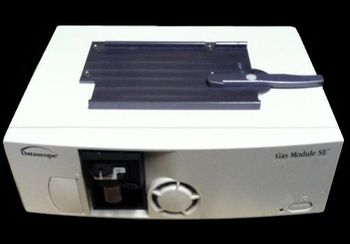
Datascope Gas Module II
 Datascope · Model Gas Module II
Compact and light weight Provides identification and quantification of: O2, CO2, N2O, Halothane, Isoflurane, Sevoflurane, Desflurane, Enflurane Fully integrated into Passport 2, Spectrum and Spectrum OR user-interface and displays. Breath-by-breath Fast O2, CO2 and N2O monitoring with automatic or manually controlled measurement of five anesthetic agents. In addition, MAC values can be displayed on the Spectrum OR. Optional Spirometry measures patients airway pressures and lung volumes. The numeric data and loops can be displayed on the Spectrum OR. Ideal for all environment.
Key tips
- ·A failed daily leak test takes the machine out of service immediately - there is no acceptable workaround.
- ·Never run an agent-specific vaporizer with the wrong agent, even briefly, during testing.
- ·CO2-absorbent exhaustion mimics several unrelated fault symptoms - rule it out early.
Typical Failure Modes
Compiled for this model from its own documentation and established engineering knowledge for this equipment class - not from a verified service record. Confirm against the manufacturer's service manual.
Gas readings inaccurate or drifting
HighSymptoms: CO2 / agent / N2O / O2 values biased, will not calibrate, zero drift.
Root cause: Sample-cell / bench contamination, an aged O2 cell, or a calibration-gas / calibration issue.
Sample-line / water-trap occlusion
MediumSymptoms: "Occlusion" or "sample line blocked", low sample flow, no waveform.
Root cause: Blocked sampling line or a saturated / full water trap (Nafion / moisture trap).
Sample pump fault
MediumSymptoms: Low or no sample flow with a clear line, pump noisy or stopped.
Root cause: Worn sample pump.
O2 sensor fault (paramagnetic / galvanic)
MediumSymptoms: O2 reads wrong or will not calibrate.
Root cause: Aged galvanic O2 cell or a paramagnetic-sensor fault.
Module / host-communication fault
LowSymptoms: Host monitor does not see the gas module, intermittent dropout.
Root cause: Module connector / docking or an internal board fault.
Serviceable Parts & Consumables
Serviceable items for this model, compiled from its documentation and engineering knowledge for this equipment class. Service class and relative cost are estimates, not manufacturer figures; no part numbers are given. Confirm intervals and pricing against the manufacturer.
Water trap / moisture trap
Class ConsumableRel. cost $R&R Easy
Sampling line
Class ConsumableRel. cost $R&R Easy
Sample pump
Class Periodic replacementRel. cost $$R&R Moderate
O2 sensor / cell
Class Frequent wear itemRel. cost $$R&R Fairly easy
Gas bench / sample cell
Class Major service partRel. cost $$$R&R Difficult
| Part | Service class | Relative cost | R&R difficulty |
|---|---|---|---|
| Water trap / moisture trap | Consumable | $ | Easy |
| Sampling line | Consumable | $ | Easy |
| Sample pump | Periodic replacement | $$ | Moderate |
| O2 sensor / cell | Frequent wear item | $$ | Fairly easy |
| Gas bench / sample cell | Major service part | $$$ | Difficult |
Relative cost: $ lowest · $$$$ highest service-part cost for this equipment class. Not a price.
PM Checklist
Preventive-maintenance tasks typical of this equipment class. Perform to the manufacturer's procedure and your facility's policy - this is general reference, not a schedule for this specific unit.
- ·Daily pre-anesthesia machine check: leak test, O2 sensor calibration, per facility protocol
- ·Scheduled vaporizer calibration and agent-specific service
- ·Absorber / CO2 canister replacement
- ·Breathing circuit and hose inspection
- ·Annual full PM and electrical safety test
Troubleshooting Approach
A starting sequence for this model, compiled from its documentation and engineering knowledge for this equipment class. Follow the manufacturer's service documentation for the actual procedure.
Symptom: Fails the pre-use leak / machine self-test
- Run the check with the exact breathing circuit, absorber and vaporisers that will be used.
- Reseat the CO2-absorber canister and check its seal; replace exhausted absorbent.
- Inspect the breathing-system gaskets, the bag arm and the APL valve.
- Confirm each vaporiser is seated / Selectatec-latched with an intact back-bar O-ring.
- Re-run the test; escalate an internal low-pressure leak that cannot be localised.
Symptom: Ventilator not delivering the set tidal volume / bellows or piston fault
- Verify tidal volume with a calibrated gas-flow analyser.
- Inspect the bellows (or piston seal) for a leak and the drive-gas valve.
- Calibrate the flow sensors.
- Check circuit-compliance compensation is enabled and the circuit is intact.
- Replace the bellows / flow sensors as isolated and re-verify.
Symptom: O2 flow wrong / hypoxic-guard fault / no O2 flush
- Verify O2 flow with a calibrated flow meter.
- Tap a sticking flowmeter float; replace the rotameter tube if it sticks.
- Check the hypoxic-guard link maintains the minimum O2:N2O ratio.
- Confirm the O2-failure alarm sounds when O2 pressure is removed.
- Refer the flowmeter block / hypoxic guard for service.
Symptom: Agent concentration wrong / vaporiser back-bar leak
- Verify output with a calibrated agent analyser across the dial range.
- Confirm the correct agent is filled.
- Reseat the vaporiser and replace the back-bar O-rings.
- Repeat the machine leak test.
- Send the vaporiser to an authorised service centre for recalibration if output is out of spec.
Typical Location
Where this class of equipment is typically deployed - general reference, not this unit's own placement record.
- Operating rooms
- Procedure / endoscopy suites requiring sedation
- Obstetric delivery rooms
Documents & Manuals
Safety & Recalls
Synced live from the FDA openFDA API.
- RECALL
There is an issue related to the Safety Disk not meeting a performance requirement that may impact Intra-Aortic Balloon catheter (IAB) displacement volume. This potential failure of an impacted Safety Disk may lead to slightly reduced IAB inflation during therapy or a reduction in the degree of augmentation provided to the patient during therapy.
Troubleshoot this device with Bio
Describe a symptom or error code. Bio answers from this device's own documented error codes, failure modes, parts, and guides.
Ask Bio