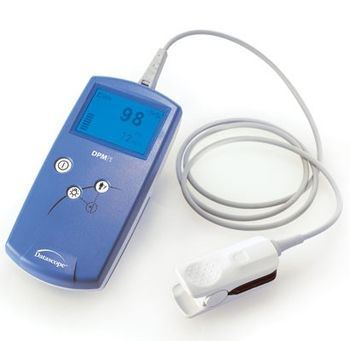
Datascope DPM1
 Datascope · Model DPM1
Suitable for adult, pediatric, and neonatal patients Enables spot check monitoring of SpO2 and pulse rate with automatic data refresh every second Miniature design offers an impressive 0.3 lb device making it a pleasure to use on the go Backlit LCD prominently displays SpO2 and pulse rate readings accompanied by a pulse signal strength indicator Additional useful indicators shown on the LCD include patient ID, low power indicator, data storage indicator, error condition and standby mode Helpful prompts, including memory full, ID storage full, low battery and general error conditions, aid in simple and quick troubleshooting Memory supports storage of 200 data records for a maximum of 100 patient IDs Connect to a PC using a standard communication cable for downloading and printing patient trend data 4 AA alkaline or rechargeable batteries provide up to 15 hours of run time Automatic standby and shutdown modes assist in preserving battery power Power-off button features a 2-second delay to prevent accidental shutdown.
Key tips
- ·A no-signal/flatline alarm gets checked on the patient first, not the monitor - rule out a real clinical event before troubleshooting.
- ·Recalibrate NIBP against a reference manometer, not just a self-test pass.
- ·Reused patient cables (SpO2, ECG leads) are a common source of intermittent-fault complaints - swap the cable before the module.
Typical Failure Modes
Compiled for this model from its own documentation and established engineering knowledge for this equipment class - not from a verified service record. Confirm against the manufacturer's service manual.
No SpO2 / pulse reading or poor signal
HighSymptoms: No saturation / pulse value, "pulse search", low signal quality, implausible values.
Root cause: Worn or wrong SpO2 sensor, a damaged cable, poor site / perfusion, or motion.
Sensor / cable connector fault
MediumSymptoms: Reading drops when the cable is moved, sensor not recognised.
Root cause: Broken conductors in the sensor / extension cable, or a worn connector.
Inaccurate SpO2 vs a co-oximeter
MediumSymptoms: SpO2 consistently biased vs an arterial reference.
Root cause: Sensor degradation, or a monitor calibration / module fault.
Alarm / audio fault
MediumSymptoms: No or quiet audible alarm.
Root cause: Speaker or audio-board fault - a safety-critical failure.
Battery / power fault
MediumSymptoms: Short battery run time, will not power on.
Root cause: Aged battery.
Serviceable Parts & Consumables
Serviceable items for this model, compiled from its documentation and engineering knowledge for this equipment class. Service class and relative cost are estimates, not manufacturer figures; no part numbers are given. Confirm intervals and pricing against the manufacturer.
SpO2 sensor (reusable / disposable)
Class Frequent wear itemRel. cost $$R&R Easy
Pulse-oximetry extension cable
Class Frequent wear itemRel. cost $$R&R Easy
Battery
Class Periodic replacementRel. cost $$R&R Fairly easy
SpO2 module / board
Class Major service partRel. cost $$$R&R Moderate
Alarm speaker / audio board
Class Major service partRel. cost $$R&R Moderate
| Part | Service class | Relative cost | R&R difficulty |
|---|---|---|---|
| SpO2 sensor (reusable / disposable) | Frequent wear item | $$ | Easy |
| Pulse-oximetry extension cable | Frequent wear item | $$ | Easy |
| Battery | Periodic replacement | $$ | Fairly easy |
| SpO2 module / board | Major service part | $$$ | Moderate |
| Alarm speaker / audio board | Major service part | $$ | Moderate |
Relative cost: $ lowest · $$$$ highest service-part cost for this equipment class. Not a price.
PM Checklist
Preventive-maintenance tasks typical of this equipment class. Perform to the manufacturer's procedure and your facility's policy - this is general reference, not a schedule for this specific unit.
- ·Routine cable and lead-wire inspection for fraying/wear
- ·Battery conditioning cycle
- ·NIBP calibration check against a reference manometer
- ·ECG / SpO2 accuracy verification against a patient simulator
- ·Annual electrical safety test
Troubleshooting Approach
A starting sequence for this model, compiled from its documentation and engineering knowledge for this equipment class. Follow the manufacturer's service documentation for the actual procedure.
Symptom: No SpO2 / pulse reading or poor signal
- Fit a fresh, correct-size sensor on a warm, well-perfused, still site.
- Swap the SpO2 extension cable.
- Confirm the pleth / signal-quality indicator improves.
- Test the monitor with an SpO2 simulator across several saturations.
- Replace the sensor / cable, or refer the SpO2 module if the simulator also fails.
Symptom: Reading drops when the cable is moved / sensor not recognised
- Flex the sensor and extension cable along their length while watching the trace.
- Inspect the connectors for damage and clean them.
- Try a known-good cable and sensor.
- Confirm the sensor type matches the module.
- Replace the cable; refer the module connector if it persists.
Symptom: SpO2 biased vs a co-oximeter / accuracy concern
- Compare to an arterial co-oximetry result where clinically indicated.
- Try a known-good sensor of the correct type.
- Verify against an SpO2 simulator at 80 / 90 / 97 %.
- Check the module software / calibration revision.
- Refer the module for calibration if it fails the simulator.
Symptom: No or quiet audible alarm
- Confirm alarm volume is not set to minimum and alarms are not paused.
- Trigger a test alarm (remove the sensor) and listen.
- Check the speaker and its connector.
- Replace the speaker / audio board - a failed alarm is a safety fault.
- Verify the alarm at the set volume before returning to service.
Technical Specs
- Height
- 5.5 in
- Length
- 1.3 in
- Pulse Rate Range
- 25-254 BPM
- Weight
- 0.29 lbs
- Operating Life
- 15 hr
- SpO2 Range
- 0-100%
- Width
- 2.6 in
Typical Location
Where this class of equipment is typically deployed - general reference, not this unit's own placement record.
- ICU / CCU
- Emergency Department
- OR / PACU
- General med-surg floors
- Step-down units
- Telemetry units
Documents & Manuals
Troubleshoot this device with Bio
Describe a symptom or error code. Bio answers from this device's own documented error codes, failure modes, parts, and guides.
Ask Bio