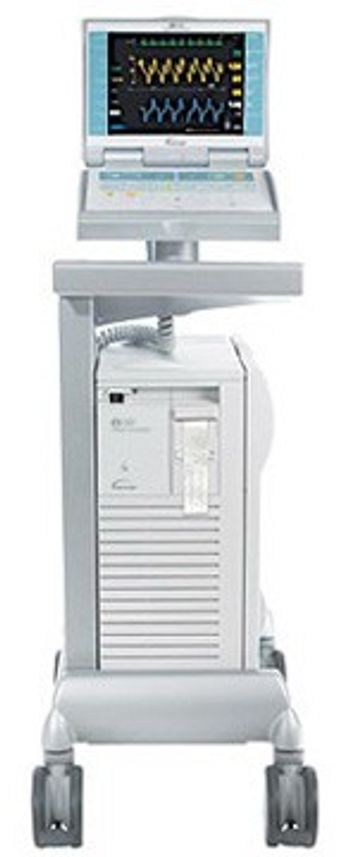
Datascope CS100
 Datascope · Model CS100
Automatically evaluates and selects optimal trigger source and lead Sets inflation at the dicrotic notch and deflates IAB at the start of systole Responds to changes in signal quality by selecting new trigger source and re-timing to adapt to patient rhythm changes.
Key tips
- ·When no category-specific guidance fits, default to the manufacturer's own service manual and the general troubleshooting method in the Engineer's Guide.
- ·Run an incoming and annual electrical safety test regardless of how niche the device is.
Typical Failure Modes
Compiled for this model from its own documentation and established engineering knowledge for this equipment class - not from a verified service record. Confirm against the manufacturer's service manual.
IAB deflation fails to trigger at systole onset
HighSymptoms: Balloon remains inflated during systole; ECG-triggered waveform shows delayed or absent deflation; patient develops hypotension or lower extremity ischemia signs.
Root cause: Trigger signal acquisition circuit desensitized to dicrotic notch; lead set impedance mismatch or open circuit; firmware trigger timing drift.
Battery runtime below IFU minimum specifications
MediumSymptoms: Unit operates on battery for significantly reduced duration; low-battery warning activates prematurely; unit shuts down unexpectedly during procedure.
Root cause: Aging NiMH or Li-ion cell capacity loss; battery management system calibration drift; improper charge cycle adherence by clinical staff.
Display intermittency or dimming
MediumSymptoms: Screen flickers, segments dim, or goes blank during operation; therapy continues but user cannot verify parameters or trigger status.
Root cause: Backlight inverter failure; LCD panel connector thermal fatigue; display driver integrated circuit temperature-related degradation.
Lead set connectivity loss or signal noise
HighSymptoms: Trigger source selection cycles erratically; 'no trigger' alarm despite proper catheter placement; waveform quality degrades intermittently.
Root cause: Lead connector pin corrosion; cable micro-fracture near strain relief; internal signal conditioning circuit sensitivity loss.
Internal clock drift affecting timing accuracy
LowSymptoms: IAB timing relative to ECG becomes progressively offset; auto-trigger misidentifies patient rhythm; documented therapy delivery offsets.
Root cause: Crystal oscillator aging; power supply ripple affecting timing reference; RAM battery depletion (if applicable).
Serviceable Parts & Consumables
Serviceable items for this model, compiled from its documentation and engineering knowledge for this equipment class. Service class and relative cost are estimates, not manufacturer figures; no part numbers are given. Confirm intervals and pricing against the manufacturer.
Trigger lead set (dual-lumen catheter assembly)
Consumable; lifespan shortened by kinking or repeated sterilization cycles.
Class Periodic replacementRel. cost $R&R Easy
Mainboard signal conditioning circuit
Surface-mount components; sensitive to electrostatic discharge during repair.
Class Major service partRel. cost $$$R&R Difficult
Rechargeable battery pack
Per FDA recall: maintenance critical. Cycle count monitoring required.
Class Periodic replacementRel. cost $$R&R Fairly easy
LCD display assembly with backlight
Intermittent dimming often resolved by reseating ribbon connector before board replacement.
Class Periodic replacementRel. cost $$R&R Moderate
Internal timebase crystal oscillator
Surface-mount quartz; rarely fails but drift symptoms warrant recalibration check.
Class Major service partRel. cost $R&R Moderate
| Part | Service class | Relative cost | R&R difficulty |
|---|---|---|---|
| Trigger lead set (dual-lumen catheter assembly) Consumable; lifespan shortened by kinking or repeated sterilization cycles. | Periodic replacement | $ | Easy |
| Mainboard signal conditioning circuit Surface-mount components; sensitive to electrostatic discharge during repair. | Major service part | $$$ | Difficult |
| Rechargeable battery pack Per FDA recall: maintenance critical. Cycle count monitoring required. | Periodic replacement | $$ | Fairly easy |
| LCD display assembly with backlight Intermittent dimming often resolved by reseating ribbon connector before board replacement. | Periodic replacement | $$ | Moderate |
| Internal timebase crystal oscillator Surface-mount quartz; rarely fails but drift symptoms warrant recalibration check. | Major service part | $ | Moderate |
Relative cost: $ lowest · $$$$ highest service-part cost for this equipment class. Not a price.
PM Checklist
Preventive-maintenance tasks typical of this equipment class. Perform to the manufacturer's procedure and your facility's policy - this is general reference, not a schedule for this specific unit.
- ·Follow the manufacturer's PM schedule
- ·Perform incoming and annual electrical safety testing per facility biomedical program
Troubleshooting Approach
A starting sequence for this model, compiled from its documentation and engineering knowledge for this equipment class. Follow the manufacturer's service documentation for the actual procedure.
Symptom: IAB fails to deflate at systole onset
- 1. Verify lead set connection at console and catheter; confirm no visible damage to cable or connector pins.
- 2. Perform lead set impedance check per service manual; replace if out-of-tolerance or if resistance exceeds specified limit.
- 3. Run auto-trigger calibration routine; if trigger source continues to cycle erratically, suspect mainboard signal conditioning circuit and replace.
Symptom: Battery runtime significantly below IFU minimum
- 1. Execute full charge-discharge cycle per manufacturer protocol; verify charger indicator behavior and terminal voltage.
- 2. Check battery cycle count via service menu; if count exceeds rated limit, replace battery pack.
- 3. Inspect battery terminals and console charge port for corrosion or bent pins; clean or reseat as needed.
Typical Location
Where this class of equipment is typically deployed - general reference, not this unit's own placement record.
- Varies by device - check the unit's own manual for facility placement guidance
Documents & Manuals
- Datascope - Intra-Aortic Balloon Pump - CS100 Operator Manual.pdfUser Manual · External
- Datascope CS100 Operator's ManualUser Manual · External
- Datascope CS100 BrochureBrochure · External
- Datascope CS100 CalibrationDocument · External
- Datascope CS100 PM sectionDocument · External
- Datascope CS100_IPBDocument · External
- Datascope CS100Quick look sheetDocument · External
Safety & Recalls
Synced live from the FDA openFDA API.
- RECALL
The firm has identified that the battery runtime and cycle specifications contained in the devices Instructions for Use (IFU) need to be updated.
- RECALL
If battery maintenance is not performed appropriately, the battery may provide less than the minimum run time of operating power. Revised labeling and training are being offered.
- RECALL
Certain MAQUET/Datascope Intra-Aortic Balloon Pumps (IABP) have the potential to experience display related issues. Although the IABP continues to deliver therapy to the patient, display related issues may cause the user to be unable to view the IABP on the information screen.
Troubleshoot this device with Bio
Describe a symptom or error code. Bio answers from this device's own documented error codes, failure modes, parts, and guides.
Ask Bio