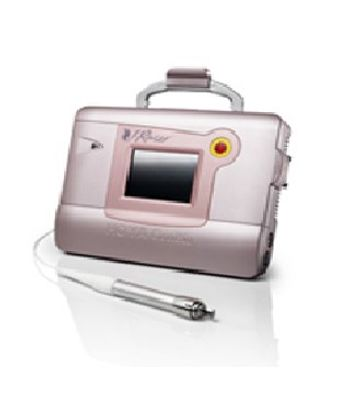
Cynosure V-Raser
 Cynosure · Model V-Raser
Compact diode laser The V-Raser® is a compact diode laser designed to treat vascular lesions, including facial telangiectasias. The 980 nm wavelength delivers safe, effective treatment of common high-flow blood vessels, including red and blue vessels especially on the face. The variable spot sizes allow physicians to treat small, hard-to-reach vessels, such as crevices and the sides of the nose. V-Raser® provides resolution of vascular lesions in one to three treatments, depending on vessel size. The targeted design of the V-Raser® is an ideal complement to other laser and light-based therapies, including MedLite and RevLite lasers, for a comprehensive approach to photo-damaged skin. V-Raser® treats the visible facial spider veins while MedLite or RevLite can target brown pigment, tighten pores and tone the skin. V-Raser® can also be used to supplement IPL treatment. Because facial spider veins and telangiectasias are so common among adults, V-Raser® can provide the perfect introduction to laser therapies for a broad base of aesthetic patients. Weighing only four pounds – less than most laptops – V-Raser® is extremely compact and can fit virtually anywhere in the clinic. Value-priced, V-Raser® offers a high return-on-investment for aesthetic practices of all sizes.
Key tips
- ·Verify true laser output with an external power meter, not the console readout - the display drifts independently of real delivered energy.
- ·Never bypass a door interlock, key switch, or footswitch safety to finish a treatment - laser safety interlocks are not optional.
- ·Most low-output complaints trace to the delivery fiber or handpiece, not the laser source - inspect and swap those first.
- ·Intermittent mid-treatment shutdowns are usually cooling-related - check coolant level and flow before suspecting the diode or lamp.
Typical Failure Modes
Compiled for this model from its own documentation and established engineering knowledge for this equipment class - not from a verified service record. Confirm against the manufacturer's service manual.
No or low laser output
HighSymptoms: Weak or no output at the delivery device, treatment ineffective, power not reaching the set value.
Root cause: Laser module / lamp / diode-bar ageing, a damaged delivery fibre / handpiece / applicator, or a driver / power-supply fault.
Cooling / thermal shutdown
HighSymptoms: Unit shuts down after a period, over-temperature or low-flow alarm.
Root cause: Chiller / TEC fault, low or contaminated coolant, a failed pump, or blocked airflow.
Delivery fibre / handpiece / applicator fault
MediumSymptoms: Burn marks at the tip, high loss, intermittent output, applicator not recognised.
Root cause: Damaged or contaminated fibre / applicator / connector.
Skin-cooling / contact-cooling fault (aesthetic)
MediumSymptoms: Skin cooling not delivered, cooling / cryogen alarm.
Root cause: Contact-cooling / cryogen supply, a valve, or the tip.
Footswitch / interlock / key fault
MediumSymptoms: Laser will not fire, key / interlock / footswitch error.
Root cause: Footswitch, door interlock, or key-switch fault.
Serviceable Parts & Consumables
Serviceable items for this model, compiled from its documentation and engineering knowledge for this equipment class. Service class and relative cost are estimates, not manufacturer figures; no part numbers are given. Confirm intervals and pricing against the manufacturer.
Laser module / lamp / diode bar
Power re-calibration required after replacement.
Class Periodic replacementRel. cost $$$$R&R Expert-level
Delivery fibre / handpiece / applicator
Class Frequent wear itemRel. cost $$$R&R Fairly easy
Chiller / TEC components & coolant filter
Class Periodic replacementRel. cost $$$R&R Difficult
Contact-cooling tip / cryogen valve (aesthetic)
Class Periodic replacementRel. cost $$R&R Moderate
Footswitch
Class Periodic replacementRel. cost $$R&R Fairly easy
| Part | Service class | Relative cost | R&R difficulty |
|---|---|---|---|
| Laser module / lamp / diode bar Power re-calibration required after replacement. | Periodic replacement | $$$$ | Expert-level |
| Delivery fibre / handpiece / applicator | Frequent wear item | $$$ | Fairly easy |
| Chiller / TEC components & coolant filter | Periodic replacement | $$$ | Difficult |
| Contact-cooling tip / cryogen valve (aesthetic) | Periodic replacement | $$ | Moderate |
| Footswitch | Periodic replacement | $$ | Fairly easy |
Relative cost: $ lowest · $$$$ highest service-part cost for this equipment class. Not a price.
PM Checklist
Preventive-maintenance tasks typical of this equipment class. Perform to the manufacturer's procedure and your facility's policy - this is general reference, not a schedule for this specific unit.
- ·Laser output power verification against a calibrated external power meter
- ·Cooling-system check: coolant level, flow rate, and filter / heat-exchanger condition
- ·Delivery-system inspection: handpiece, delivery fiber or articulated arm, and output optics
- ·Interlock, key-switch, emergency-stop, and footswitch function test
- ·Beam-alignment and optical-path check per the service manual
- ·Annual full PM and electrical safety test
Troubleshooting Approach
A starting sequence for this model, compiled from its documentation and engineering knowledge for this equipment class. Follow the manufacturer's service documentation for the actual procedure.
Symptom: No or low output
- Measure output at the delivery device with a laser power meter against the setting.
- Fit a known-good delivery fibre / handpiece / applicator.
- Confirm the cooling system runs and coolant is at level and clean.
- Check the key, interlock and footswitch are satisfied.
- Escalate a confirmed laser-module or driver fault to the OEM; recalibrate power after any module work.
Symptom: Thermal shutdown
- Confirm the cooling fans / pump run and airflow is clear.
- Check the coolant level and replace the coolant filter.
- Let the unit cool and restart.
- Clean the air filters / vents.
- Monitor for recurrence during a treatment.
Technical Specs
- Weight
- 4 lbs
Typical Location
Where this class of equipment is typically deployed - general reference, not this unit's own placement record.
- Operating rooms and surgical procedure suites
- Dermatology and medical-aesthetic clinics
- ENT, gynecology, and specialty procedure rooms
- Outpatient surgical centers
Documents & Manuals
No documents available for this device yet.
Troubleshoot this device with Bio
Describe a symptom or error code. Bio answers from this device's own documented error codes, failure modes, parts, and guides.
Ask Bio