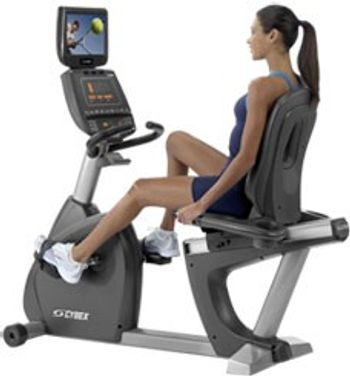
CYBEX 750R
 CYBEX · Model 750R
Pedal Design - Extra wide double sided pedal design accommodates any size foot. The easy to adjust pull strap buckle closure gives users the comfort they seek. Resistance Range - The 750R's wide range of resistance (from 20 to 900 watts) can create a challenging or modest exercise experience. 20 Watts is much lower than most other bikes on the market and is important for de-conditioned users. 900 watts "can make a grown man cry" - quote from a veteran cyclist. Handlebars - Multi-positioned handlebars promotes a comfortable hand position with HR grips where they are most convenient. Seat Engineering - A CYBEX proprietary seat was designed by cyclists to provide comfort for the long ride. You need 3 things: as much surface area as possible for support in the proper areas - while allowing full range of leg motion - while being kind to between the legs - and only CYBEX has it. On a CYBEX bike riders really can work up a sweat so the seat back is designed with holes for optimized ventilation to keep you cool on any length of ride. Front wheels - Because bikes are more mobile than many other exercise machines, they don't stay in the same place all the time. The 750 cycles have wheels on the front for easy rolling so they can be moved around. Single Stage Drive - The self-tensioning single-stage drive and hybrid eddy-current self-generating brake provide high torque capabilities with exceptionally low drag to provide an exceptionally broad resistance range of 20 to 900 watts with superbly smooth operation.
Key tips
- ·Never disable a low-pressure/circuit-disconnect alarm while troubleshooting - silence it, don't disable it.
- ·Verify the O2 supply source and pressure before assuming an internal fault.
- ·Circuit type must match the patient population (adult/pediatric/neonatal) - a mismatched circuit invalidates delivered volumes.
Typical Failure Modes
Compiled for this model from its own documentation and established engineering knowledge for this equipment class - not from a verified service record. Confirm against the manufacturer's service manual.
Resistance / brake fault
HighSymptoms: Resistance will not change, feels wrong, or is uneven through the stroke.
Root cause: Eddy-current brake / magnet assembly, a resistance-motor fault, or a control fault.
Console dead / no data
MediumSymptoms: Console will not power on, no speed / cadence / power / HR data.
Root cause: Console battery / power, a sensor-cable fault, or the console board.
Pedal / crank / drive fault
MediumSymptoms: Play or knocking in the cranks, freewheel slips, drive belt / chain noise.
Root cause: Worn bottom-bracket bearings, pedals, or drive belt / chain.
Speed / cadence sensor fault
MediumSymptoms: Cadence or speed reads zero or erratically.
Root cause: Reed / optical sensor or its cable / magnet.
Seat / adjustment mechanism fault
LowSymptoms: Seat post or backrest will not adjust or lock, wear in the slider.
Root cause: Worn adjustment latch / slider.
Serviceable Parts & Consumables
Serviceable items for this model, compiled from its documentation and engineering knowledge for this equipment class. Service class and relative cost are estimates, not manufacturer figures; no part numbers are given. Confirm intervals and pricing against the manufacturer.
Eddy-current brake / resistance motor
Class Major service partRel. cost $$$R&R Difficult
Console board / power
Class Major service partRel. cost $$R&R Moderate
Bottom-bracket bearings / pedals
Class Periodic replacementRel. cost $$R&R Moderate
Drive belt / chain
Class Periodic replacementRel. cost $R&R Moderate
Speed / cadence sensor
Class Periodic replacementRel. cost $R&R Fairly easy
| Part | Service class | Relative cost | R&R difficulty |
|---|---|---|---|
| Eddy-current brake / resistance motor | Major service part | $$$ | Difficult |
| Console board / power | Major service part | $$ | Moderate |
| Bottom-bracket bearings / pedals | Periodic replacement | $$ | Moderate |
| Drive belt / chain | Periodic replacement | $ | Moderate |
| Speed / cadence sensor | Periodic replacement | $ | Fairly easy |
Relative cost: $ lowest · $$$$ highest service-part cost for this equipment class. Not a price.
PM Checklist
Preventive-maintenance tasks typical of this equipment class. Perform to the manufacturer's procedure and your facility's policy - this is general reference, not a schedule for this specific unit.
- ·Daily pre-use check: self-test, circuit integrity, alarm function
- ·Scheduled circuit and inspiratory filter replacement per manufacturer interval
- ·Flow and pressure sensor calibration verification
- ·Battery load test and runtime check
- ·Annual full PM and electrical safety test
Troubleshooting Approach
A starting sequence for this model, compiled from its documentation and engineering knowledge for this equipment class. Follow the manufacturer's service documentation for the actual procedure.
Symptom: Resistance will not change
- Confirm the console powers the brake (battery / mains).
- Check the sensor / brake cable connections.
- Feel the resistance through a full range setting.
- Test or replace the resistance motor / brake assembly.
- Verify resistance against known power targets if the unit supports it.
Symptom: Console dead or no data
- Replace the console batteries / check the power feed.
- Reseat the sensor and generator cables.
- Confirm the cadence sensor and magnet alignment.
- Try the console on another base if possible.
- Replace the console board if it stays dead.
Technical Specs
- Height
- 49.5
- Length
- 63.5 in
- Weight
- 178 lbs
- Width
- 25 in
Typical Location
Where this class of equipment is typically deployed - general reference, not this unit's own placement record.
- ICU / CCU
- Emergency Department
- Operating Room (anesthesia-adjacent)
- NICU
- Respiratory Therapy department
- Patient transport
Documents & Manuals
Troubleshoot this device with Bio
Describe a symptom or error code. Bio answers from this device's own documented error codes, failure modes, parts, and guides.
Ask Bio