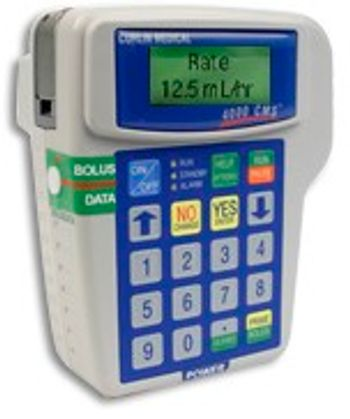
Curlin Medical 4000 CMS
 Curlin Medical · Model 4000 CMS
The Curlin 4000 CMS, is a multi-therapy ambulatory electronic infusion device capable of delivering continuous PCA, PCEA, subcutaneous, TPN, intermittent and variable modes. This unique, technologically advanced and innovative system continuously monitors and displays line pressure to help you detect potential catheter patency problems, such as occlusions, obstructions and pinched off catheters. The Curlin 4000 CMS™ is communication-capable (connects with PCs or PDAs); sophisticated (high resolution, user audit trail, accuracy, detailed information recording); and feature-rich (shift-totals, on-screen hourly totals, highly visible large fonts, quick-repeat and continuous back-light-on with AC power). In addition, it incorporates the unique line pressure display and productivity features of the CMS™ Software program. The 4000 CMS™ has been specifically designed to resolve the ongoing conflict between quality vs. high costs, enhancing patient safety while lowering infusion expenses. Its simplicity of operation, highlighted by menu-driven protocols with context sensitive help screens, makes the Curlin 4000 CMS™ extremely simple to use. The 4000 CMS™ has received the "CE" mark as well as many other certificates marking it for sale in the European community. The 4000 CMS™ has the ability to deliver at low rates, a flow resolution that is up to 25 times better than any other ambulatory pump on the market. The 4000 CMS™ works synergistically with a PC and/or Palm™ PDA improving the outcome, and reducing the risk of programming errors. All these features, along with its extensive information database makes the 4000 CMS™ an essential medical equipment element, capable of offering significantly improved operating performance and safety, at a substantially reduced cost. Curlin pumps give you a choice of different non-DEHP set configurations, including needleless injection sites, 0.22 and 1.2 micron filtered sets, yellow-striped epidural sets, sets with 150 ml integral fluid containers, and syringe delivery sets. All Curlin sets incorporate an active, integral-flow-stop.
Key tips
- ·Free-flow protection must be verified on every PM - a failed anti-free-flow clamp is a direct overdose risk.
- ·Test occlusion alarms in both directions - failing to alarm when it should is more dangerous than a false alarm.
- ·Battery run-time complaints are the most common real-world nuisance call - a full charge/discharge cycle test catches most of them.
Typical Failure Modes
Compiled for this model from its own documentation and established engineering knowledge for this equipment class - not from a verified service record. Confirm against the manufacturer's service manual.
Failure / error message stops delivery
HighSymptoms: The pump alarms and displays an error message / code and stops.
Root cause: A subsystem fault indexed in the service manual - motor / drive, a sensor, set-detection, or a board.
Occlusion alarm / pressure fault
MediumSymptoms: Repeated occlusion alarms, delivery stops, or an occlusion is missed.
Root cause: Kinked or clamped line, a closed roller clamp, a positional patient tube, pressure-sensor drift, or an improperly loaded set.
Air-in-line alarm
MediumSymptoms: Frequent air-in-line alarms, delivery stops.
Root cause: Air in the set, an improperly loaded set, or an ultrasonic air-detector fault.
Flow-rate accuracy drift
MediumSymptoms: Delivered volume outside tolerance on the annual test, especially at low rates.
Root cause: Worn pumping mechanism / plunger drive.
Battery will not hold charge
MediumSymptoms: Short run time, low-battery early after a full charge.
Root cause: Aged battery pack.
Door / plunger / sensor mechanical wear
LowSymptoms: Set will not load, door will not latch, plunger grip poor.
Root cause: Worn door latch, plunger jaws, or anti-free-flow mechanism.
Serviceable Parts & Consumables
Serviceable items for this model, compiled from its documentation and engineering knowledge for this equipment class. Service class and relative cost are estimates, not manufacturer figures; no part numbers are given. Confirm intervals and pricing against the manufacturer.
Battery pack
Class Periodic replacementRel. cost $$R&R Fairly easy
Pumping mechanism / rotor / plunger drive
Class Major service partRel. cost $$$R&R Difficult
Pressure / air-detector sensor assembly
Class Major service partRel. cost $$R&R Moderate
Door / latch / anti-free-flow assembly
Class Major service partRel. cost $$R&R Moderate
Drive motor / gearbox
Class Major service partRel. cost $$$R&R Difficult
| Part | Service class | Relative cost | R&R difficulty |
|---|---|---|---|
| Battery pack | Periodic replacement | $$ | Fairly easy |
| Pumping mechanism / rotor / plunger drive | Major service part | $$$ | Difficult |
| Pressure / air-detector sensor assembly | Major service part | $$ | Moderate |
| Door / latch / anti-free-flow assembly | Major service part | $$ | Moderate |
| Drive motor / gearbox | Major service part | $$$ | Difficult |
Relative cost: $ lowest · $$$$ highest service-part cost for this equipment class. Not a price.
PM Checklist
Preventive-maintenance tasks typical of this equipment class. Perform to the manufacturer's procedure and your facility's policy - this is general reference, not a schedule for this specific unit.
- ·Occlusion pressure and flow-rate accuracy verification
- ·Battery conditioning cycle
- ·Door latch and air-in-line sensor inspection
- ·Post-drop functional check before return to service
- ·Annual PM per manufacturer schedule
Error Codes
Extracted directly from this unit's own service manual.
10Motor Control Loss
Replace batteries. Connect AC Adaptor. Turn power off/on and resume.
11Keyboard Buffer Full
Report error code to factory.
12Air In Line test circuit failure
Turn pump Off/ON or Call provider
13Pressure Sens DN Bad Down Strain Beam
Check Admin Set turn pump Off/On Replace set and Resume.
14Pressure Sens UP Bad Up Strain Beam
Check Admin Set Turn pump Off/On Replace set and Resume.
15Bad Encoder
Turn pump Off/On or Call Provider
16Bad Analog to Digital Conversion
Turn pump Off/On or call Provider
17Bad Clock
Turn pump OFF Call Provider
18Bad Air In Line comparator register reading from FPGA
Call Provider
19Bad Door Sensor
Turn Pump OFF Call Provider
20Empty Lithium Battery
Empty Lithium Battery Report error code to factory.
21Bad Tristate Pin
Turn Pump OFF Call Provider
22Bad Test Pin
Turn Pump OFF Call Provider
23Bad Reverence Voltage
Turn Pump OFF Call Provider
24Bad Motor Supply
Turn Pump OFF Call Provider
25Stalled Pump
Turn pump OFF/ON Call Provider Broken Motor Shaft Turn power off/on and resume.
26Bad Motor Inhibit
Turn Pump OFF Call Provider
27Bad Motor Supply Enable
Turn Pump OFF Call Provider
28Bad Motor Logic Enable
Turn Pump OFF Call Provider
29Low Alarm Batt
Connect AC Adapt Turn pump OFF/ON Low Auxiliary Battery Connect pump to AC Battery Eliminator and turn power off/on to pump. May require turning pump off/on a few times.
30Bad Auxiliary Battery
Turn Pump OFF Call Provider
31Audio Main Speaker Low
Turn Pump OFF Call Provider
32Audio Main Speaker High
Check/replace D31. Replace PCB.
33Low Alarm Audio
Connect AC Adapt Turn pump OFF/ON Audio Auxiliary Speaker Low Connect pump to AC Battery Eliminator and turn power off/on to pump. May require turning pump off/on a few times.
34Audio Auxiliary Speaker High
Call Provider
35History File
Turn pump OFF/ON History Log Erased Report error code to factory.
36Bad Cal Data Bad EEPROM Data CRC value
Turn pump OFF Call Provider
37Analog to Digital Converter did not Run
Call Provider
38Air In Line Circuit not Tested
Call Provider
39Bad EEPROM Data CRC 2
Call Provider
40Bad EEPROM Data Header
Call Provider
41Bad Cal Range Bad EEPROM Limit
Turn Pump OFF Call Provider
100Menu not found
Turn pumpOFF/ON Call Provider
101Mode not found
Turn pumpOFF/ON Call Provider
102Item not found
Turn pumpOFF/ON Call Provider
103Field not found
Turn pumpOFF/ON Call Provider
104Data mismatch
Turn pumpOFF/ON Call Provider
105No menu pointer
Turn pumpOFF/ON Call Provider
106Count out of range
Turn pumpOFF/ON Call Provider
107Display task queue overflow
Turn pumpOFF/ON Call Provider
108Divide by zero
Turn pumpOFF/ON Call Provider
109Concentration zero value
Turn pumpOFF/ON Call Provider
110Invalid occurrence
Turn pumpOFF/ON Call Provider
111Multiple param struct access
Turn pumpOFF/ON Call Provider
112Multiple status struct access
Turn pumpOFF/ON Call Provider
140Infusion volume out of range
Turn pumpOFF/ON Call Provider
141Infusion rate out of range
Turn pumpOFF/ON Call Provider
142Infusion time out of range
Turn pumpOFF/ON Call Provider
143Volume conversion error
Turn pumpOFF/ON Call Provider
144Rate conversion error
Turn pumpOFF/ON Call Provider
145Time conversion error
Turn pumpOFF/ON Call Provider
146Bad PCA dose ratio
Turn pumpOFF/ON Call Provider
160Stuck PERIOD Key
Turn pump OFF/ON or Call Provider Stuck Period / Silence Key If key was pressed, release it. Otherwise report error code to factory.
161Stuck ON OFF Key
Turn pump OFF/ON or Call Provider Stuck On / Off Key If key was pressed, release it. Otherwise report error code to factory.
162Stuck 0 Key
Turn pump OFF/ON or Call Provider Stuck 0 Key If key was pressed, release it. Otherwise report error code to factory.
163Stuck 1 Key
Turn pump OFF/ON or Call Provider Stuck 1 Key If key was pressed, release it. Otherwise report error code to factory.
164Stuck 2 Key
Turn pump OFF/ON or Call Provider Stuck 2 Key If key was pressed, release it. Otherwise report error code to factory.
165Stuck 3 Key
Turn pump OFF/ON or Call Provider Stuck 3 Key If key was pressed, release it. Otherwise report error code to factory.
166Stuck 4 Key
Turn pump OFF/ON or Call Provider Stuck 4 Key If key was pressed, release it. Otherwise report error code to factory.
167Stuck 5 Key
Turn pump OFF/ON or Call Provider Stuck 5 Key If key was pressed, release it. Otherwise report error code to factory.
Troubleshooting Approach
A starting sequence for this model, compiled from its documentation and engineering knowledge for this equipment class. Follow the manufacturer's service documentation for the actual procedure.
Symptom: Alarm with an error message / code, delivery stopped
- Note the exact error message or code from the display.
- Look it up in the pump's technical service manual troubleshooting section.
- Run the biomed diagnostics / service utilities to exercise the named subsystem (motor / drive, a sensor, set-detection, a board).
- Follow the manual's parts-replacement procedure for that fault.
- Run the full scheduled-maintenance test set, including a flow-accuracy check, after any repair.
Symptom: Occlusion alarm / pressure fault (or a missed occlusion)
- Check the line for kinks, closed clamps and a closed roller clamp; check the patient site and cannula.
- Reload the administration set correctly, clearing all air.
- Confirm the set is an approved type for this pump.
- Run the pressure-sensor / force-sensor test in the service menu.
- Replace the set; refer the pump if the pressure sensor or pumping mechanism is indicated.
Symptom: Air-in-line alarm / free-flow or feed not delivering
- Prime the set fully and reload it; tap out micro-bubbles at the drip chamber.
- Confirm the set seats correctly against the air-in-line detector / rotor.
- Clean the ultrasonic air-detector window.
- Run the air-detector (or rotor / cassette) test in diagnostics.
- Replace a worn pumping mechanism / anti-free-flow assembly if flow accuracy or detection is out.
Symptom: Battery will not hold charge / short run time
- Fully charge, then run a battery run-down / capacity test in the service menu.
- Check the charging circuit and contacts.
- Replace the battery pack when capacity is below the service limit.
- Recalibrate the battery gauge if the pump supports it.
- Confirm run time meets spec after replacement.
Technical Specs
- Volume to be Infused
- 1 to 9999 ml
- Height
- 5.1 in
- Length
- 2.5 in
- Flow Rate Range
- 0.1 to 400 ml/h
- Weight
- 17.5 oz
- Flow Accuracy
- 5 %
- Infusion Pump Type
- Ambulatory
- KVO Range
- 0 to 10 ml/h
- Width
- 4 in
Typical Location
Where this class of equipment is typically deployed - general reference, not this unit's own placement record.
- Patient care floors
- ICU
- OR
- Oncology / infusion centers
- Home health (portable pumps)
Documents & Manuals
Safety & Recalls
Synced live from the FDA openFDA API.
- RECALL
Over-delivery/free-flow involving Curlin ambulatory peristaltic multi-therapy infusion pumps where the pumping chamber door (platen) had become deformed in a manner that permitted gravity flow.
Related calculators
From BioLab, for work done with this kind of equipment.
Troubleshoot this device with Bio
Describe a symptom or error code. Bio answers from this device's own documented error codes, failure modes, parts, and guides.
Ask Bio